

Shopify
Compare costs Read comparison →£19/month billed annually
Before VAT; processing and app costs extra
- Online and in-person selling
- Commerce app integrations
- International selling tools

Wix
Compare costs Read comparison →Core: around £16/month annually
Before VAT; payment processing extra
- Drag-and-drop page design
- Products and bookings together
- Templates for business websites

Squarespace
Compare costs Read comparison →Basic: £12/month annually
Before VAT; 2% commerce fee plus processing
- Portfolio and shop together
- Content-led website design
- Core removes commerce fees
Shopify is my first recommendation for most growing retailers comparing ShopWired alternatives, particularly if you need more integrations or want to connect online and in-person selling. But switching to a bigger platform only makes sense if it solves a specific problem.
For a design-led website with bookings, I would shortlist Wix. Squarespace suits creative businesses where content supports a smaller shop, while WooCommerce gives WordPress users more control over their store.
ShopWired still deserves a place in your comparison. Its unlimited products and lack of an extra platform fee for using an external payment gateway are useful advantages. If your existing setup works, moving could add costs without improving how you sell.
Here’s how these 4 alternatives compare, including when I would stay put.
ShopWired Alternatives at a Glance
Start with the problem you want to solve: running a growing shop, improving your website or gaining more control over its software.
Shopify, Wix and ShopWired prices below are before VAT, while Squarespace quotes UK prices with VAT included. Annual prices are monthly equivalents paid on an annual billing basis, not rolling monthly subscriptions. Card processing costs are separate from platform transaction fees.
| Platform | Best fit | Commerce entry plan | Billing and fees | Main limitation |
|---|---|---|---|---|
| Shopify | Growing multichannel retailers | Basic: £19/month annually or £25 monthly | Basic adds 2% when using a third-party payment provider | Apps and payment choices can increase costs |
| Wix | Shops combining products and bookings | Core: £16/month annually | Payment processing extra | Assess complex retail workflows before switching |
| Squarespace | Creative and content-led businesses | Basic: £12/month annually | Basic charges a 2% commerce fee; processing extra | Scheduling has a separate subscription |
| WooCommerce | WordPress stores needing customisation | Free core software | Hosting, extensions and maintenance cost extra | You must arrange technical upkeep |
Which Pick Suits Your Needs?
- Choose Shopify if retail growth comes first. Start here when missing integrations or disconnected selling channels are holding you back.
- Choose Wix if your website does several jobs. It is a sensible shortlist option for a business selling products alongside appointments.
- Choose Squarespace if presentation drives enquiries and sales. Think portfolios, editorial content and a supporting product range.
- Choose WooCommerce if you need control. It suits businesses prepared to fund technical ownership rather than accept a managed platform’s boundaries.
Do not choose on the entry price alone. A cheaper subscription can become the more expensive option once you recreate your current ShopWired setup.
Shopify suits growing retailers who need more integrations or want to connect online and in-person selling. It is the strongest pick when a specific app or connected retail workflow closes a real gap in a ShopWired store.
- Pro: Large app ecosystem for integrations
- Pro: Online and in-person selling
- Pro: Local currencies via Shopify Markets
- Con: 2% fee with third-party payment providers
- Con: Paid apps and themes add to the bill
- Best for
- Multichannel retail
- Hosting
- Included
- Bookings
- Via apps
Wix suits businesses whose shop is only part of the website, such as a studio selling products alongside appointments. Core and higher plans combine commerce with scheduling and drag-and-drop page design.
- Pro: Drag-and-drop page design
- Pro: Commerce plus scheduling from Core
- Pro: Templates for service-led websites
- Con: Free and Light plans cannot take payments
- Con: Check trade pricing and fulfilment fit
- Best for
- Products plus bookings
- Hosting
- Included
- Bookings
- Built in from Core

Squarespace suits creative and content-led businesses that need to showcase work before selling it, such as an artist selling prints. Core removes the 2% commerce fee charged on the Basic plan.
- Pro: Templates built for showcasing work
- Pro: Content and commerce on one site
- Pro: 0% commerce fee on Core
- Con: 2% commerce fee on Basic
- Con: Acuity Scheduling billed separately
- Best for
- Creative businesses
- Hosting
- Included
- Bookings
- Acuity (extra cost)

WooCommerce suits WordPress users who want control over hosting, extensions and custom workflows. The core software is free, but hosting, paid extensions and ongoing maintenance become the store owner’s responsibility.
- Pro: Free, open-source core software
- Pro: Choose your own hosting and extensions
- Pro: Runs on WordPress you may already use
- Con: Updates, backups and security are on you
- Con: Hosting and extensions cost extra
- Best for
- WordPress sites
- Hosting
- Arrange your own
- Bookings
- Via extensions
1. Shopify: For Growing Multichannel Stores

Shopify is the strongest starting point here if you want to expand your retail operation rather than simply redesign your website. Its appeal is the combination of commerce integrations and online and in-person selling. Our Shopify review covers its features in more depth.
However, a bigger ecosystem is not automatically better value. You need to identify which connections would save work or enable sales that your current store cannot support.
What I Like
- More room to build around your store: Shopify’s app ecosystem makes it a useful candidate when you need specialist functionality. Shortlist the actual integrations you require rather than treating app choice as a benefit by itself.
- Connected selling: Online and in-person sales support makes Shopify worth considering if you sell through a website and at physical events. Establish which point-of-sale features you need before budgeting.
- International growth options: Shopify Markets supports local currencies and regional storefront settings. Taking payments in local currencies requires Shopify Payments or Adyen, and conversion charges can apply.
What I Dislike
- External payment-provider fees: Basic’s additional 2% charge can undermine the apparent subscription saving against ShopWired.
- Costs beyond the subscription: Paid apps and premium themes can increase your bill. A feature-rich setup also means more dependencies to manage when you change how your store works.
How Much Does Shopify Cost?
Basic costs £19 per month billed annually, or £25 on monthly billing, before VAT. Shopify Payments card rates start at 2% plus 25p on Basic; these are processing charges, not the separate third-party provider surcharge.
For illustration, £5,000 of monthly sales subject to a 2% platform surcharge would add £100 before your payment provider’s charges. That matters more than a small subscription saving.
Budget for your required apps before choosing a plan. Our Shopify pricing guide breaks down every plan and fee. Avoid pricing a bare Shopify store against the fully functioning ShopWired store you already operate.
How Does Shopify Compare to ShopWired?
The ShopWired vs Shopify decision is not about removing a product limit: both offer unlimited products. ShopWired also supports selling through channels such as eBay and Facebook/Instagram, so switching is not the only route beyond your website.
Shopify becomes more compelling when a particular integration or connected retail workflow closes a real gap. ShopWired remains attractive if your existing gateway and operational setup already work well.
Before committing, map an ordinary order from purchase to dispatch. A useful integration should remove a manual step, such as entering the same order details twice.
Should You Choose Shopify Instead of ShopWired?
Choose Shopify for a clear commerce or integration advantage. Stay with ShopWired if retaining your payment provider would make Shopify materially more expensive without a matching operational benefit.
2. Wix: For Design Flexibility and Business Tools
Wix is my recommendation when your shop is only part of the website you need. It makes particular sense for a business combining product sales with appointments or other customer-facing services.
The tradeoff is focus. A flexible website builder may suit your marketing better, but that does not automatically make it a better home for your retail operation.
What I Like
- Drag-and-drop design: Wix gives you control over page layouts. This is useful when your main frustration concerns how you present your business rather than how you process orders.
- Commerce alongside scheduling: Core and higher plans combine selling tools with scheduling. A business offering workshops and related products has a practical reason to investigate this setup.
- A website-first approach: Templates and visual editing make Wix a sensible shortlist choice when service pages deserve as much attention as product pages. Shopify is the stronger starting point when retail expansion dominates your plans.
What I Dislike
- Free building is not free selling: Wix’s free plan and Light plan are not substitutes for a paid ecommerce subscription.
- Operational fit needs scrutiny: Do not assume your current trade pricing or fulfilment process will work identically. Check the exact workflow, including any required apps.
- Design freedom creates work: More layout control means more decisions. Set a clear design brief so the migration does not become an open-ended website project.
How Much Does Wix Cost?
Wix’s UK ecommerce plans cost, before VAT:
- Core: £16 per month billed annually, the minimum plan for accepting payments and ecommerce.
- Business: £25 per month billed annually, worth comparing if Core’s allowances do not cover your requirements.
Wix’s UK plans page lists annual billing only. Payment processing remains an additional cost.
Core includes 50GB of storage and 5 collaborators, while Business provides 100GB and 10 collaborators. Those allowances may matter if several people manage your website, but do not upgrade simply because a larger plan exists.
How Does Wix Compare to ShopWired?
Wix is a stronger candidate if your problem is, “My shop works, but my wider website does not.” ShopWired is harder to replace convincingly when your priority is maintaining an established retail workflow.
For example, a workshop business selling materials could reasonably prioritise Wix’s combination of scheduling and commerce. A retailer dependent on trade accounts should establish feature parity before spending time on a redesign.
Ask whoever handles orders to assess the proposed setup, not just whoever manages the website’s appearance.
Should You Choose Wix Instead of ShopWired?
Choose Wix when design flexibility and bookings solve a genuine business need. Keep ShopWired if your main requirements concern retail operations and Wix cannot clearly improve them.
3. Squarespace: For Creative and Service Businesses

Squarespace is the option I would shortlist for a creative business whose website must showcase work as well as sell it. Its templates and content-led approach suit that brief. Our Squarespace review looks at its templates and editor in more detail.
It is less persuasive as a move made solely to expand retail capability. If your current frustration involves complicated order handling, prioritise that over the appearance of the replacement website.
What I Like
- Presentation-led websites: Squarespace’s templates provide a useful foundation for a portfolio with an accompanying shop. That is useful when customers need to browse your work before choosing a product.
- Content and commerce together: It suits businesses that need to explain their work before asking customers to buy. Consider it for an artist selling prints or a service business offering related products.
- A clear commerce-fee upgrade: Core removes Basic’s commerce transaction fee. That gives you a straightforward cost comparison, although card processing still applies.
What I Dislike
- Appointments cost extra: Acuity Scheduling is billed separately from a Squarespace website subscription. Include it in the budget if appointments or classes are central to your business.
- Different product categories have different fees: Courses and memberships do not follow the same fee structure as ordinary commerce.
- Retail requirements still come first: If you rely on trade pricing or a particular fulfilment integration, confirm that Squarespace supports it before committing to a redesign.
How Much Does Squarespace Cost?
The relevant starting plans are:
- Basic: £12 per month billed annually, VAT included, with a 2% commerce transaction fee.
- Core: £17 per month billed annually, VAT included, with 0% commerce transaction fees.
Payment processing is additional on both plans.
The subscription difference is £5 per month. On fee-eligible commerce sales, 2% of £250 is £5, so Core’s fee saving matches that difference at £250 in monthly sales, before considering other features.
Do not apply that calculation to every digital offering. Courses, videos and member sites have separate Digital Products fees; downloadable products fall under commerce. Price the category you actually sell.
How Does Squarespace Compare to ShopWired?
Squarespace makes more sense when content and presentation lead the purchase journey. ShopWired is the more natural option to retain when your existing retail processes are the part of the business you least want to disrupt.
A photographer selling a selected print range has a different brief from a merchant managing trade customers and frequent repeat orders. Both need checkout, but checkout alone does not define their platform requirements.
For appointment-led businesses, compare the complete Squarespace-plus-Acuity bill with Wix before deciding. Our Squarespace vs Wix vs Weebly comparison puts the two builders side by side.
Should You Choose Squarespace Instead of ShopWired?
Choose Squarespace for a content-led business with manageable shop requirements. Stay with ShopWired if the redesign offers little benefit beyond appearance or complicates your retail operation.
4. WooCommerce: For WordPress and Customisation

WooCommerce is my pick if control is the reason you want to leave ShopWired. Its free, open-source WordPress core lets you build around your requirements rather than choose only from a hosted platform’s available options.
That freedom transfers responsibility to you. WooCommerce is not a free, fully managed replacement for ShopWired.
What I Like
- Control over your setup: You can choose your hosting and extensions. This is useful when a specific requirement does not fit your current platform, provided you have the budget to implement it properly.
- A WordPress foundation: If WordPress already supports your content operation, WooCommerce deserves consideration. You still need to assess whether combining the shop and content site will simplify management.
- Scope for tailored workflows: Open-source software provides a route to custom development. However, custom work needs a development budget and ongoing support.
What I Dislike
- Maintenance becomes your responsibility: WordPress, themes, extensions and gateways need updates. Backups and staging tests should be part of the operating plan, not tasks postponed until something breaks.
- Support needs an owner: Hosting and software suppliers may handle different parts of the setup. Decide who investigates checkout problems when the cause is unclear.
- Customisation can become a liability: Every extension or bespoke feature adds something to maintain. Shopify or ShopWired may be the more economical choice if standard functionality covers your needs.
How Much Does WooCommerce Cost?
WooCommerce’s core software is free, with no platform revenue share. That is only the starting point for your budget.
Ask for an itemised cost covering:
- Hosting: The service running your WordPress website.
- Paid software: Any premium theme, extension or integration.
- Implementation: Store setup, migration and custom development.
- Ongoing care: Updates, backups and technical support.
- Payment processing: Your provider’s charges for taking payments.
There is no single reliable subscription figure for that combination. Obtain a quote against your actual requirements rather than assuming free software will undercut a managed platform.
Also assign a cost to your own time. A setup you maintain yourself is not costless simply because no developer sends an invoice.
How Does WooCommerce Compare to ShopWired?
WooCommerce offers more technical ownership; ShopWired offers a more contained platform relationship. The better choice depends on whether ShopWired’s restrictions are costing you more than that convenience is worth.
Before approving custom development, ask whether the requirement is essential or simply a preferred way of working. Reproducing every familiar process can make migration unnecessarily expensive.
If you switch, name the person responsible for updates and checkout checks before launch.
Should You Choose WooCommerce Instead of ShopWired?
Choose WooCommerce when WordPress integration or custom requirements justify technical ownership. Keep ShopWired if you want to concentrate on selling and have no clear plan for maintenance.
How to Choose a ShopWired Alternative
Choose the platform that removes your most expensive constraint, not the one with the longest feature list. Start with these checks:
- Name the switching reason: Write down the specific problem and what a successful replacement must do. “More flexible” is too vague to assess.
- Compare total costs: Include subscriptions, required apps, processing and platform fees. Add migration and ongoing technical help separately. Our ecommerce platform comparison tool lines up plans side by side.
- Check your payment gateway: Confirm support for your provider and any extra platform charge. An existing processing agreement can change the economics.
- Verify UK integrations: Check your accounting and delivery connections, including how data moves between systems and what requires manual entry.
- Recreate trade requirements: Assess customer-specific prices and account rules before committing. Do not assume similarly named features behave identically.
- Price your next stage: Compare the plan you need now with the one you would need after growth.
There is also a concrete case for staying. ShopWired Essentials costs £34.95 monthly or £31.46 per month billed annually, before VAT, with a £50,000 annual turnover threshold. Trade accounts cost £10 per month on Essentials and are included on Advanced and Premium.
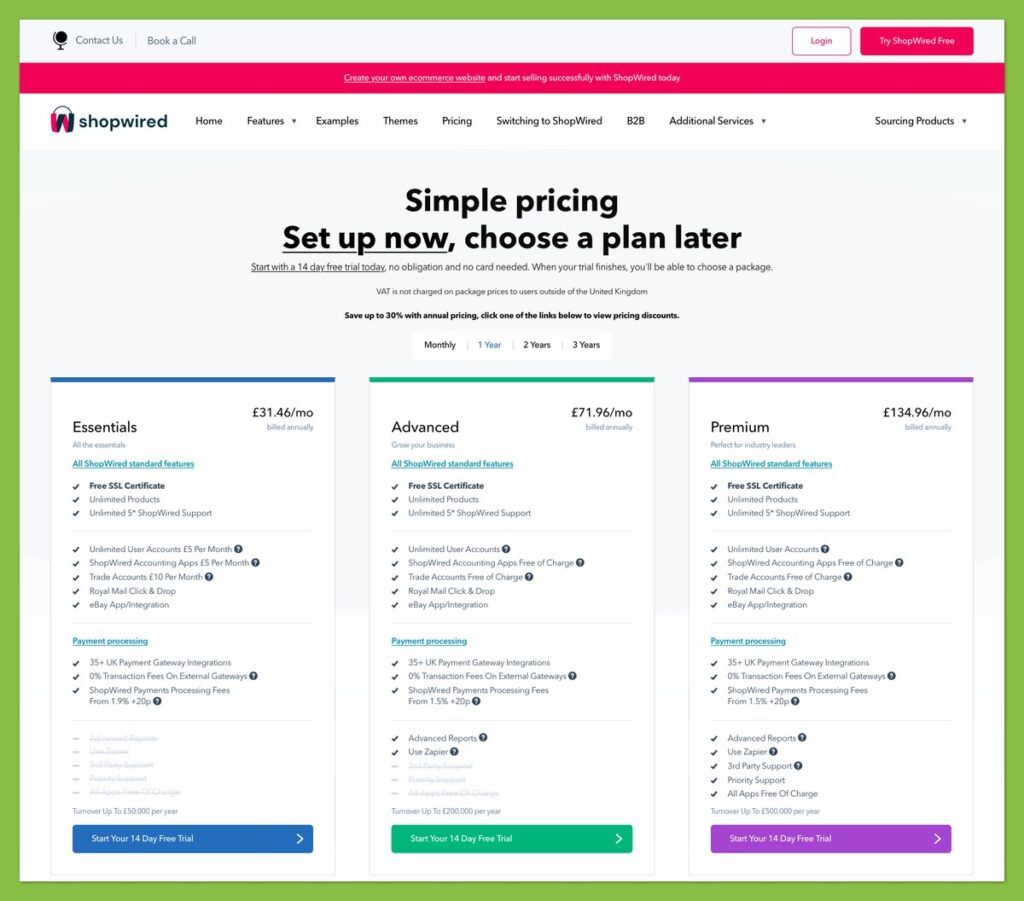
If that setup covers your needs, a replacement should deliver a measurable benefit. A new editor alone may not justify rebuilding a working shop.
How to Move Your Store From ShopWired
Plan the transfer before cancelling anything. A CSV export is a data file, not a guarantee that another platform can import it correctly.
Your main routes are:
- Manual CSV migration: Consider this for straightforward data when you can map fields and check the results yourself.
- A migration service: Consider it for larger transfers, but confirm exactly which records and relationships it supports.
- A developer or agency: Use this route when custom integrations or unusual data structures make automated migration risky.
ShopWired supports order exports as CSV files, and its API provides access to resources including products and customers. The destination’s import capabilities still determine what can be recreated.
Work through these steps:
- Keep backups: Preserve exports and a record of the existing website before making changes.
- Map your data: Match product fields and variants to the destination’s structure. Import a representative sample first.
- List exceptions: Confirm what happens to historical orders, gift cards and subscriptions. Do not assume customer passwords or themes will transfer.
- Map URLs: Record existing addresses and prepare redirects to their closest replacements.
- Test the store: Check orders, shipping charges, tax settings and customer emails before changing the domain.
- Reconcile at launch: Account for orders and stock changes made while the new store was being prepared.
Keep access to the old store until you have verified the migration and retained the records your business needs.
How We Selected These Alternatives
These recommendations compare each platform’s features, pricing and operational requirements against what a ShopWired store already does. The scores in the comparison chart reflect how well each platform fits its switching need.
The shortlist covers 4 different switching needs: retail growth, website flexibility, creative presentation and technical control. Cost comparisons distinguish subscription charges from platform transaction fees and card processing.
Your required integrations and migration complexity may change the best choice. Compare those before committing.
Prices checked in November 2026.
Which ShopWired Alternative Should You Choose?
Choose Shopify first for commerce-led growth, particularly when a specific integration or connected selling workflow would improve your operation.
Wix is the more relevant shortlist choice for a website combining products and bookings. Squarespace suits a creative, content-led business, while WooCommerce makes sense when control is worth the maintenance commitment.
But staying with ShopWired is a valid outcome. If its tools and gateway flexibility already serve you well, switching needs a stronger justification than a lower headline price.
Your next step should be a requirements checklist and complete cost comparison, followed by a small trial of your hardest workflow. Commit only when the replacement proves it solves the problem.
FAQs
Is There a Free Alternative to ShopWired?
WooCommerce’s core software is free, but hosting, maintenance and payment processing are not. Paid extensions or development may also be necessary. Wix lets you build a website for free, but you need Core or higher to accept payments. None of these options is a completely free managed shop.
Is Shopify Cheaper Than ShopWired?
Shopify Basic has a lower starting subscription, but the total depends on your payment provider and required apps. Its third-party provider surcharge can outweigh the subscription saving. Compare the full setup you need, not just the advertised entry plan.
Will Moving From ShopWired Hurt My SEO?
Migration can affect search visibility if URLs change without suitable redirects or valuable content disappears. Preserve useful content, map old URLs and check the live site after launch. Our Shopify vs WooCommerce vs BigCommerce SEO comparison shows how the big platforms handle SEO. No platform choice guarantees a risk-free move.
Which Alternative Is Best for a Complex Catalogue?
Shortlist Shopify for an integration-led approach and WooCommerce for custom requirements. Neither should be chosen on product count alone. Test representative products, including difficult variants and pricing rules, before deciding that either handles your catalogue better than ShopWired.


