Shopify is the better choice if you want a distinctive online store and more control over customer relationships. Shopee is the stronger starting point if you want to sell inside an established marketplace, with its checkout and local selling workflows.
The Shopify vs Shopee decision is less about which platform has more features and more about which job you need done. Shopify gives you an independent storefront to build and promote. Shopee gives you a shop within its marketplace, where buyers can discover your products alongside competing listings.
Both help you present products, take payments, run promotions and manage orders. Neither removes the work of protecting your margins or getting parcels to customers.
The country examples below focus on Singapore, with a separate Malaysia promotion example. Check your local terms before choosing.
Key takeaways
- Shopify wins for brand control: You get broader storefront and layout flexibility.
- Shopee wins for marketplace discovery: Your listings can reach shoppers already browsing.
- Shopify wins for flexible operations: Shipping rules and returns tools offer more control.
- Shopee wins for simpler storefront setup: There is less website design work.
- Pricing has no universal winner: Compare local fees, shipping and customer acquisition together.
Shopify vs Shopee at a Glance
Choose Shopify for an independent sales channel; choose Shopee for marketplace selling. Here is how their everyday selling tools compare.
| Merchant priority | Shopify: Best for control | Shopee: Best for marketplace selling |
|---|---|---|
| Store format | Independent online storefront | Shop within Shopee’s marketplace |
| Core costs | Recurring plan, payment processing and applicable extras | Applicable sales fees, programmes and promotional costs |
| Product listings | Products presented within your own store structure | Listings presented within marketplace rules |
| Checkout | Payment setup depends on country and provider eligibility | Marketplace checkout with locally available methods |
| Promotions | Discount codes, email campaigns and customer segmentation | Vouchers, discounts, ads and campaign participation |
| Shipping | Configurable rates and carrier integrations; label eligibility varies | Supported and non-supported logistics, depending on market |
| Returns | Returns, exchanges and refunds managed through the admin | Platform-governed return and refund process |
| Shop appearance | Broader theme and layout customization | Shop Decoration within a marketplace framework |
| Customer discovery | You need a plan to attract visitors | Marketplace discovery opportunities, with competing listings |
| Support access | Plan-dependent assistance, including 24/7 chat on Basic and Grow | Local support channels; Singapore includes 24/7 chat |
The tradeoff is responsibility. Shopify gives you more decisions to make because you control more of the shopping experience. Shopee standardizes more of that experience, but its rules also limit how far you can reshape it.
A merchant with an existing audience may value Shopify’s flexibility more than marketplace exposure. A new seller without an audience may reasonably make the opposite choice.
1. Pricing: Which Offers Better Value?
There is no universal pricing winner because sales volume, local fees and customer acquisition change the answer. Shopify has a clear recurring plan cost; Shopee requires a closer look at the charges that apply to your seller account and orders.
Shopify: A subscription plus selling costs
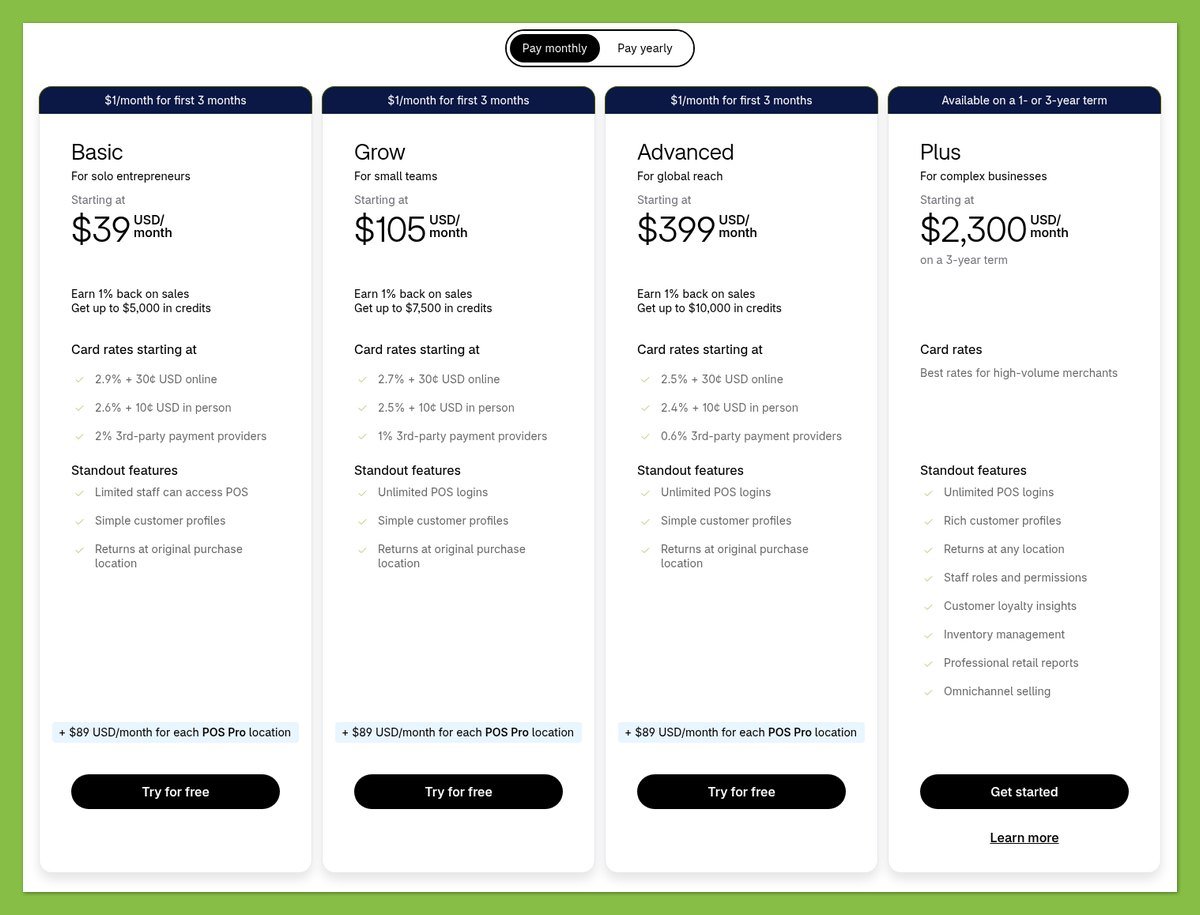
Singapore pricing example: All amounts below are in Singapore dollars, not US dollars. Annual prices are monthly equivalents under annual billing, not monthly payment options.
| Shopify plan | Paid monthly | Monthly equivalent, billed yearly | Standard online card rate |
|---|---|---|---|
| Basic | S$39/month | S$29/month | 3.2% + S$0.50 |
| Grow | S$132/month | S$99/month | 3.1% + S$0.50 |
| Advanced | S$531/month | S$399/month | 3% + S$0.50 |
These Singapore standard card rates are not universal payment rates. International cards and American Express have different rates.
Shopify’s third-party transaction fees are separate from payment processing: 2% on Basic, 1% on Grow and 0.6% on Advanced. If you use a third-party payment provider, check both its processing charges and the applicable Shopify fee.
For a small shop, Basic is the sensible starting point unless a higher plan solves a specific operational need. A slightly lower card rate alone is not a reason to take on a much larger subscription.
Shopee: Check the applicable fee stack
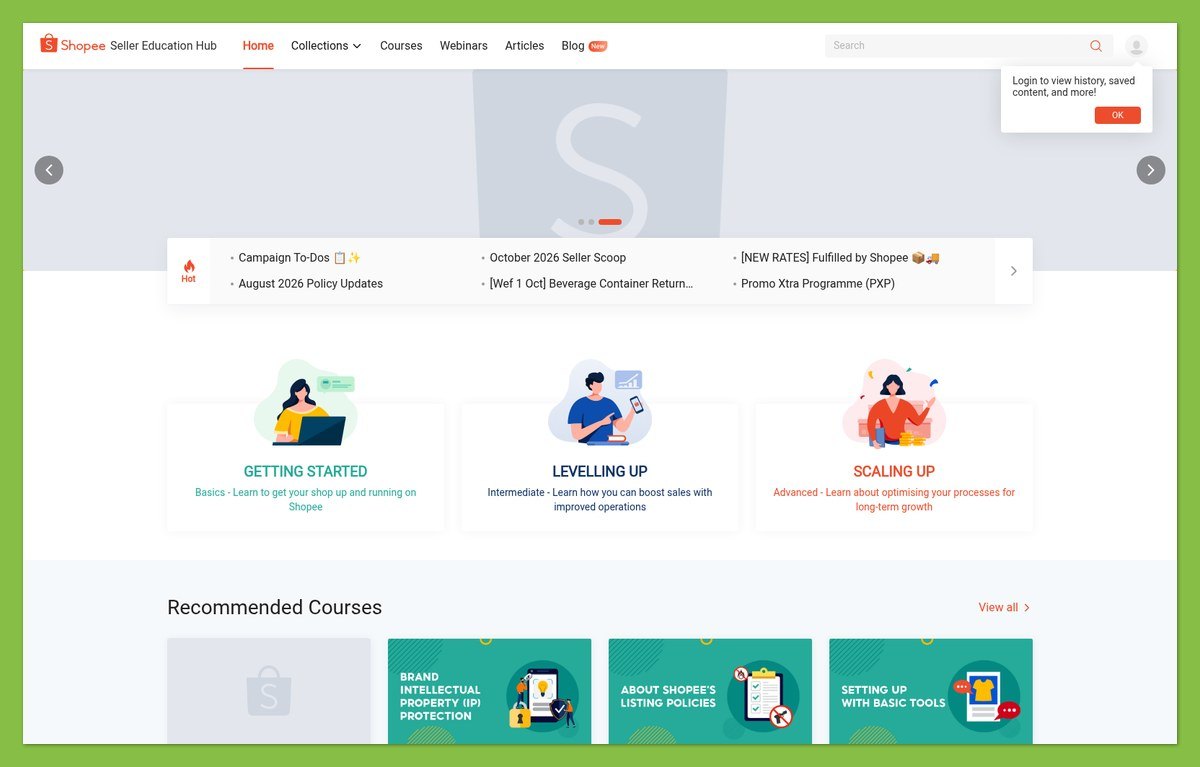
Shopee should not be treated as a free alternative simply because its cost structure differs from Shopify’s subscription model.
Singapore fee example: The applicable components can include the following. This is not a list of charges that every seller pays.
| Cost component | What to check |
|---|---|
| Commission | The rate applicable to your seller account and sales |
| Transaction fee | The charge on successful transactions |
| Programme fees | Charges associated with programmes you join |
| Cross-border or SPayLater fees | Whether these apply to the transaction |
| Ads and promotions | Advertising spend and your share of promotional costs |
| Shipping | The portion of delivery charges you bear |
Shopee’s Singapore rates are notified to sellers. Use your current local fee schedule rather than importing a percentage from another country or an older seller discussion.
Compare the money left after each sale
The useful Shopify vs Shopee fees comparison starts with the same basket, not two headline prices.
Calculate revenue minus product costs, applicable platform and payment fees, seller-funded discounts, shipping and customer acquisition. For Shopify, also spread the subscription and any app costs across your expected orders.
An existing audience can make Shopify more attractive because you may need less paid acquisition. Shopee’s discovery opportunities can be valuable if you have no audience, but advertising and discounting can still reduce your margin.
The practical choice: Price your typical order on both platforms before committing. Shopify’s fixed cost becomes easier to spread as orders increase; Shopee’s marketplace reach can justify sales-related charges when it brings profitable orders.
2. Selling Tools: How Do They Compare?
Shopify wins for flexible selling workflows, while Shopee is the better fit for marketplace-managed selling. Both cover the core journey from product listing to completed order, but they give you different levels of control along the way.
Products and inventory
Shopify suits you when stock management needs to extend beyond a straightforward shop catalog. Its inventory tools support:
- Stock quantities and locations: Track inventory across your operating locations.
- Transfers and stock counts: Move stock and reconcile recorded quantities.
- Purchase orders: Manage incoming inventory as part of your replenishment workflow.
Shopee organizes selling around marketplace listings and orders. Your product presentation needs to fit its listing requirements rather than a store structure you design independently.
For a small catalog, that framework may be entirely sufficient. Shopify’s broader inventory scope becomes more useful when you need to coordinate stock across locations or keep purchasing and inventory work together.
Before choosing, map your actual product range. Check how each platform handles the options and stock distinctions you need, rather than assuming a longer feature list will make your daily work easier.
Payment options and cash flow
Shopify gives you payment-provider choices subject to local availability. Shopee gives buyers the payment methods supported by its marketplace checkout, rather than letting you attach any external gateway you prefer.
Singapore payment example:
| Payment consideration | Shopify | Shopee |
|---|---|---|
| Core arrangement | Shopify Payments is available to eligible merchants | Payments run through marketplace checkout |
| Card payments | Supported through eligible payment setup | Credit and debit cards supported, subject to restrictions |
| Other methods | Depend on provider and local availability | Options include ShopeePay, SPayLater, DBS PayLah! and PayNow |
| Seller checks | Business verification and eligibility apply | Local payment availability and restrictions apply |
For Singapore merchants, Shopify Payments brings payment processing and order management into the Shopify admin. Its availability in Singapore does not mean it is available in every other Shopee market.
Cash flow deserves attention too. In Singapore, Shopee Guarantee withholds seller payments pending buyer receipt confirmation. You should understand the applicable release conditions before relying on order proceeds to replenish stock.
Do not compare only the number of payment methods. Compare the methods your buyers use, their fees and the time before funds become available.
Shipping and returns
There is no worldwide Shopify vs Shopee shipping winner. Local carrier availability and the work required to hand over each parcel matter more than a broad claim about convenience.
Shopify supports several shipping-rate approaches:
- Flat rates: Charge a set delivery price.
- Order-value or weight-based rates: Adjust the charge to the basket.
- Free shipping: Offer delivery without a separate customer charge.
- Carrier or app-calculated rates: Use supported integrations, with applicable requirements.
Connecting your own carrier accounts for calculated rates can involve plan or additional-fee requirements. More importantly, configuring shipping rates is not the same as buying labels through Shopify’s carrier accounts.
Singapore shipping example: Singapore is not on the current eligible-location list for Shopify carrier-account label purchasing. You can still arrange delivery through local carriers, apps or other fulfillment workflows.
SingPost has a Shopify integration that maps store delivery settings to its services. Check the integration’s requirements before assuming every function is available on your chosen plan.
Shopee Singapore distinguishes Shopee Supported Logistics from non-supported logistics. Non-supported shipments are tracked through the logistics provider, and shipping charges may be shared among the buyer, seller and Shopee. That does not mean Shopee funds every delivery or handles all fulfillment work.
Returns reveal a clearer difference. Shopify supports returns, exchanges and refunds in the admin, with optional self-serve returns and eligibility rules. Shopee Singapore handles return and refund requests within platform rules, reviews evidence and does not offer direct buyer-seller exchanges through that process.
Choose Shopify when you need more operational control. Shopee’s predefined workflow can mean fewer arrangements to design yourself.
3. Marketing: Which Helps You Reach Customers?
Shopee wins for marketplace discovery; Shopify wins for seller-controlled customer marketing. If your biggest problem is finding your first buyers, Shopee has the more immediately relevant model. If it is bringing customers back to your brand, Shopify offers the stronger toolkit.
Discovery: An existing marketplace or your own destination
Shopee places your products in an environment where shoppers can browse and compare listings. That gives you a route to discovery without first making your independent website a destination.
The catch is competition. Access to marketplace shoppers is an opportunity, not a promise that your listing will attract clicks or profitable orders.
Shopify gives you a storefront, but you still need a reason for people to visit it. Your acquisition plan might involve search-focused content, advertising or an audience you have already built.
Search strategy therefore means different things on the two platforms. On Shopify, you are trying to attract visitors to your own store. On Shopee, you are trying to make products appealing and discoverable within a marketplace.
For an unfamiliar brand, Shopee is the more practical discovery starting point. Shopify makes more sense when you can explain where your visitors will come from.
Promotions: Both can help you sell an offer
Both platforms support promotions, but their tools serve different sales environments.
| Marketing task | Shopify | Shopee |
|---|---|---|
| Price incentives | Discount codes and gift cards | Discounts, vouchers and bundle deals |
| Campaign activity | Email campaigns and marketing automations | Campaign nomination and marketplace advertising |
| Repeat purchasing | Customer segmentation and abandoned checkout recovery | Shop and product promotions within the marketplace |
| Main constraint | You must attract visitors and build a reachable audience | Programme access and promotion rules vary by market |
Shopify’s segmentation helps you organize customers for more targeted communication. Its email and automation tools make it a stronger choice when repeat purchases are central to your business.
That does not mean marketing is unlimited or free. Check sending limits, app charges and the availability of particular services before budgeting.
Shopee’s Marketing Centre puts promotions close to the marketplace buying process. Campaign participation can be useful, but availability and exact tools vary by country and programme.
Malaysia promotion example: Shopee distinguishes platform vouchers, free-shipping discounts and seller shop or product vouchers. Do not assume every voucher is paid for by Shopee.
Measure profit, not just the promotion response
For either platform, judge a campaign by the money left after discounts, ads and delivery contributions. More orders are not automatically better orders.
Choose Shopee to pursue marketplace demand; choose Shopify to build a more independent repeat-customer strategy. Shopee still offers useful shop promotions, while Shopify can work for a new brand if you have a credible acquisition plan.
4. Ease of Use: Which Is Simpler to Manage?
Shopee wins for simpler storefront setup because you do not have to build an independent website. Shopify asks you to make more decisions, but those decisions buy you control rather than merely adding administration.
Shopify: More setup, more choices
Shopify setup involves shaping both your storefront and the way it operates. The practical workload includes:
- Account and payment setup: Confirm business details and provider eligibility.
- Product setup: Prepare listings and organize your catalog.
- Store presentation: Choose and configure your theme.
- Delivery setup: Establish rates and a workable fulfillment arrangement.
Once orders arrive, Shopify brings inventory and order tasks into the admin. Returns and refunds can also be managed there, although carrier or app-specific work may still sit elsewhere.
The main difficulty is deciding what you need. A small seller can create unnecessary work by adding integrations before identifying a real requirement.
Shopee: Less design work, more predefined rules
Shopee narrows the setup scope because the marketplace supplies the surrounding shopping experience. Your attention shifts to:
- Seller setup: Complete the eligibility and verification steps for your market.
- Listings: Prepare accurate product information and images.
- Payments and logistics: Understand the locally supported arrangements.
- Daily orders: Fulfill sales and handle issues within platform procedures.
That is a simpler storefront project, not a guarantee of effortless selling. You still need to understand fees, delivery responsibilities and the rules governing customer requests.
A predefined workflow is helpful when it matches your business. It becomes restrictive when you want to handle an order differently.
Practical tip: Before committing, walk through one ordinary order and one return on paper. Identify who takes payment, who creates the shipping arrangement and who decides the refund outcome.
Shopee is the easier recommendation for getting a first marketplace shop organized. Shopify remains the better fit if accepting more setup work prevents awkward workarounds later.
5. Shop Customization: Which Gives You More Control?
Shopify wins this round because it gives you broader control over the storefront, not just a page inside a marketplace. Shopee can still look recognizably yours, but its Shop Decoration tools operate within a more bounded framework.
Shopify: Shape the shopping experience

Shopify’s theme editor supports content sections and blocks, alongside settings for colors, typography and layout. App embeds and mobile previews provide further ways to shape and check presentation.
Some Canvas-badged themes use Canvas rather than that editor, so the exact editing experience depends on the theme.
The advantage is not simply making a prettier homepage. You can give product information and brand content a structure that suits how you want customers to browse.
That freedom also gives you more decisions to get wrong. Consistent images and clear navigation matter more than using every available design option.
Shopee: Brand your space within familiar boundaries
Shopee’s Shop Decoration lets you personalize your marketplace shop page. It is not accurate to say Shopee offers no branding.
For either platform, prioritize the presentation work buyers actually use:
- Brand identity: Keep visual choices consistent.
- Product images: Make products easy to understand and compare.
- Grouping and navigation: Help shoppers locate relevant items.
- Promotional space: Give featured offers a clear purpose.
Shopify offers more room to arrange those elements around your brand. Shopee keeps them within a familiar marketplace environment, which can suit sellers who do not want to design an entire browsing experience.
Choose Shopify if presentation is part of your competitive advantage. Choose Shopee if a recognizable shop within an established interface is enough. Its narrower scope can keep your attention on products rather than design.
6. Support: What Help Can Sellers Get?
This support round is a tie in Singapore: both platforms offer 24/7 live chat. Shopee adds in-app calls, but channel availability alone does not establish better service.
Shopify: Store and platform assistance
- ✔️ Round-the-clock access: Basic and Grow include 24/7 live chat.
- ✔️ Plan-dependent assistance: Advanced lists enhanced live chat, while Plus has priority support.
- ✔️ Self-service guidance: Help resources cover store setup and merchant operations.
- ❌ Channel limits: Do not assume ordinary plans include general telephone support.
Shopify’s support is relevant when you need help with the platform and store administration. A carrier or third-party app may still need to resolve problems involving its own service.
A higher support tier is not evidence that every issue will be resolved faster. Choose a plan for its operational value, not an assumed response-time guarantee.
Shopee: Local marketplace help and disputes
Singapore support example:
- ✔️ Round-the-clock chat: Live chat is available 24/7.
- ✔️ In-app calls: Internet calls are available from 8am to 10pm daily, including public holidays.
- ✔️ Seller routing: The contact flow lets you select Seller and the relevant issue.
- ❌ Market-specific access: These channels and hours should not be assumed elsewhere.
Shopee also investigates Singapore return and refund disputes using evidence from buyers and sellers. That gives it a role in the transaction outcome, not just technical troubleshooting.
Keep order records and relevant shipping evidence ready. Access to an agent does not guarantee that a dispute will be decided in your favor.
Choose on support fit, not channel count. Shopify assists with running your store; Shopee combines marketplace assistance with platform-governed order processes.
How We Compared Shopify and Shopee
This document-based comparison covers published pricing, help documentation, seller guidance and carrier information across six merchant tasks. It does not include hands-on testing.
Recommendations reflect feature scope and business fit, rather than measured sales or support performance. Fees, payment methods, logistics, support channels and promotion tools vary by market.
Prices current as of October 2026. Confirm local fees, eligibility and programme terms before committing, especially for payments and shipping.
Shopify vs Shopee: Which Should You Choose?
Choose Shopify if you want to build a branded sales channel and can take responsibility for attracting visitors. Its stronger customization, customer marketing and operational flexibility make that extra work worthwhile.
Choose Shopee if you want marketplace discovery and a more predefined local selling workflow. Accept that platform rules and applicable fees will shape your margins and customer experience.
Using both may make sense, but do not assume free, automatic synchronization. Check integration support and additional charges separately.
Before choosing, confirm your payment eligibility, map your delivery workflow and calculate the margin on one typical basket. Then choose the platform that fits how you will actually sell.


