Shopify and Poshmark are both ways to sell online, but they serve very different purposes.
We’ve spent considerable time researching and testing ecommerce platforms to bring you a clear recommendation.
As a result of our research, Shopify is the better choice for building a long-term online business – but Poshmark has a compelling case for the right kind of seller.
Shopify vs Poshmark: Quick Verdict
- Shopify – Best overall, ideal for building a branded ecommerce store
- Poshmark – Best for casual resellers flipping secondhand fashion
In this comparison, I’ll walk through why Shopify outperforms Poshmark for most online sellers, while also showing you exactly when Poshmark is the smarter move.
Quick Comparison: Shopify vs Poshmark
| Feature | Shopify | Poshmark |
|---|---|---|
| Platform type | Hosted ecommerce platform, your own domain | Fashion-focused resale marketplace |
| Pricing model | Monthly subscription + payment processing fees | Free to list; flat $2.95 or 20% commission per sale |
| Best for | Brands, retailers, and scaling businesses | Casual resellers and side-hustlers clearing fashion items |
| Traffic source | You drive traffic via SEO, ads, social, email | Built-in Poshmark buyer base |
| Branding | Fully branded store, your domain and logo | Profile/closet only; Poshmark’s brand dominates |
| Product scope | New, used, digital, services; no SKU limits | Primarily physical fashion and home goods |
| Fulfillment | In-house, 3PL, dropshipping, print-on-demand | Seller packs and ships via Poshmark labels only |
| Automation | Strong via apps, workflows, and integrations | Manual listing and shipping; limited in-app promo tools |
| Scalability | High; supports large catalogs and high order volume | Limited by sourcing capacity and your personal time |
Best for Pricing: Poshmark (for low volume) vs Shopify (for growth)
Pricing is where these two platforms diverge most sharply, and the right answer depends entirely on your selling volume and ambitions.
Shopify runs on a monthly subscription model. Plans are priced as follows (billed annually):
- Basic – $29/month
- Shopify (mid-tier) – $79/month
- Advanced – $299/month
- Shopify Plus – from $2,300/month (enterprise)
On top of your subscription, you’ll pay payment processing fees. Using Shopify Payments, that’s around 2.9% + $0.30 per transaction on the Basic plan, dropping to 2.5% + $0.30 on Advanced.
If you use a third-party gateway like Stripe or PayPal, an additional transaction fee applies – roughly 2.0% on Basic down to 0.6% on Advanced. There’s no listing fee or commission on what you sell.
Poshmark takes the opposite approach: it’s free to list, and you only pay when you make a sale. For items sold under $15, Poshmark takes a flat $2.95.
For sales of $15 or more, the commission jumps to 20% – meaning you keep 80 cents of every dollar. Buyers pay a flat shipping fee (around $6.49 in the US), and Poshmark provides the label.
For someone clearing out their wardrobe or flipping a handful of items a month, paying nothing upfront is obviously appealing. But at higher volumes or higher price points, that 20% commission adds up fast. A $100 item nets you just $80 on Poshmark; on Shopify, you’d pay a few dollars in processing fees and keep the rest.
The Winner
It depends on your volume. Poshmark wins for low-volume, no-commitment selling. Shopify wins the moment you’re moving consistent inventory and need your margins to work in your favor.
Best for Selling Online: Shopify
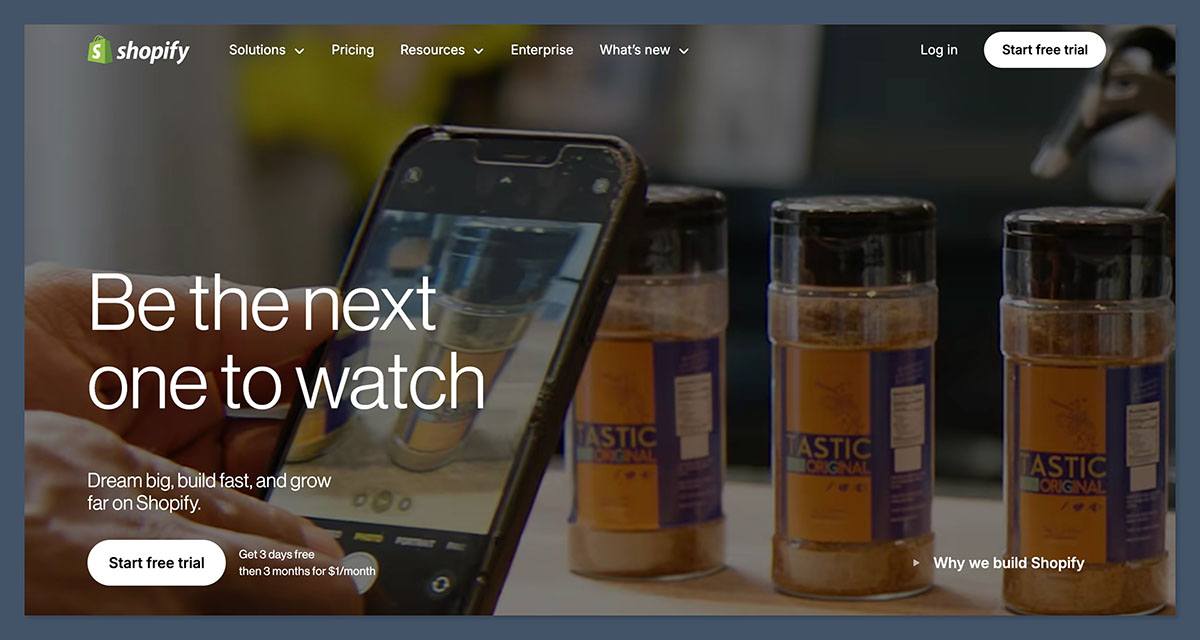
Shopify is built from the ground up for ecommerce.
You get abandoned cart recovery, discount codes, multichannel selling through marketplaces and social platforms, and a native checkout that supports over 100 payment methods including PayPal, Apple Pay, and Google Pay.
Shopify Magic, its AI integration, can generate product descriptions automatically – a genuine time-saver when you’re managing a large catalog.
Poshmark offers a very different set of selling tools, all built around its social marketplace model. You can share listings to “Posh Parties” (themed virtual shopping events), send price-drop notifications to users who’ve liked your items, and make offers directly to interested buyers.
These are effective within the platform, but they’re Poshmark-specific tactics, not transferable ecommerce skills or infrastructure.
One significant constraint with Poshmark is that dropshipping is not allowed. You must physically have each item, pack it yourself, and ship it using Poshmark’s prepaid label. This caps your scalability at your personal capacity.
Shopify, by contrast, supports dropshipping and print-on-demand integrations, so you can sell products that ship directly from a supplier without ever touching the inventory yourself.
Shopify also gives you access to an app market of over 8,000 third-party integrations. This means you can layer on product reviews, upsell flows, loyalty programs, subscriptions, and more. Poshmark has no equivalent ecosystem – what you see in the app is what you get.
The Winner
Shopify offers a far more capable and scalable set of selling tools. Poshmark’s features are well-suited to its marketplace format but can’t compete with Shopify for serious ecommerce.
Best for Branding and Control: Shopify
With Shopify, you build a store on your own domain with full control over design, navigation, and the customer experience. You own your customer data, order history, and email list – assets that grow in value over time and follow you wherever you go.
Poshmark gives you a “closet” – a seller profile within the Poshmark ecosystem. You can’t use a custom domain, you can’t meaningfully customize the storefront layout, and you don’t own the customer relationship. Buyers are Poshmark’s audience first.
If you build a following of 10,000 people on Poshmark, that audience lives inside Poshmark’s platform and can’t easily be migrated elsewhere.
This is the strategic difference between the two platforms in a nutshell: Shopify helps you build a long-term, transferable ecommerce asset. Poshmark is closer to renting a stall in a busy market where the operator sets the rules.
The Winner
Shopify, and it isn’t close. If brand equity and customer ownership matter to you, Poshmark can’t deliver them by design.
Best for Marketing Your Products: Shopify
Marketing on Shopify means you have access to the full playbook: SEO optimization, email marketing campaigns, social media integrations with Instagram and TikTok, and marketplace connections to Amazon and Etsy through the Shopify Marketplace Connect app.
Shopify even partnered with Semrush to offer an Ecommerce Booster app with actionable SEO recommendations for your store.
Poshmark’s marketing tools are platform-native and limited to what works inside the app.
Sharing your listings frequently, participating in Posh Parties, and engaging with followers can boost your visibility – but none of that activity helps you build an audience outside Poshmark, rank in Google, or run a retargeting ad. If Poshmark changes its algorithm or shuts down, your marketing efforts disappear with it.
For internationalization, Shopify supports over 30 languages and can automatically redirect shoppers to translated storefronts.
Poshmark operates primarily in the US, with limited expansion to a small number of other markets.
The Winner
Shopify gives you real, durable marketing infrastructure. Poshmark’s tools are useful within the platform but build no standalone audience or brand equity.
Easiest to Use: Poshmark
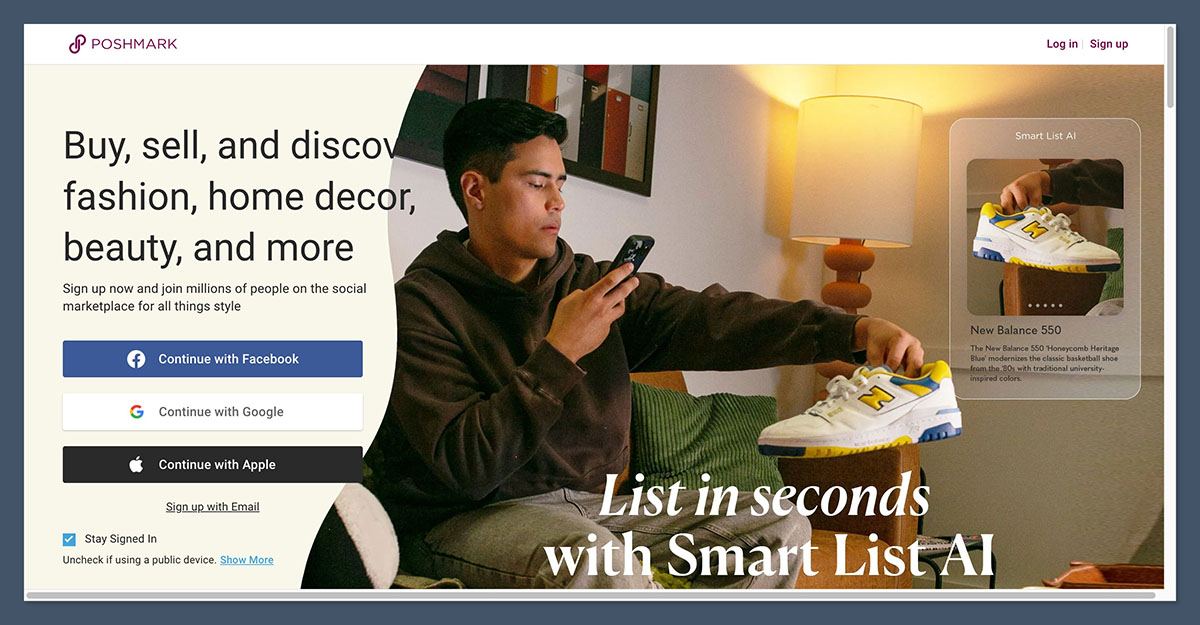
This is one area where Poshmark genuinely holds an edge – at least for getting started. Creating a listing on Poshmark takes minutes: snap a photo, write a description, set a price, and you’re live.
There’s no storefront to design, no apps to configure, and no payment setup required. The friction is intentionally low.
Shopify’s setup is more involved. You’ll be guided through onboarding questions about your business, then presented with a dashboard and a setup checklist.
The section-based editor is reasonably intuitive once you’re in it, but there’s a learning curve – particularly when it comes to connecting payments, configuring shipping zones, and selecting the right apps for your needs.
Shopify offers extensive help resources including guides, video tutorials, a community forum, and business courses to support you through that process.
For someone who just wants to sell a few jackets from their wardrobe this weekend, Poshmark is the easier on-ramp. For someone building a real ecommerce business, Shopify’s setup investment pays dividends quickly.
The Winner
Poshmark is simpler to start. Shopify has a steeper initial setup but gives you far more once you’re up and running.
Best for Product Range: Shopify
Shopify imposes no meaningful restrictions on what you sell. New products, secondhand goods, digital downloads, services, subscriptions – all are supported, with no limit on the number of SKUs you can list. This makes it viable for everything from a boutique clothing label to a large wholesale distributor.
Poshmark was built for secondhand fashion and has expanded into home goods and some new items, but the platform’s DNA is still very much the personal closet resale model.
It’s best suited to individual or small-batch items – the kind of inventory you source from thrift stores, clearance racks, or your own wardrobe. Repeatable catalog SKUs aren’t really what the platform is designed for.
The Winner
Shopify, for almost any use case beyond secondhand fashion resale. Poshmark is purpose-built for a specific niche and doesn’t try to be more than that.
Best for Business Support: Shopify
Shopify offers 24/7 live chat support with escalation to a human advisor for complex queries, social media support across multiple platforms, and a comprehensive Help Center with guides, video tutorials, and business courses. Phone support is available for Shopify Plus merchants.
Poshmark’s support is more limited. There’s a help center and email-based support, but no live chat or phone option for standard sellers.
Given that Poshmark is geared toward casual individual sellers rather than businesses, this is arguably appropriate – but it’s worth knowing if you run into a problem and need fast resolution.
The Winner
Shopify offers significantly more robust business support, with 24/7 access and a thorough knowledge base to help you grow.
Shopify vs Poshmark: When to Choose Each
Choose Shopify if:
- You want to build a long-term brand with customer data, a custom domain, and repeatable inventory
- You sell (or plan to sell) consistent SKUs and want to scale with SEO, paid traffic, or email marketing
- Your margins can support a monthly subscription, and a 20% commission per sale would be too costly at your average order value
- You want to use dropshipping, print-on-demand, or third-party logistics to reduce fulfillment effort
Choose Poshmark if:
- You’re decluttering your wardrobe or flipping limited quantities of secondhand fashion
- You want to start selling with zero upfront cost and are comfortable paying commission per sale instead of a fixed monthly fee
- You’d rather tap into an existing marketplace audience than invest in SEO, ads, or email campaigns
- You’re not trying to build a standalone brand – you just want items sold quickly and simply
How We Researched This Comparison
Our ecommerce platform comparisons are built on hands-on research and testing across key criteria, weighted by what matters most to sellers. For this comparison, we evaluated both platforms across the following areas:
- Selling features – inventory tools, checkout, payment options, and fulfillment flexibility
- Pricing and fees – total cost of selling at different volumes and price points
- Branding and control – domain ownership, storefront customization, and customer data access
- Marketing capabilities – SEO, email, social, and multichannel options
- Ease of use – onboarding, listing creation, and day-to-day management
- Support – quality and availability of help resources
Shopify vs Poshmark: Our Winner
For anyone serious about ecommerce – building a brand, scaling inventory, and owning the customer relationship – Shopify is the clear choice.
Its selling features, marketing tools, and growth infrastructure are in a different category to what Poshmark offers.
That said, Poshmark earns its place for a specific type of seller. If you’re a casual reseller with no interest in building a brand, its zero-upfront model and built-in audience make it an attractive, low-friction way to turn secondhand items into cash.
The 20% commission is high, but if the alternative is paying a monthly Shopify subscription for a handful of sales, Poshmark is the more practical option.
The honest answer is that these two platforms aren’t really competing for the same seller.
If you’re unsure which camp you fall into, start with Shopify’s free trial and see whether you’re ready to commit to building something – or whether Poshmark’s simplicity is exactly what you need right now.
Frequently Asked Questions
Can I use Shopify and Poshmark at the same time?
Yes. Some sellers use Poshmark to move one-off or secondhand items while running a Shopify store for their main branded inventory. They serve different purposes and don’t conflict with each other.
Is Poshmark free to use?
It’s free to create an account and list items. Poshmark charges a flat $2.95 on sales under $15 and a 20% commission on sales of $15 or more – so you only pay when you sell something.
Does Shopify take a percentage of sales?
Shopify doesn’t take a commission on your product prices. You pay a monthly subscription plus payment processing fees (typically 2.9% + $0.30 per transaction on the Basic plan using Shopify Payments, with rates reducing on higher-tier plans).
Can you dropship on Poshmark?
No. Poshmark requires sellers to physically hold and ship each item using Poshmark’s prepaid label. Dropshipping is not permitted on the platform.
Which platform is better for selling clothes?
It depends on the type of clothes. Poshmark is ideal for secondhand or one-off fashion items sold to an existing marketplace audience. Shopify is better if you’re selling a branded clothing line, running consistent inventory, or want to build a standalone fashion store with your own domain and marketing channels.


