Shopify and Laravel are two very different tools, and that’s the point.
We’ve spent considerable time analyzing both options to bring you a clear, honest recommendation depending on what you’re actually trying to build.
The short version: if you want to sell online without writing code, Shopify wins. If you’re a developer building something custom, Laravel is your starting point.
Shopify vs Laravel: Quick Verdict
- Shopify – Best overall for merchants who want to sell online fast (Claim your first 3 months for $1/month)
- Laravel – Best for developers building custom or non-standard ecommerce applications
In this article, I’ll break down exactly why these two tools serve different audiences, comparing them on pricing, features, scalability, developer experience, and more — so you can make the right call for your project.
Quick Comparison: Shopify vs Laravel
| Shopify | Laravel | |
|---|---|---|
| Type | Hosted SaaS ecommerce platform | Open-source PHP framework |
| Best for | Merchants launching online stores | Developers building custom web apps |
| Starting cost | $29/month | Free (you pay for hosting + dev time) |
| Ecommerce out of the box | ✅ Full-featured | ❌ Build it yourself |
| Hosting | Managed by Shopify | Self-managed or PaaS |
| Technical skill required | Low | High |
| Customization ceiling | Medium (within platform limits) | Unlimited |
| PCI compliance | Handled by Shopify | Your responsibility |
| Time to launch | Days to weeks | Weeks to months |
What Is Shopify?
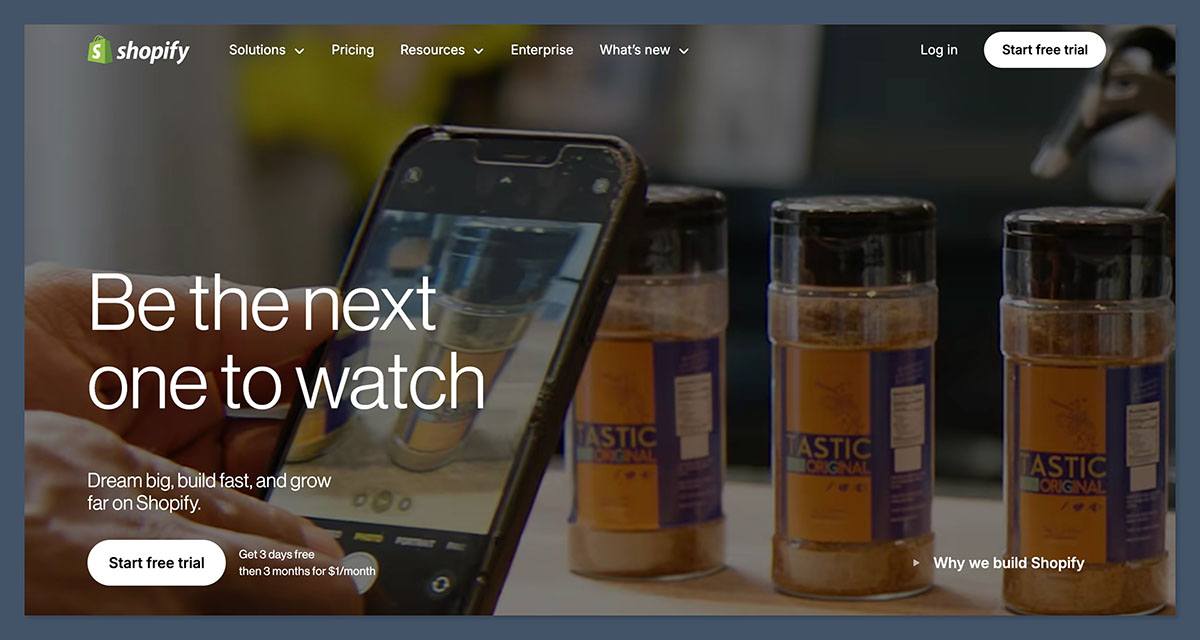
Shopify is a hosted commerce platform — sometimes called a commerce operating system — that bundles everything a merchant needs to sell online into one managed subscription.
Hosting, checkout, payments, inventory management, tax tools, and a massive app ecosystem all come included. You don’t need to touch a server, write backend code, or worry about PCI compliance.
Shopify works for solo founders launching their first product and for high-volume brands doing millions in sales. It’s deliberately built so that merchants, not developers, can run their stores day-to-day.
What Is Laravel?
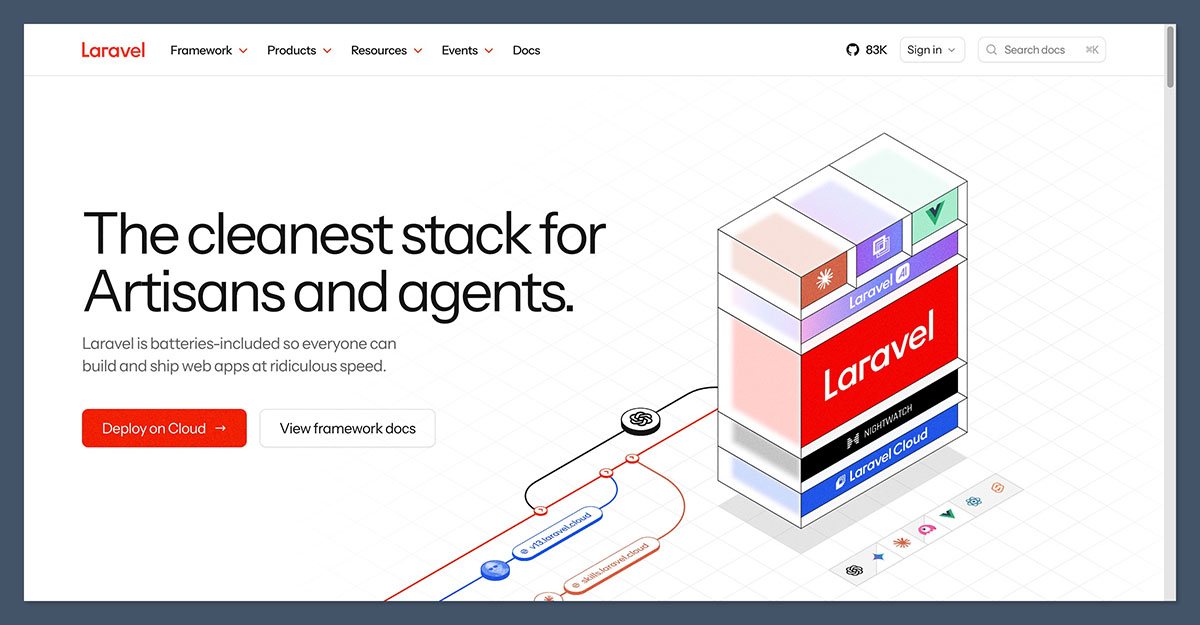
Laravel is a PHP framework for building web applications.
It’s not an ecommerce platform — it’s a foundation. Developers use it to build all kinds of products: SaaS tools, marketplaces, internal portals, APIs, and yes, custom ecommerce applications. But nothing commerce-specific ships out of the box.
Laravel 11, the current version, streamlined the framework’s default structure, added a built-in WebSocket server (Reverb) for real-time features, and improved performance through faster route compilation and a more efficient query builder. It’s a mature, developer-loved framework with a rich ecosystem of first-party tools like Horizon, Telescope, Forge, and Vapor.
The key distinction: Shopify is a product you use. Laravel is a framework you build with.
Best for Pricing: Shopify (for most people)
Pricing is where things get genuinely complicated, because Shopify and Laravel don’t cost money in the same ways.
Shopify Pricing
Shopify’s plans (billed annually) run as follows:
- Basic – $29/month – The entry-level plan for new stores. Includes an online store, unlimited products, basic reports, up to 2 staff accounts, and standard shipping discounts. Payment processing starts at 2.9% + $0.30 per transaction.
- Shopify – $79/month – Steps up with 5 staff accounts, standard analytics and reports, abandoned cart recovery, discount codes, customer segmentation, and better shipping rates. The sweet spot for stores with a steady flow of orders.
- Advanced – $299/month – Built for established stores that need more depth. Adds a custom report builder, up to 15 staff accounts, third-party calculated shipping rates, duties and import tax calculation, and the lowest transaction fees among standard plans.
- Shopify Plus – From around $2,300–$2,500/month – Shopify’s enterprise tier, built for high-volume operations. Includes everything in Advanced plus unlimited staff accounts, full checkout customization, workflow automation via Shopify Flow, Launchpad for campaign scheduling, B2B wholesale tools, up to 9 expansion stores, higher API rate limits, and dedicated account management.
On top of plan fees, you’ll pay payment processing (around 2.9% + $0.30 per transaction on Basic, dropping on higher tiers), and potentially $20–$300/month per third-party app for things like reviews, subscriptions, and loyalty programs.
Those app costs can add up quickly on a growing store.
That said, Shopify currently offers a deal where new merchants can get their first 3 months for just $1/month — a solid way to test the platform before committing. There’s also a 3-day free trial.
Laravel Cost Structure
Laravel itself is free and open-source. But “free framework” doesn’t mean free project. The real costs are:
- Development time – Building a commerce application from scratch takes weeks or months of developer hours, which is the largest cost by far
- Hosting – From a cheap VPS to fully managed cloud infrastructure, costs scale with traffic and architecture
- Third-party services – Payment providers (Stripe, PayPal), search, transactional email, and other services all add recurring costs
- Ongoing maintenance – Security patches, dependency updates, and feature development require continued engineering investment
For a simple store, Shopify is almost always cheaper to get live. For a long-term, complex platform where you’d otherwise pay for dozens of Shopify apps and Plus-tier fees, a custom Laravel build can work out more cost-effective over a 3–5 year horizon — but only if you have the engineering capacity to maintain it.
The Winner
Shopify wins for most merchants. Predictable monthly pricing with everything included is easier to budget than an open-ended custom build. Laravel becomes viable on cost only at significant scale, with a capable development team and non-standard requirements that Shopify can’t satisfy.
Best for Selling Online: Shopify
This one isn’t a close call. Shopify was built specifically for selling online. Laravel was not.
Shopify’s Commerce Stack
Out of the box, Shopify gives you:
- Product catalog, variants, collections, inventory tracking, and order management
- Secure checkout, multi-currency support, taxes, discount codes, shipping profiles, and abandoned cart recovery
- Shopify Payments plus 100+ third-party payment options including Shop Pay, PayPal, Apple Pay, and Google Pay
- Point of sale for in-person selling
- B2B tools and cross-border market management
- Over 8,000 third-party apps covering reviews, subscriptions, loyalty, upsells, advanced search, and more
Shopify Magic, its AI integration, lets merchants generate product descriptions quickly. Sales channels connect your store directly to Instagram, TikTok, Amazon, Etsy, and other platforms without third-party middleware.
Laravel’s Commerce Capabilities
Laravel ships with routing, controllers, an ORM, queues, events, schedulers, and authentication. Ecommerce logic — catalogs, checkout, payments, tax, order management — you build yourself, or you wire up using third-party packages like Cashier for billing or community packages like Aimeos or Bagisto.
That’s genuinely powerful for the right project. A marketplace with custom pricing rules, a B2B portal with complex account hierarchies, or a multi-tenant SaaS where commerce is one feature among many — these are all reasonable Laravel territory. A standard DTC store selling 50 SKUs is not.
The Winner
Shopify wins outright for commerce features. It has a complete, production-tested ecommerce stack. Laravel gives you the tools to build one, which is a very different proposition.
Best for Marketing: Shopify
Getting customers to your store matters as much as running it. Here again, Shopify’s purpose-built nature gives it a lead.
Marketing Tools
Shopify includes native email marketing (Shopify Email), social selling integrations with Instagram and TikTok, and multichannel selling via the Shopify Marketplace Connect app for Amazon and Etsy. SEO fundamentals — clean URL structures, sitemaps, meta tags, and image alt text — are handled by default, and Shopify’s partnership with Semrush powers an Ecommerce Booster app for actionable SEO recommendations.
Internationalization is strong too: Shopify supports over 30 languages and handles translated storefronts with automatic redirects based on browser language settings.
Laravel’s Marketing Capabilities
With Laravel, you control everything — URL architecture, rendering strategy (server-side, SPA, or hybrid), performance optimizations, structured data markup. A skilled team can build SEO and marketing capabilities that match or exceed Shopify’s. The problem is that nothing ships pre-built. Email marketing, social integrations, analytics — all of it requires either custom development or third-party service integrations.
The Winner
Shopify wins for marketing out of the box. The built-in and app-based marketing toolkit saves significant development time. Laravel can match it, but only with substantial engineering investment.
Easiest to Use: Shopify
Shopify is designed for merchants, not developers. Its onboarding asks a few questions about your business state and goals, then drops you into a setup checklist that walks you through adding products, customizing your store, and configuring payments.
The section-based editor is straightforward, and the admin interface is polished after years of iteration.
Laravel is an entirely different experience — because it’s not a product at all. Using Laravel means writing PHP code, setting up a local development environment, managing a database, configuring a server, and deploying your application.
There is no dashboard, no drag-and-drop, no setup wizard. The target user is a developer who wants full control, not a merchant who wants to launch quickly.
Laravel 11 did improve developer experience meaningfully — a leaner default app skeleton, simpler configuration, improved Artisan CLI commands, and per-second rate limiting — but these improvements serve developers, not merchants.
The Winner
Shopify wins decisively on ease of use. For non-technical users, Laravel isn’t really an option at all without a development team behind it.
Best for Design and Templates: Shopify
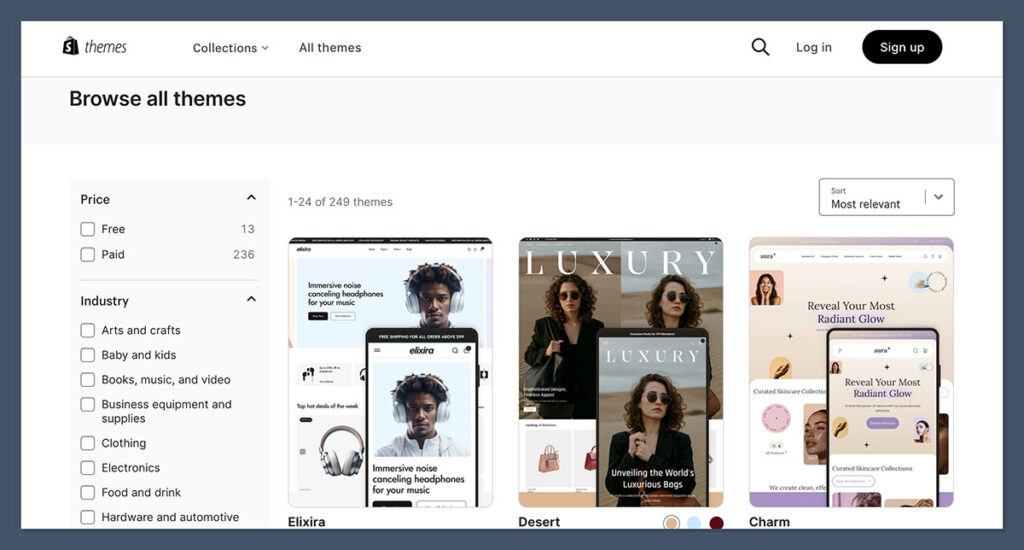
Shopify offers more than 190 templates across a wide range of industries, from pet supplies to jewelry to furniture. Thirteen are free; premium options run $100–$500 as a one-time fee.
Templates are built for commerce, with product pages, collection pages, and cart flows designed and tested for conversion.
Laravel has no templates in this sense. You can use any frontend framework — Blade, Livewire, Inertia.js with Vue or React, or a decoupled frontend entirely — but the design is entirely on you to build or source.
That’s maximum flexibility, but it’s not the same as having 190 vetted, commerce-optimized themes to choose from.
The Winner
Shopify wins for design and templates. Its library covers a wide range of styles and industries, and every theme is built with ecommerce UX in mind. Laravel gives you more freedom but zero starting point.
Best for Scalability and Performance: It Depends
This is one area where the answer genuinely splits depending on your situation.
Shopify’s Scalability
Shopify handles global scale for merchants — in 2025 it processed around $378.4 billion in GMV. Merchants inherit Shopify’s infrastructure: CDN, DDoS protection, PCI compliance, and automatic capacity scaling during traffic spikes.
For standard commerce growth, you don’t manage any of this. You upgrade plans, optimize your theme, and manage your apps.
The ceiling appears when your business logic outgrows what Shopify’s platform allows. Highly custom checkout flows, complex pricing engines, or non-standard order workflows can hit limits that no plan tier resolves.
Laravel’s Scalability
Laravel 11 improved performance noticeably — faster route compilation, better query builder memory management, and reduced bootstrap time make it well-suited for high-traffic applications.
The framework supports horizontal scaling through queues, caches, and microservices architecture. Laravel Vapor (serverless deployment on AWS) makes it possible to scale without managing servers directly.
The catch: you have to design and operate all of that architecture yourself. Scalability with Laravel is a function of your engineering team’s competence, not a feature you inherit from a platform.
The Winner
Shopify wins for merchants who want scalability without engineering overhead. Laravel wins for teams that need to scale unconventional, custom-built applications and have the technical depth to manage that infrastructure.
Best for Security and Maintenance: Shopify
Shopify handles PCI-DSS compliance for the platform and payments when using Shopify Payments. Security patches, infrastructure hardening, SSL, backups — Shopify’s responsibility. Merchants manage users, apps, and settings. That’s it.
With Laravel, security is your job. The framework provides excellent built-in protections — CSRF protection, prepared statements to prevent SQL injection, password hashing — but misconfigurations, outdated dependencies, or poorly vetted packages can introduce risk.
PCI compliance for payment handling requires deliberate implementation or the use of compliant payment providers like Stripe, which handle the most sensitive parts of the transaction.
The Winner
Shopify wins for security and maintenance. For most businesses, inheriting a platform’s security posture is vastly preferable to owning it entirely.
Best for Business Support: Shopify
Shopify offers 24/7 live chat support with escalation to human agents, phone support for Plus merchants, and an extensive Help Center with guides, video tutorials, a community forum, and business courses. You can also reach the team via social media.
Laravel is open-source software with community-driven support.
There’s excellent documentation, an active community forum, and a vibrant ecosystem of tutorials and packages. Laravel Forge and Vapor come with their own support channels. But there’s no support hotline, no live chat for the framework itself. When something breaks in production, you rely on your development team and the community.
The Winner
Shopify wins for dedicated business support. Access to a 24/7 support team is a genuine asset for merchants without in-house technical staff.
Shopify vs Laravel: How to Choose
Choose Shopify if:
- You want to launch an online store without writing backend code
- Your store follows standard patterns: catalog, variants, discount rules, shipping profiles, and subscriptions via apps
- Fast time-to-market matters more than full technical control
- You prefer predictable SaaS pricing over long-term engineering costs
- You don’t have in-house developers or a budget for a custom build
Choose Laravel if:
- You need non-standard workflows: custom pricing engines, complex B2B account logic, multi-vendor marketplaces, or deep ERP/CRM integration
- You have in-house developers and want full ownership of your data model, business logic, and infrastructure
- Your ecommerce functionality is one part of a larger custom platform, not the whole product
- You’re building something where Shopify’s platform constraints would eventually become blockers
How We Evaluated These Options
This comparison is based on hands-on research and testing across both platforms, focusing on the following areas:
- Commerce features – What ships out of the box and what requires additional build or app spend
- Pricing and total cost of ownership – Plan fees, app costs, payment processing, and development overhead
- Scalability – How each option handles growth at the platform and infrastructure level
- Developer experience – Tooling, ecosystem, and the quality of the build experience
- Security and maintenance – Who owns what, and what that means for ongoing operations
- Ease of use – Realistic accessibility for non-technical users
Shopify vs Laravel: Our Verdict
For the vast majority of people asking “Shopify vs Laravel,” the answer is Shopify — not because Laravel is worse, but because they’re asking the wrong question.
Laravel isn’t a Shopify alternative. It’s a PHP framework that developers can use to build one.
If you want to sell online, Shopify gives you a proven commerce stack, 8,000+ apps, global infrastructure, and 24/7 support — all without writing a single line of backend code.
If you’re a developer or technical team building something that doesn’t fit inside a hosted commerce platform, Laravel is an excellent, battle-tested foundation for that custom work.
The right choice comes down to one question: do you need to sell online, or do you need to build something? If it’s the former, start your Shopify trial today.


