Teelaunch is one of the more interesting print-on-demand (POD) services for Shopify and Etsy sellers, mostly because of how far its catalog stretches beyond the usual shirt-mug-hoodie lineup. It is also one of the more polarizing.
The same platform that earns glowing merchant reviews for its catalog and customer service also collects a steady stream of complaints about shipping reliability and order handling, which makes it a tool you should choose deliberately rather than by default.
I spent time inside the app, dug through Teelaunch’s own documentation, and read widely across merchant and end-customer feedback to figure out where it genuinely earns a spot in your supplier stack and where it puts your brand at risk.
Below is the honest version: what Teelaunch does well, where it slips, and the specific seller it actually suits.
Why you can trust this review
This review is based on hands-on time inside the Teelaunch app, a close read of its official product and policy documentation, and a wide survey of real-world feedback across the Shopify App Store, Trustpilot, Reddit, and independent video reviews.
Pricing was verified against Teelaunch’s current product catalog rather than older figures, because POD base costs change often. The goal is a balanced, trade-off-led view, not a sales pitch.
Teelaunch at a Glance
| Rating | 3.8 out of 5 (Good) |
|---|---|
| Best for | Niche and unusual products, Shopify and Etsy sellers, lower base costs on specific SKUs |
Pros
- No monthly fee, you only pay when an order is placed
- Unusually broad catalog, including metal signs, drinkware, and home decor
- Competitive base prices that leave room for healthy margins
- Built-in 24-hour order hold to catch buyer mistakes before production
Cons
- Reliability is inconsistent, with real reports of fulfillment and shipping failures
- Production and delivery times vary a lot by product and facility
- Heavily Shopify-centric, so non-Shopify workflows feel less polished
- International shipping can be slow and expensive
Need the short version? Here is what stood out, good and bad.
What I Like
- The catalog is genuinely differentiated. Alongside the standard apparel and drinkware, you can sell items like laser-cut metal signs that are harder to find on mainstream POD apps.
- There is no subscription to access the platform, so your only cost is the base product plus shipping when a customer actually buys.
- Base prices are competitive, which means more margin headroom on the products you choose to carry.
- The default 24-hour order hold gives you a window to fix wrong addresses or variants before anything goes to print.
What I Dislike
- Reliability is the recurring weak spot. Some merchants run hundreds of orders with almost no issues, while others report non-delivery and frustrating resolutions.
- Shipping speed and quality depend on which fulfillment partner makes the product, so a mixed catalog can mean an uneven customer experience.
- The platform is built around Shopify first, so Etsy and other channels feel like add-ons rather than equals.
- Customer service is praised by many sellers but criticized by others for slow response windows, especially on end-customer issues.
What Is Teelaunch and Who Is It For?
Teelaunch is a print-on-demand and order-fulfillment service that installs as an app inside Shopify and also connects to Etsy, WooCommerce, BigCommerce, and TikTok.
You upload your designs, build and publish products to your store, set your retail prices, and Teelaunch prints, packs, and ships each item only after a customer orders it. You keep the difference between your retail price and the base cost as profit.
The company has been running since 2012, and positions itself as a value-driven partner with a price-match promise and global fulfillment. In practice, the ideal Teelaunch user is an experienced Shopify or Etsy seller who wants catalog depth or cheaper base costs on specific products, and who is comfortable doing their own quality assurance rather than trusting a supplier blindly.
It is a weaker fit for brand-new sellers who cannot absorb the occasional order failure, or for premium brands with very low tolerance for shipping and quality variance.
How Teelaunch Works
The setup flow will feel familiar if you have used any POD app. You install Teelaunch from the Shopify App Store, build a product by choosing a blank item and uploading your artwork, set your retail price, and publish it to your store. From that point, orders sync automatically into Teelaunch for fulfillment, so most of your day-to-day work is design and listing rather than manual order processing.
When you browse a product inside the app, you can see its production time, where it ships from, customization options, and shipping cost before you commit to listing it.
You can also order a sample of any product before you put it in front of customers, which is the single most useful habit to build with Teelaunch given the variance discussed below. Samples are requested by contacting customer service rather than through a one-click button.
Editor’s Note
The 24-hour order hold is one of Teelaunch’s more thoughtful defaults. New orders sit for a day before they are released to production, which gives you a window to correct a misspelled address, fix a wrong variant, or cancel an obvious mistake. For sellers who deal with frequent buyer errors, this buffer quietly prevents a lot of avoidable reprints and refunds. Editorial Team
How Much Does Teelaunch Cost?
This is where Teelaunch is genuinely strong. There is no monthly platform fee and the app is free to install. You only pay when a customer places an order, and the charge is the base product cost plus shipping.
That makes it easy to open a store with a large number of SKUs without any upfront commitment beyond your Shopify subscription.
Base costs vary by product and the facility that makes it. As a current snapshot, typical ranges look like this:
| Product type | Typical base cost |
|---|---|
| T-shirts and apparel | $11 to $19 |
| Mugs and drinkware | $5 to $8 |
| Phone cases | $8 to $14 |
| Canvas and wall art | $9 to $65 |
| Specialty and home decor | Up to roughly $85 |
Shipping is billed separately and is not included in those figures. Domestic US shipping typically adds a few dollars per order (often in the $3 to $6 range depending on the item), while international shipping is noticeably more expensive and slower.
Teelaunch also offers custom bulk shipping quotes for large same-SKU orders, and a price-match promise if you find a lower base cost elsewhere.
Editor’s Note Treat the ranges above as a starting point, not gospel. Base prices and shipping rates on every POD platform shift over time, and Teelaunch’s vary by fulfillment partner.
Before you build your margins around a product, check its live cost in the catalog and order a sample so you know exactly what your customer will receive and how long it takes to arrive. Editorial Team
Teelaunch’s Product Catalog
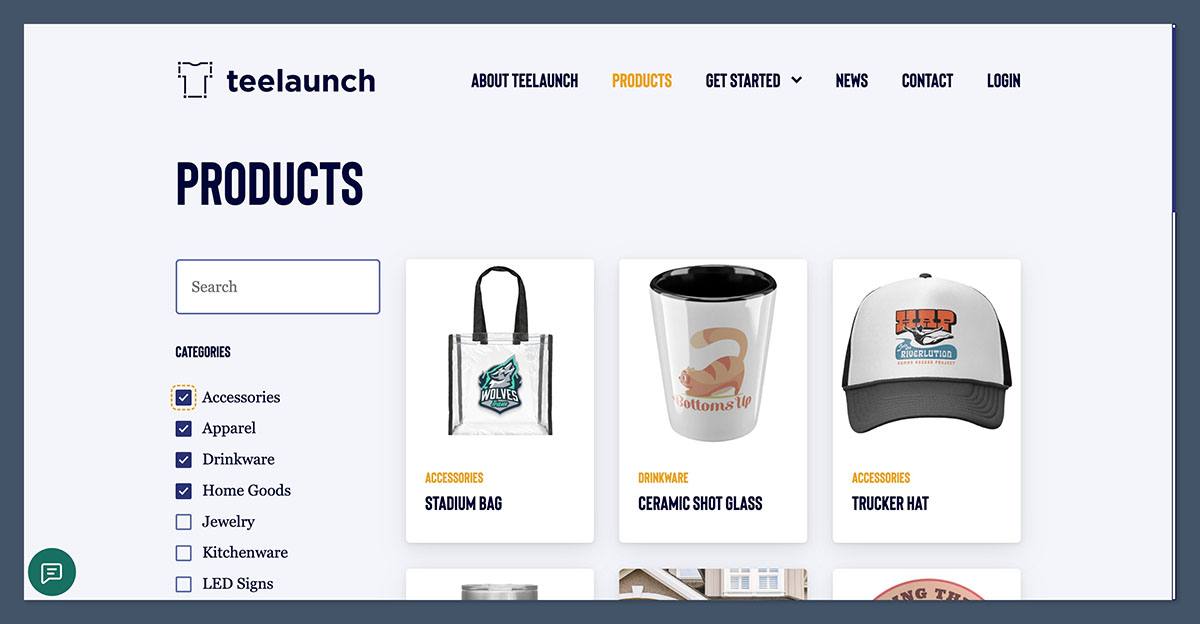
Catalog breadth is Teelaunch’s signature feature. You get all the POD staples, then a meaningful layer of items that most competitors do not carry, which is exactly what makes it useful as a way to differentiate a store.
- Apparel and basics: t-shirts, hoodies, sweatshirts, and other standard garments printed with methods like direct-to-garment and sublimation.
- Drinkware and home goods: mugs, tumblers, and a range of household items.
- Unusual and standout items: laser-cut metal signs, jewelry, pet products, and decor pieces produced through specialized partner facilities.
The metal signs are a good example of the catalog depth. They are produced as laser-cut steel in a dedicated facility and positioned as a premium product across multiple sizes, which is the kind of item that helps a store look less like every other POD shop.
The flip side is that each unusual product comes from a different facility with its own production and shipping behavior, which feeds directly into the reliability story.
Integrations and Sales Channels
Teelaunch is built Shopify-first, with support for several other channels layered on top. Here is how the main connections work.
Shopify
This is the home turf. You build products inside the app, push them to your store, and orders flow into Teelaunch automatically. The integration is smooth, and “set and forget” automation works well once your SKUs are configured correctly.
Etsy
Products pushed to Etsy land as draft listings for you to finalize, and Teelaunch documents Etsy-specific rules like maximum title length and no all-caps titles. The integration is mature, but it clearly sits a step below the Shopify experience in polish.
TikTok and other channels
Teelaunch documents shipping templates and free-shipping strategies for TikTok Shop, and it can be reached from WooCommerce and BigCommerce stores as well. For more complex multi-channel setups, some sellers route orders through third-party tools that connect multiple sales channels into Teelaunch.
Personalization and order control
Teelaunch supports personalized orders, letting customers add custom text or photos to certain products, and it offers ways to hold those orders for review before production. Combined with the default 24-hour buffer, this gives you more control over what actually gets printed than some “instant send” POD tools.
Shipping and Fulfillment
Teelaunch leans on a distributed production network and argues, reasonably, that shortening the distance between factory and customer is the simplest way to speed up delivery.
It supports a broad list of international destinations across North America, parts of South America, Europe, the Middle East, and select other regions, though that is “global” rather than truly everywhere.
The honest caveat is consistency. Because products are made at different facilities, production and shipping times vary by item. A seller offering one tightly curated product line tends to report smooth, predictable delivery.
A seller with a wide mixed catalog is more likely to see uneven timelines and the occasional problem order. International orders in particular can take noticeably longer, with some buyers reporting multi-week waits.
Customer Experience and Reliability
This is the section that should shape your decision, because the feedback genuinely splits in two.
The positive side
On the Shopify App Store, Teelaunch holds a rating of roughly 4.2 out of 5, with the large majority of merchants giving five stars. Recurring praise covers responsive customer service, a user-friendly app, smooth Shopify integration, and reliable fulfillment once products are set up.
Several long-term sellers describe years of use with very few customer complaints, and at least one merchant noted that earlier shipping and packaging problems on metal signs were fixed once Teelaunch switched fulfillment partners.
The negative side
Look beyond merchant reviews and the picture darkens. Trustpilot and a widely shared 2025 Reddit thread include serious complaints: orders that never arrived, confusion over tracking, slow or hard-to-reach customer service, and at least one account of a customer being asked to pay for shipping a second time to get a lost package re-sent.
Independent video reviews echo the theme, praising the unique products while flagging variable shipping and inconsistent quality across product types.
How to read the split
Part of this divergence is structural. Shopify App Store reviews come from merchants, often early in their relationship with the platform, while Trustpilot and Reddit capture longer-term and end-customer experiences, including the moments when something goes wrong.
The practical takeaway is not that Teelaunch is bad, but that it is inconsistent. It can be excellent for a specific seller and product line, and painful for another, so the burden is on you to test before you scale.
How Does Teelaunch Compare to Competitors?
Teelaunch sits in the mid-tier of POD providers. It is not the biggest name, and it competes mainly on catalog breadth and base cost rather than on polish or scale. Here is how it lines up against the better-known alternatives.
| Platform | Monthly fee | Catalog focus | Best for |
|---|---|---|---|
| Teelaunch | None, pay per order | Broad, with unusual items like metal signs | Differentiated catalogs on Shopify and Etsy |
| Printful | None (paid tiers optional) | Apparel-led, strong branding options | Brand-focused sellers wanting control and consistency |
| Printify | Free tier, paid Premium plan | Largest network, many supplier choices | Maximizing supplier and price flexibility |
| Gelato | Free tier, paid plans | Global local production, posters and apparel | International sellers prioritizing fast local delivery |
The pattern is clear. If your priority is rock-solid consistency and brand control, Printful is the safer pick. If you want the widest supplier choice, Printify wins on flexibility. If global delivery speed matters most, Gelato’s local production model is hard to beat. Teelaunch’s argument is catalog character and margin, which is a real advantage for the right seller.
How We Reviewed Teelaunch
To keep this review fair, we looked at Teelaunch from several angles rather than relying on a single source. The assessment combined hands-on time in the app, a review of Teelaunch’s official documentation on products, shipping, and policies, and a wide survey of independent feedback.
- Product and workflow: how products are built, listed, and fulfilled, including the order-approval buffer and sample process.
- Pricing: current base costs verified against the live catalog, plus the no-fee model and shipping structure.
- Reliability: merchant reviews on the Shopify App Store weighed against end-customer feedback on Trustpilot, Reddit, and independent video reviews.
- Fit: which sellers and product strategies the platform actually suits, and which it does not.
Final Verdict: Should You Use Teelaunch?
Teelaunch is a strong supplier for the right job and a risky one for the wrong job.
The no-fee model, competitive base costs, and unusually broad catalog make it a smart addition for experienced Shopify and Etsy sellers who want to stand out with products their competitors do not carry, and who are willing to order samples and run their own quality checks.
The reliability variance is real, though, and you should plan around it rather than hope it away.
The most sensible approach for most sellers is to use Teelaunch for the specific products where it shines, such as metal signs or particular decor items, while keeping a more consistent provider for core bestsellers.
Test a product line thoroughly before you put your brand’s reputation behind it, and the upside is there. Skip the testing and scale blindly, and Teelaunch is the kind of platform that can generate the complaints you read about online.
In short: an excellent side-catalog supplier and a capable primary one, as long as you go in with your eyes open and a sample order in hand.
Teelaunch FAQ
Does Teelaunch charge a monthly fee?
No. The app is free to install and there is no subscription to access the platform. You only pay when a customer places an order, and the charge is the base product cost plus shipping.
Is Teelaunch good for beginners?
It can be, but with caution. The app is easy to use and the no-fee model lowers the barrier to entry. The reliability variance, however, means beginners should start with a small, well-tested product line rather than launching a large mixed catalog they cannot quality-check.
What platforms does Teelaunch integrate with?
Teelaunch is built around Shopify and also connects with Etsy, WooCommerce, BigCommerce, and TikTok. The Shopify integration is the most polished, while the other channels work but feel more like add-ons.
Can I order samples from Teelaunch?
Yes. You can order a sample of any product before listing it, which is strongly recommended given the variance in quality and shipping across different fulfillment facilities. Samples are arranged by contacting customer service.
Why are Teelaunch reviews so mixed?
Merchant reviews on the Shopify App Store are largely positive, while end-customer reviews on Trustpilot and Reddit include more complaints about shipping and order handling. The two audiences capture different stages of the experience, which is why the platform looks excellent in some places and unreliable in others.
How does Teelaunch compare to Printful and Printify?
Printful tends to win on consistency and branding, and Printify on supplier and price flexibility. Teelaunch competes mainly on catalog breadth and base cost, with standout items like metal signs that the bigger names do not always offer.


