We’ve spent hours analyzing both platforms to bring you a clear, no-fluff recommendation.
Shopify and Payhip both let you sell online, but they’re built for very different sellers.
Shopify is a full-stack ecommerce platform built for product-based brands with complex needs. Payhip is a lean, creator-friendly storefront built for digital products, memberships, and coaching.
Picking the wrong one wastes time and money, so let’s break down exactly where each platform wins.
Shopify vs Payhip: Quick Verdict
- Shopify – Best overall for physical product brands, multichannel selling, and scaling stores
- Payhip – Best for solo creators selling digital downloads, courses, and memberships
In this comparison, I’ll walk through pricing, features, ease of use, and more to help you decide which platform fits your business.
Quick Comparison: Shopify vs Payhip
| Category | Shopify | Payhip |
|---|---|---|
| Starting price | $5/month (Starter) | $0/month (Free plan) |
| Transaction fees | 0% with Shopify Payments; up to 2% with third-party gateways | 5% on Free; 2% on Plus; 0% on Pro |
| Best for | Physical products, DTC, dropshipping, POD, multichannel | Digital downloads, courses, memberships, coaching |
| Digital product delivery | Requires app | Built-in |
| EU/UK VAT handling | Requires configuration or apps | Built-in, automatic |
| App ecosystem | 8,000+ apps | Limited |
| Free trial | 3-day free trial | Free plan available (no trial needed) |
| Scalability | Starter to enterprise (Shopify Plus) | Good for lean creator businesses |
Best for Pricing: Payhip
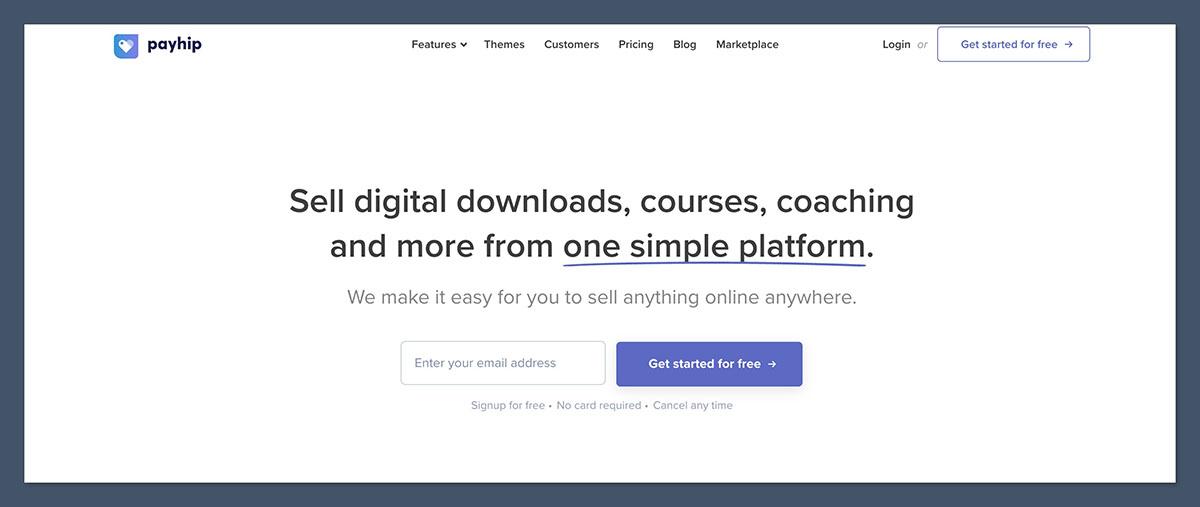
Payhip has one of the most accessible pricing structures in ecommerce. Its Free plan costs nothing and includes every feature the platform offers. The only difference between plans is the platform fee charged per sale.
| Platform | Plan | Monthly cost (annual billing) | Platform fee per sale |
|---|---|---|---|
| Payhip | Free | $0 | 5% |
| Payhip | Plus | $29 | 2% |
| Payhip | Pro | $99 | 0% |
| Shopify | Starter | $5 | N/A (link-based selling only) |
| Shopify | Basic | $29 | 2% with third-party gateways |
| Shopify | Grow | $79 | 1% with third-party gateways |
| Shopify | Advanced | $299 | 0.6% with third-party gateways |
| Shopify | Plus | From $2,300 | Negotiated; ~0.2% platform fee |
Payhip’s approach is straightforward: every feature is unlocked on every plan, and you only pay more to reduce your per-sale fee. This makes it genuinely appealing for creators who are just starting out and want to keep overhead at zero while they build an audience.
Shopify’s pricing is more layered. You pay a monthly subscription, processing fees through Shopify Payments, and additional transaction fees if you use a third-party payment gateway.
On the Basic plan, that’s 2.9% + $0.30 per transaction with Shopify Payments, dropping to 2.5% + $0.30 on Advanced. The costs add up quickly, especially for lower-volume stores.
For creators starting from scratch, Payhip’s free plan is hard to beat. For product-based brands with higher average order values and volume, Shopify’s structure becomes more cost-efficient over time, particularly with Shopify Payments and annual billing.
The Winner: Payhip
Payhip wins on pricing accessibility. A $0 entry point with all features included is genuinely rare in ecommerce. Shopify offers more infrastructure at higher tiers, but for lean creator businesses, Payhip’s model is the more affordable starting point.
Best for Selling Online: Shopify
When it comes to raw selling capability, Shopify is in a different league for most ecommerce use cases. It’s built to handle complex catalogs, multichannel distribution, and high-growth operations.
Product types and catalog
Shopify handles physical products exceptionally well. Inventory tracking, product variants, SKUs, collections (manual and automated), and shipping rules are all built in even on lower-tier plans.
It also supports dropshipping and print-on-demand through a wide range of app integrations.
Digital products are possible on Shopify, but you’ll need an app for automated file delivery, streaming, or course hosting. That’s an extra layer of setup and often an extra cost.
Payhip flips this completely. It has native support for eBooks, software, audio, video, and other file formats (up to several GB), with automatic delivery and download limits built in.
Online courses, coaching sessions, memberships, and subscriptions are all handled natively, no apps required. It can also sell physical products, but its inventory tools are far more basic than Shopify’s.
Multichannel selling
Shopify connects to Instagram, TikTok, Google, Amazon, and other marketplaces from a single backend. For brands that want their products visible across multiple channels simultaneously, this is a significant advantage.
Payhip is more of a “link-in-bio plus checkout” setup than a multichannel commerce engine.
Payments
Shopify supports over 100 payment methods including PayPal, Apple Pay, and Google Pay, plus its own native gateway, Shopify Payments, which eliminates the extra transaction fee.
Payhip processes payments through Stripe and PayPal only. Both are reliable options, but Shopify’s breadth gives it more flexibility for international and enterprise sellers.
App ecosystem
Shopify’s app market has over 8,000 integrations covering email marketing, subscriptions, loyalty programs, upsells, reviews, and automation. Payhip’s ecosystem is much smaller.
That said, Payhip does include affiliate management, discount coupons, and simple upsells natively, which means creators need fewer third-party tools to run basic marketing operations.
The Winner: Shopify
Shopify’s sales features are unmatched for product-based businesses. For digital creators, Payhip’s native tools close the gap considerably, but for anyone selling physical goods or across multiple channels, Shopify is the clear choice.
Best for Marketing: Shopify
Both platforms offer tools to help you promote your products, but they differ significantly in depth and flexibility.
Shopify’s marketing toolkit covers multichannel integrations (Instagram, TikTok, Google Shopping), a built-in email marketing feature, abandoned cart recovery, advanced discount and promotion options, and a large library of marketing apps for funnels, loyalty, and automation.
The Shopify x Semrush Ecommerce Booster app is also a notable addition for stores investing in SEO.
Payhip covers the essentials for creator marketing: discount coupons, a simple upsell feature, and a built-in affiliate program. The affiliate tool is particularly useful for creators who rely on their audience to spread the word, and it removes the need for a separate platform.
However, for email campaigns, social channel integrations, and more sophisticated promotions, you’ll need to connect external tools.
The Winner: Shopify
Shopify has more built-in marketing muscle and a far larger app ecosystem for growth-focused stores. Payhip’s affiliate program is a genuine advantage for creators, but it doesn’t close the overall gap.
Easiest to Use: Payhip
Shopify has invested heavily in its onboarding experience. When you sign up, it asks about your business stage and goals, then tailors a setup checklist to walk you through your first steps. The section-based editor is intuitive, and the product backend is well-organized.
That said, the sheer scale of Shopify’s feature set means there’s a real learning curve, particularly when exploring apps, shipping settings, and advanced configurations.
Payhip is noticeably faster to get started with. The platform is designed around simplicity: upload your product, connect a payment method, and you’re selling. There’s no theme market to navigate, no app decisions to make, and no complex settings to configure.
For creators who want to go from zero to selling in an afternoon, Payhip’s straightforward setup is a meaningful advantage.
The tradeoff is that Payhip’s simplicity is also a ceiling. You won’t find deep customization options, and the storefront editor is limited compared to what Shopify offers. For sellers who need control over design and site structure, that matters.
The Winner: Payhip
Payhip wins for speed and simplicity. Shopify’s onboarding is solid, but the platform’s breadth means more decisions to make. For creators who want a fast, low-friction setup, Payhip is the easier starting point.
Best for Design and Storefronts: Shopify
Shopify offers a theme-based storefront system with more than 190 templates across a wide range of industries. Themes are customizable through the Online Store editor, and the platform supports multi-page sites, blogs, and advanced section layouts.
Premium themes range from $100 to $500 as a one-time purchase. There are 13 free themes available, which is a limited selection for budget-focused sellers.
Payhip’s storefront editor uses basic templates suited to creator portfolio-style layouts with a product catalog. It’s clean and functional, but the design depth is significantly less than Shopify’s. Navigation, content structure, and layout customization are all more constrained.
For sellers whose primary goal is a polished brand experience, Shopify is the better fit.
The Winner: Shopify
Shopify’s template library and storefront editor are considerably more powerful. Payhip’s setup works well for creators who prioritize simplicity over visual customization.
Best for Taxes and Compliance: Payhip
This is one of the clearest wins in the comparison. Payhip has built-in EU VAT and UK VAT handling for digital products. It collects and remits VAT automatically, and provides tax reporting to keep you compliant. For EU or UK-based creators selling digital goods, this removes a significant administrative burden.
Shopify does offer automatic tax calculations in many regions, but EU VAT on digital products typically requires additional apps or manual configuration.
Advanced tax features improve on higher-tier plans and Plus, but for smaller sellers, getting EU VAT right on Shopify takes more setup work.
The Winner: Payhip
For digital sellers dealing with EU or UK VAT, Payhip’s automatic handling is a genuine time-saver. Shopify can be configured to handle it, but Payhip makes it effortless out of the box.
Best for Scalability: Shopify
Shopify is designed to grow with you. The platform scales from a first sale all the way up to Shopify Plus, which supports 200 inventory locations, multi-storefront management, B2B selling, and fully customizable checkout flows.
Its ecosystem of agencies, developers, and apps means you can build an increasingly sophisticated commerce operation without migrating platforms.
Payhip scales well in terms of revenue (all plans support unlimited products and no revenue caps), but it remains intentionally simple.
The feature set doesn’t change significantly between tiers, and the platform isn’t designed for complex, heavily customized operations. It’s an excellent tool for staying lean, but if your business grows into multichannel retail, physical inventory, or enterprise-level needs, you’ll likely outgrow it.
The Winner: Shopify
Shopify’s scalability from solo store to enterprise is one of its biggest strengths. Payhip is built for lean creator businesses and does that job well, but it’s not designed for the kind of growth that Shopify can support.
Best for Business Support: Shopify
Shopify offers 24/7 live chat support with escalation to a human advisor for complex issues. Phone support is available for Shopify Plus merchants. Its Help Center includes guides, video tutorials, a community forum, and business courses.
You can also reach Shopify via social media channels including X, Facebook, and Instagram. The main limitation is that priority support is reserved for Plus subscribers.
Payhip’s support offering is leaner. It covers email-based support and a help documentation library, but lacks the 24/7 live chat and phone access that Shopify provides.
For sellers who anticipate needing regular assistance, especially during setup or scaling, Shopify’s support infrastructure is more reassuring.
The Winner: Shopify
Shopify’s 24/7 live chat and comprehensive Help Center give it a clear edge. Payhip’s support is adequate for its target audience but doesn’t match Shopify’s availability or depth.
Shopify vs Payhip: Pros and Cons
Shopify pros
- Comprehensive toolset for physical and hybrid (online + in-person) retail, including advanced inventory, shipping, and POS
- Multichannel selling across social platforms and marketplaces, plus a massive app ecosystem
- Scales from starter to enterprise with Shopify Plus, including B2B and multi-storefront capabilities
- Strong analytics and reporting, improving with higher-tier plans
- Excellent 24/7 support and a large community of developers and agencies
Shopify cons
- Higher fixed monthly costs plus additional transaction fees if you don’t use Shopify Payments
- Digital products require apps to match Payhip’s native capabilities, adding complexity and cost
- Overkill for simple digital-only businesses that just need a checkout and a basic site
- EU VAT handling for digital products requires extra setup or third-party apps
Payhip pros
- Free plan with access to all features and no monthly commitment required
- Native support for digital delivery, courses, coaching, memberships, and subscriptions
- Built-in EU and UK VAT handling for digital products, automatic and effortless
- Affiliate management and simple marketing tools included without needing additional apps
- Fast, low-friction setup ideal for solo creators and side-project sellers
Payhip cons
- Far less capable for physical inventory, complex shipping, or large product catalogs
- Limited design flexibility and a much smaller app ecosystem compared to Shopify
- Not suited for multichannel commerce or brick-and-mortar retail
- Support options are more limited than Shopify’s 24/7 availability
How We Compared Shopify and Payhip
This comparison is based on hands-on analysis of both platforms across the following areas:
- Pricing and fees – Monthly plans, transaction fees, and overall cost at different revenue levels
- Sales features – Product types supported, payment options, multichannel capabilities, and built-in tools
- Marketing – Promotion tools, SEO features, affiliate management, and integrations
- Ease of use – Onboarding, setup speed, and day-to-day usability
- Design and storefronts – Template quality, customization options, and layout flexibility
- Taxes and compliance – VAT handling, regional tax tools, and reporting
- Scalability – Growth headroom, ecosystem depth, and enterprise capabilities
- Support – Availability, contact options, and self-service resources
Shopify vs Payhip: Our Final Verdict
These two platforms are solving different problems, and the right choice depends almost entirely on what you’re selling.
Choose Shopify if: you’re building a brand around physical products, dropshipping, or print-on-demand. You plan to sell across multiple channels and possibly in person. You want deep analytics, an extensible app stack, and the infrastructure to scale toward enterprise operations.
Choose Payhip if: you’re a solo creator selling digital assets, online courses, memberships, or coaching. You want EU and UK VAT handled automatically with no extra setup. You prefer a $0-to-start model, native digital delivery, and a simple setup that doesn’t require managing apps or configuring complex settings.
For product-based brands with growth ambitions, Shopify is the stronger long-term platform.
For digital creators who want to start lean and keep overhead low, Payhip offers a compelling set of native tools that Shopify can only match with additional apps and cost.
Shopify vs Payhip: FAQs
Is Payhip better than Shopify for selling digital products?
For most digital creators, yes. Payhip includes automatic file delivery, course hosting, memberships, and EU VAT handling out of the box. Shopify can handle digital products, but you’ll need third-party apps to match the same functionality, which adds cost and complexity.
Can I use Payhip for free?
Yes. Payhip’s Free plan has no monthly cost and includes all features. The only difference between plans is the platform fee per sale: 5% on Free, 2% on Plus ($29/month), and 0% on Pro ($99/month). Payment processor fees from Stripe or PayPal apply on top.
Does Shopify charge transaction fees?
Shopify does not charge additional transaction fees if you use Shopify Payments as your payment gateway. If you use a third-party gateway, fees range from 2% on Basic down to 0.6% on Advanced. Plus merchants can negotiate custom rates.
Which platform is easier to set up?
Payhip is considerably faster to set up for most creators. You can upload a product and start selling in a single session without making app, theme, or configuration decisions. Shopify’s onboarding is well-designed but the platform’s scope means more choices to work through before your store is live.
Can Payhip handle EU VAT automatically?
Yes. Payhip automatically collects and remits EU and UK VAT on digital product sales, which is a significant advantage for European creators who want to stay compliant without dealing with it manually. Shopify can handle EU VAT but requires additional setup or apps to achieve the same result.
Does Shopify work for digital products?
It can, but it’s not its primary strength. Shopify requires an app for automated digital file delivery, and course or membership functionality typically means adding and paying for a third-party integration. For sellers focused exclusively on digital products, Payhip is a more purpose-built option.


