Shopify and Instacart both live in the commerce space, but they couldn’t be more different. We’ve spent over 150 hours researching and analyzing both platforms to help you understand exactly what each one does, who it’s for, and which one fits your business.
Spoiler: comparing them isn’t really an apples-to-apples thing – it’s more like comparing the grocery store to the delivery truck.
Shopify is an ecommerce operating system for merchants who want to build, run, and scale their own online and offline stores.
Instacart is a consumer-facing grocery and retail marketplace built on logistics and retail media. Same universe, totally different planets.
In this comparison, I’ll break down how each platform works, who it serves, how they make money, and where each one actually makes sense for your business.
Shopify vs Instacart: Quick Verdict
Shopify – Best for merchants who want to own their storefront, customer data, and brand experience across every channel.
Instacart – Best for grocery retailers and CPG brands that want incremental demand, fast delivery infrastructure, and retail media monetization.
These platforms aren’t really competitors – they serve fundamentally different needs. But if you’re evaluating where to invest your time and money in ecommerce, understanding the differences matters.
Quick Comparison: Shopify vs Instacart
Get a quick and clear overview of how Shopify and Instacart stack up:
| Dimension | Shopify | Instacart |
|---|---|---|
| Core identity | Ecommerce platform and merchant operating system | Online grocery marketplace plus logistics and retail-media platform |
| Primary customer | Merchants (SMB to enterprise, DTC and B2B) | Consumers, grocery retailers, and CPG brands |
| Main revenue | Subscriptions, payments, transaction fees, apps/themes, logistics | Delivery/service fees, Instacart+ subscriptions, retail-media ads, retailer tech fees |
| Pricing | $29–$299/mo (Basic to Advanced); Shopify Plus for enterprise | Free for consumers; revenue from fees, ads, and retailer partnerships |
| Key moat | App/partner ecosystem, multi-channel tools, high switching costs | Local network effects, retailer relationships, first-party grocery purchase data |
| Growth levers 2024–26 | Enterprise/B2B, international, AI tools, headless commerce, logistics | Retail media expansion, Connected Stores, Instacart Business, international pilots |
| Geographic focus | Global; strong in North America, growing internationally | Primarily U.S. and Canada; early tests in Europe and Latin America |
Best for Business Model: It Depends on Who You Are
This is where Shopify and Instacart diverge most sharply. They make money in completely different ways because they serve completely different customers.
How Shopify Makes Money
Shopify’s revenue comes from two main buckets: subscription revenue and merchant services. The subscription side is straightforward – tiered plans ranging from $29 to $299 per month (billed annually), with Shopify Plus for enterprise and B2B merchants. It’s predictable recurring revenue with a clear upsell path.
But here’s the thing most people miss: merchant services are actually the bigger revenue driver now. That includes Shopify Payments (its native payment gateway), transaction fees, currency conversion, capital and loans, and POS hardware for in-person selling. Growth is increasingly coming from these value-added services rather than just basic subscriptions.
On top of that, Shopify earns a revenue share from its App Store and theme marketplace, where thousands of third-party developers sell integrations and customizations.
There’s also the partner program that brings in agencies and integrators who service merchants. And increasingly, AI tools for content generation, audience targeting, and store optimization are being embedded into higher-value plans.
How Instacart Makes Money
Instacart’s model is a three-sided marketplace connecting consumers, gig-economy shoppers, and retailers/brands. Revenue flows from multiple directions.
On the consumer side, there are delivery fees, service fees, and item markups. Instacart+ (formerly Express) is their subscription play – free or discounted delivery and reduced fees in exchange for recurring revenue. Think of it like Amazon Prime for groceries.
But the real profit engine? Retail media. Instacart sells sponsored product placements, shoppable ads, and targeted promotions to CPG brands and retailers.
This is now a major profit driver, and it’s where the high margins live. Revenue in 2025 is estimated above $3.3 billion, with gross margins near 75% – largely thanks to these ad products.
There’s also the B2B angle with Instacart Business, serving offices and businesses with procurement tools and expanded marketplace selection. Plus, revenue from technology fees and white-label fulfillment solutions (“Powered by Instacart”) and “Connected Stores” in-store tech sold to retailers.
The Winner Different models for different businessesShopify wins for merchants who want to own their commerce stack and scale a brand. Instacart wins for grocery retailers and CPG brands seeking demand, delivery infrastructure, and advertising reach. They’re not substitutes – they’re complementary. |
Best for Selling Online: Shopify
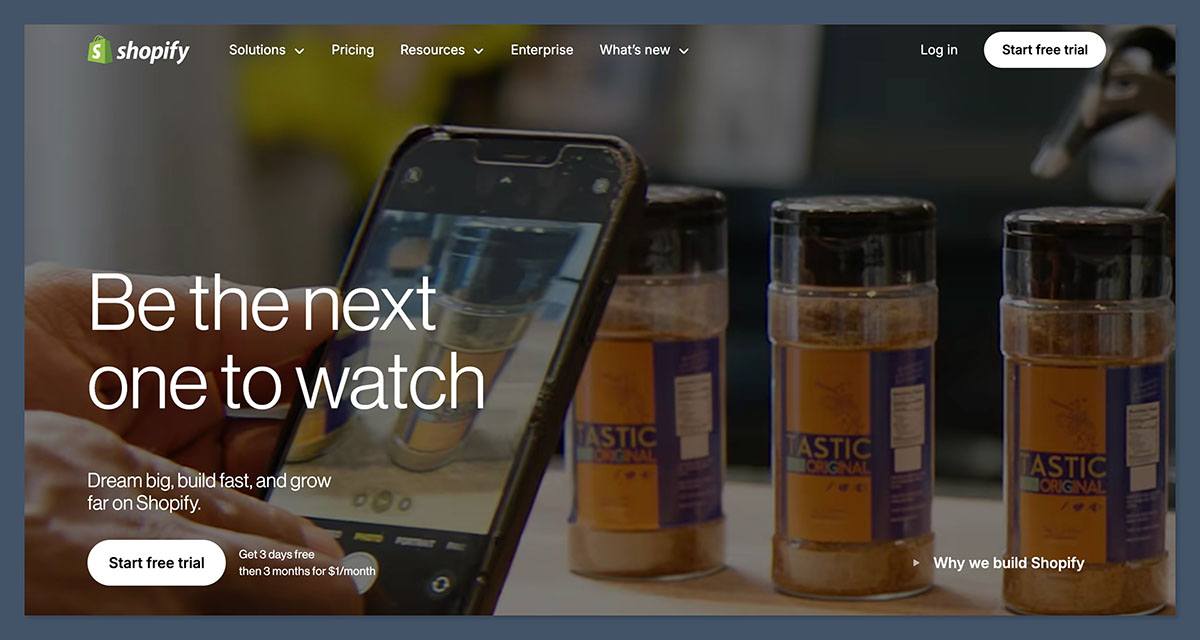
If you’re a brand or merchant who wants to own your storefront, customer data, and the entire shopping experience, Shopify is the clear winner. It was literally built for this.
Shopify’s Selling Stack
Shopify covers the full commerce lifecycle: storefront builder, product and inventory management, integrated payments, multi-channel publishing to social media and marketplaces, analytics, and POS for in-person sales.
The key here is that everything runs on a single backend, so your inventory, orders, and customer data stay synced no matter where someone buys from you.
The app market is massive – over 8,000 third-party integrations covering marketing automation, logistics, subscriptions, B2B, print-on-demand, and pretty much anything else you can think of. Shopify’s approach is app-heavy by design: the core platform handles the fundamentals, and you customize from there.
For more advanced brands, Shopify offers headless commerce via its Hydrogen framework and APIs, letting developers build fully custom frontends while still using Shopify’s backend. This is a real differentiator for enterprise brands that want total design control.
Instacart’s Selling Approach
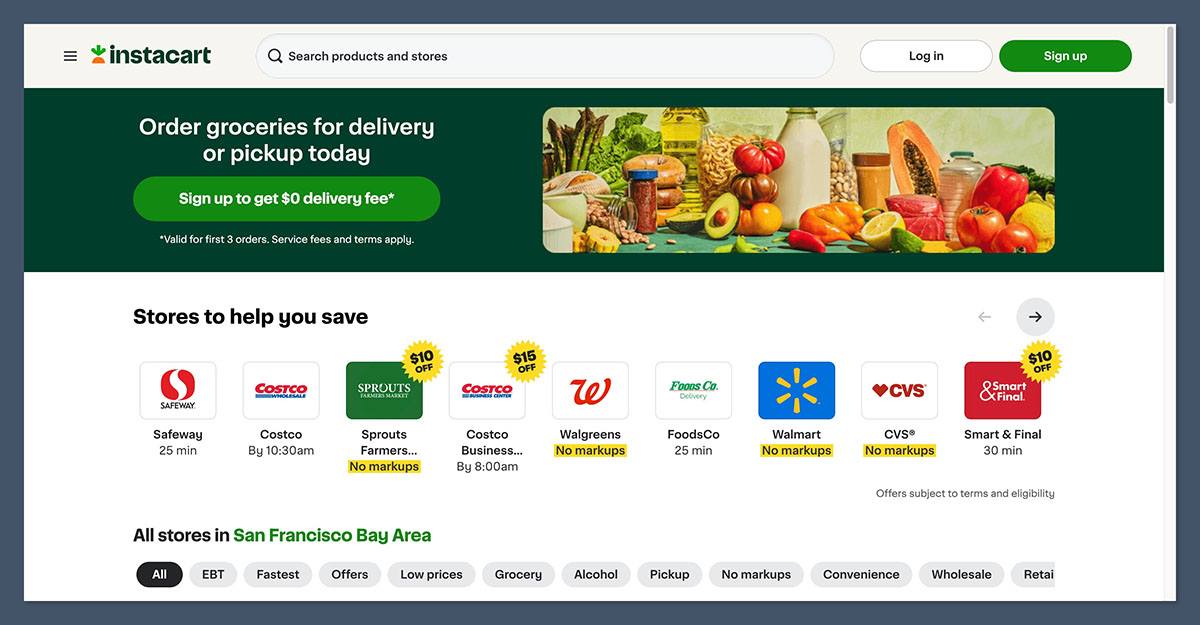
Instacart doesn’t give you a storefront. It gives you a marketplace listing. Consumers open the Instacart app, browse products from local retailers, and order for same-day delivery or pickup.
Retailers get demand and fulfillment without building their own delivery network – but they don’t own the customer relationship the way a Shopify merchant does.
The model is asset-light: Instacart doesn’t own inventory. Gig-economy shoppers pick items from retailer shelves and deliver them. Heavy logistics optimization – batching orders, route planning, dynamic pricing – is what makes the unit economics work.
For CPG brands specifically, Instacart’s value proposition is advertising: sponsored product placements that reach consumers at the exact moment they’re making grocery purchasing decisions. That first-party intent data is genuinely valuable.
The Winner Shopify gives you the tools to build and own your entire selling operation Shopify’s integrated commerce platform, massive app ecosystem, and multi-channel capabilities make it the strongest choice for merchants who want control. Instacart is better understood as a demand channel and delivery layer, not a storefront. |
Best for Marketing: Depends on Your Product
Shopify’s Marketing Toolkit
Shopify gives merchants a wide range of tools to promote their business. You can connect your store to social media platforms like Instagram and TikTok, sell across marketplaces like Amazon and Etsy via the Marketplace Connect app, and use Shopify Email to build and customize email marketing campaigns directly from your account.
On the SEO front, Shopify excels with standard features like sitemaps and image alt text, plus extras like the Ecommerce Booster app (built with Semrush) that creates actionable SEO plans. And the AI integration through Shopify Magic helps generate product descriptions, improve targeting through Shopify Audiences, and optimize store performance.
For international sellers, Shopify supports over 30 languages and can set up translated storefronts that automatically redirect customers based on their browser’s language. That’s a big deal if you’re targeting markets around the world.
Instacart’s Marketing Power
Instacart’s marketing story is completely different because the platform itself is the marketing channel. For CPG brands, Instacart’s retail media network offers sponsored products, shoppable video ads, in-cart recommendations, and targeted promotions. The advantage is timing: you’re reaching consumers when they’re actively shopping for groceries, not casually scrolling social media.
For retailers, Instacart provides demand generation by putting their inventory in front of the app’s dense user base. Co-marketing opportunities and the “Powered by Instacart” white-label fulfillment option let retailers benefit from the platform’s reach without fully outsourcing their brand presence.
The trade-off is control. On Shopify, you own every pixel of the experience and every data point. On Instacart, you’re marketing within someone else’s ecosystem.
The Winner Shopify for brand builders; Instacart for grocery-aisle visibility Shopify’s built-in tools and app ecosystem give merchants complete control over their marketing. Instacart’s retail media network is unmatched for reaching grocery shoppers at the point of purchase. |
Easiest to Use: Shopify
When it comes to getting started, Shopify has a clear edge in user-friendliness. The onboarding process is quick – you describe your business, pick where you want to sell, and you’re in.
From the dashboard, there’s a setup checklist that walks you through adding products, designing your site, and configuring settings step by step.
Shopify’s section-based editor keeps things simple for store design. You’re stacking pre-built elements like image carousels, product grids, and contact forms. It’s not drag-and-drop, but it’s straightforward and gets the job done without overwhelming you.
Instacart, on the other hand, isn’t something you “set up” in the same way. As a consumer, the app experience is polished – download, enter your address, start shopping.
As a retailer or brand looking to get on the platform, the process involves partnership agreements, integration work, catalog setup, and ongoing management of your presence within Instacart’s ecosystem. It’s not a self-serve website builder situation.
For CPG advertisers, Instacart’s ad platform has its own learning curve around campaign setup, bidding strategies, and performance optimization. It’s more akin to learning Google Ads or Amazon’s ad console than setting up a store.
The Winner Shopify’s simple setup makes it accessible for anyone Shopify keeps things straightforward with a quick onboarding process, a clean editor, and a robust product backend. Instacart’s value comes from a different kind of platform relationship entirely. |
Best for Growth and Scale: Both Excel Differently
Shopify’s Growth Path
Shopify’s strategic pillars for 2024–2026 are all about expanding its addressable market: enterprise and B2B (Shopify Plus with dedicated B2B features and headless commerce), international expansion (GMV growth outside North America is significantly outpacing core markets), and AI integration positioned as a lever to increase revenue per merchant and stickiness.
The platform continues to be recognized as one of the leading ecommerce solutions globally for both SMBs and high-growth brands.
Growth is increasingly being driven by merchant services – payments, capital, logistics – rather than just basic subscriptions, which is a healthier and stickier revenue mix.
Instacart’s Growth Path
Instacart’s trajectory is fascinating. The company hit estimated revenue above $3.3 billion in 2025, growing around 11% year-over-year. Net income in Q2 2025 was approximately $116 million, up roughly 92% from the prior year.
That profitability pivot is powered largely by high-margin retail media products and operational efficiency improvements.
The growth playbook includes: retail media 2.0 with shoppable video ads and in-cart recommendations; Connected Stores technology (smart carts, scan-and-go, AI-driven pricing) to bind retailers more tightly; international expansion pilots in Europe and Latin America; and Instacart Business for B2B procurement.
Instacart’s valuation sits around $9 billion in 2025, with durable but competitive market leadership in online grocery across the U.S. and Canada.
The Winner Both platforms have strong growth trajectories, just in different directionsShopify scales with its merchants through deeper monetization and global reach. Instacart scales through retail media, retailer technology, and geographic expansion. |
Competitive Position and Challenges
Shopify Pros
✔️ Massive app and partner ecosystem creates high switching costs and near-infinite customization
✔️ Default choice for many new DTC brands; increasingly credible for enterprise and B2B via Shopify Plus
✔️ Full commerce lifecycle coverage: storefront, payments, marketing, logistics, and analytics in one stack
✔️ Headless architecture (Hydrogen) and AI tooling attract sophisticated brands and developers
Shopify Cons
❌ Competition from marketplaces and tech giants (Amazon, Etsy, TikTok Shop) for merchant attention
❌ Balancing ecosystem interests – third-party apps sometimes conflict with in-house feature rollouts
❌ Macro impacts on retail spend can affect merchant growth and, by extension, Shopify’s take rate
Instacart Pros
✔️ Dense network effects in North America: user base, retailer coverage, and shopper supply create a strong local marketplace moat
✔️ Deep integrations with major grocery chains – increasingly a tech partner, not just a delivery layer
✔️ First-party grocery purchase intent data is uniquely valuable for CPG advertisers
✔️ Technical differentiation in routing, batching, and in-store tech (smart carts, Connected Stores) is hard to replicate
Instacart Cons
❌ Competitive pressure from retailers’ own apps, Amazon, DoorDash, Uber, and local delivery players
❌ Regulatory and cost risks from gig-economy labor models remain an ongoing concern
❌ Advertising budgets can be cyclical, which directly impacts the retail-media revenue engine
Who Should Use Which: Shopify vs Instacart
Choose Shopify When:
- You’re a brand or merchant who wants to own your storefront, data, and customer relationships
- You need multi-channel selling, global reach, and deep customization through apps or headless builds
- You care about long-term brand equity more than short-term marketplace demand
- You’re a solo founder launching your first store or an enterprise scaling to $100M+ — Shopify’s tiered plans and ecosystem can grow with you
Choose Instacart When:
- You’re a grocery or retail chain seeking incremental demand, fast fulfillment, and retail-media monetization without building your own delivery network
- You’re a CPG brand aiming to capture high-intent grocery shoppers through targeted ads and promotions at the point of purchase
- You want a channel and technology partner, not a platform to build your brand from scratch
Shopify vs Instacart: Our Verdict
Here’s the honest answer: you probably don’t need to choose between them. Shopify and Instacart solve fundamentally different problems.
Shopify is the best ecommerce platform for merchants who want to build, own, and scale their online business. Its sales features, app ecosystem, multi-channel capabilities, and growing enterprise tools make it the go-to for anyone who needs a storefront and a commerce operating system.
If you’re selling products and want to control the experience, Shopify is where you start.
Instacart is the leading online grocery marketplace in North America, and its evolution into a retail-media and technology platform makes it essential for grocery retailers and CPG brands.
If you’re in the grocery and essentials space and want to reach consumers where they’re already shopping, Instacart delivers that – literally.
The real takeaway is that these represent two very different definitions of ecommerce success: a “software-first” approach where you own everything (Shopify), and a “logistics-and-media-first” approach where you tap into existing infrastructure and demand (Instacart).
Understanding which model fits your business is the actual decision worth making.


