Product reviews are a key part of growing your ecommerce store. They influence purchasing decisions, build trust, and drive conversions.
But when it comes to choosing the right platform to collect and manage those reviews, it can be hard to tell which tool is the better fit.
Yotpo and PowerReviews are two of the most recognized names in the space.
I’ve researched and tested both extensively, and in this guide, I’ll walk you through where each platform excels, where they fall short, and which one is better for your business goals.
Quick Verdict: Yotpo vs PowerReviews
Yotpo: Best for fast-growing Shopify or DTC brands that want a self-serve setup with built-in loyalty and referral tools
PowerReviews: Best for large ecommerce or omnichannel retailers that need high-volume review syndication and deep UGC distribution
Now let’s break down exactly how they compare across setup speed, pricing, syndication, conversion tools, integrations, and more.
Quick Comparison Table
Here’s a quick overview of how Yotpo and PowerReviews compare at a glance:
| Feature | Yotpo | PowerReviews |
|---|---|---|
| Best for | Shopify & DTC brands | Enterprise retailers & marketplaces |
| Setup Style | Self-serve | Services-led |
| Syndication Reach | Limited | Extensive |
| Pricing Transparency | Published pricing on Shopify | Custom pricing only |
| Retention Features | Loyalty, referrals, SMS | None |
| Review Collection Tools | Smart Prompts, AI summaries | Sampling campaigns, deep analytics |
| Integration Support | 100+ integrations | Deep with enterprise platforms |
| Starting Price | Free to $29/month (Shopify) | Custom, often $1,000+/month |
Getting Set Up: Yotpo is Quicker to Launch
When it comes to getting started, the difference between these two platforms is pretty clear.
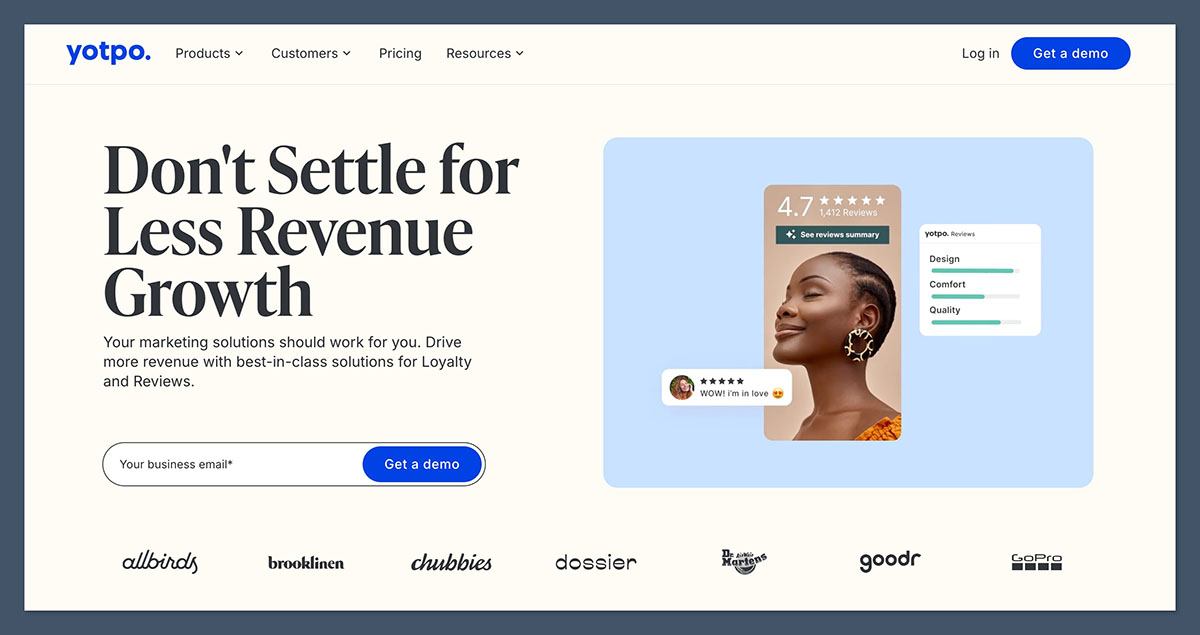
Yotpo is plug-and-play, especially for Shopify merchants.
You can install it from the Shopify App Store and begin collecting reviews in under an hour. It’s built to be self-serve, with no mandatory sales calls or onboarding requirements unless you want them. Most setup tasks can be done from the dashboard.
You’ll be able to:
- Customize review request emails and submission forms
- Install display widgets with no code
- Use one-click integrations with apps like Klaviyo and Gorgias
PowerReviews takes a more enterprise approach.
Setup usually involves consultation, onboarding meetings, and either a custom dev integration or assistance from the PowerReviews team. There’s no free plan, and everything starts with a sales conversation.
If you’re running a lean ecommerce team and need speed, Yotpo will help you go live much faster.
If you’re investing in a broader UGC strategy across multiple channels and marketplaces, the extra setup time with PowerReviews might be worth it.
Syndication: PowerReviews Has More Reach
One of PowerReviews’ standout features is its syndication network. If your products are sold on other retail websites, this matters a lot.
PowerReviews connects your reviews with a network of over 150 major retailers, including Walmart, Best Buy, Target, and more.
It also supports advanced content matching techniques, which means it can accurately pair reviews even when SKUs or UPCs differ.
Key syndication benefits with PowerReviews:
- Wider reach across retailers and marketplaces
- Higher likelihood of reviews being reused across platforms
- Retailer-specific moderation to meet compliance standards
Yotpo does support syndication but with limitations.
It’s more focused on improving your own site’s conversion rate rather than distributing content to external retail sites. Syndication is available with higher-tier plans, but it’s not the core value proposition.
If you’re a DTC brand selling mostly on your own site, Yotpo’s lighter syndication will be fine. If you rely heavily on third-party retail sales, PowerReviews is the better option here.
Pricing: Yotpo is More Transparent and Budget-Friendly
The two platforms take very different approaches to pricing, and your choice here will likely come down to your business size and budget.
Yotpo has a free plan available through the Shopify App Store, and paid plans start as low as $15 to $29/month.
Pricing is based on your order volume, and you can upgrade as you grow. For larger stores, Yotpo also offers custom pricing for its full platform, which includes advanced reviews, loyalty, SMS, and more.
Yotpo’s Shopify App Store pricing tiers:
| Plan Name | Monthly Cost | Key Features |
|---|---|---|
| Free Plan | $0 | Basic review collection and display |
| Growth Plan | $15–$29 | Rich review widgets, photo reviews, AI tools |
| Enterprise Plan | Custom pricing | Syndication, advanced moderation, loyalty |
PowerReviews does not publish pricing. Most customer reviews and third-party sources describe their plans as starting around $1,000/month, often increasing based on catalog size and feature needs.
This means:
- You’ll need to go through a sales process to get a quote
- There are no free or low-cost entry plans
- It’s best suited for brands with larger budgets and custom requirements
If cost and flexibility are important, Yotpo is the more accessible choice. PowerReviews is better suited for teams with established budgets and longer buying cycles.
Review Collection: Yotpo is More Automated, PowerReviews Offers More Depth
Both platforms offer strong review collection features, but they do it in different ways.
Yotpo is designed to make the process seamless and efficient.
It uses tools like Smart Prompts to guide customers toward writing more useful reviews. Its submission flow feels more like replying to a message, which increases response rates.
Yotpo also includes:
- AI-generated summaries of reviews
- Photo and video uploads
- Review request automation by email or SMS
PowerReviews focuses more on customization and data depth.
Its platform supports complex review collection strategies like sampling programs, split testing of email content, and analytics to track collection performance across multiple sources.
PowerReviews tools include:
- Custom email templates
- Advanced moderation and approval workflows
- Review tagging and classification
- Collection from multiple channels including retailers
If you want automation and simplicity, Yotpo’s workflow is ideal. If you need to run campaigns across different touchpoints or improve review quality across thousands of SKUs, PowerReviews has the edge.
Display Features and Onsite Conversion Tools
Your reviews are only useful if customers can easily see and trust them. Both platforms offer customizable display options, but their focus differs.
Yotpo offers sleek, Shopify-ready display widgets that are easy to configure without a developer.
It also supports media galleries, filtering, star ratings, and Q&A sections. More advanced plans come with features like:
- Rich snippets for SEO
- AI-powered summaries of reviews
- UGC carousels for homepages or collection pages
PowerReviews provides more control for enterprise retailers managing large catalogs.
It supports product-level tagging, review highlighting, video reviews, and deeper customization via APIs.
PowerReviews offers:
- Syndicated content display alongside native reviews
- Advanced filters and sorting by keywords
- Q&A modules with moderation
- Dynamic content based on product attributes
For fast-growing Shopify stores, Yotpo offers more than enough. If you’re running a large catalog and want granular control over how content displays, PowerReviews offers more enterprise-grade options.
Integrations: Yotpo Has Broader App Ecosystem
Integrations are another area where your platform choice can have long-term impact.
Yotpo integrates with over 100 ecommerce apps and platforms. Its Shopify integration is especially strong, but it also connects easily with tools like:
- Klaviyo
- Gorgias
- Attentive
- ReCharge
- Zendesk
- Meta and Google Ads
Setup is usually fast, with plug-and-play options available for most tools.
PowerReviews integrates with platforms like Salesforce Commerce Cloud, Magento, and Shopify, but these usually require more technical implementation. It also has strong API documentation for custom integrations.
PowerReviews is a better fit if you’re working with a legacy or custom ecommerce stack. For DTC brands using modern tools, Yotpo will integrate faster and with less effort.
Final Thoughts: Which Platform Is Right for You?
Both Yotpo and PowerReviews are strong tools, but they’re built for different types of ecommerce businesses.
Choose Yotpo if:
- You’re a Shopify or BigCommerce store that wants fast setup
- You want a free or low-cost entry point
- You’re focused on growing your own site’s conversions
- You plan to expand into loyalty, referrals, or SMS down the line
Choose PowerReviews if:
- You sell through large retailers and need robust syndication
- You have a large catalog with complex review needs
- You have an in-house team or agency for setup and customization
- You’re managing reviews at scale across multiple marketplaces
While Yotpo is easier to get started with, PowerReviews can deliver bigger long-term value if you’re managing reviews at a national or global retail scale.


