I’d start with Yotpo Reviews Free or Starter unless you already know which advanced feature you need. Paying for Pro, Loyalty, and a bundle before you have a clear use for them is an easy way to overspend.
The complication with Yotpo pricing is that the plan name only tells you part of the cost. You also need to choose the product, match its allowance to your monthly orders, and check the billing terms.
A $15 starting price and an $89 quote can both be correct for Reviews Starter. They just don’t describe the same order allowance.
Here’s how I’d separate those decisions, budget for growth, and choose a plan without paying for capabilities you won’t use.
60 Second Summary
- Reviews Free: $0, with review requests for 50 orders per month. A sensible starting point for a small store building its review collection.
- Reviews Starter: Starts at $15/month on Shopify, or $144/year at the starting tier. At the website’s displayed 500-order allowance, it costs $89/month.
- Reviews Pro: Starts at $119/month on Shopify, or $1,068/year at the starting tier. The displayed 500-order package costs $169/month.
- Reviews Premium and Enterprise: Custom quotes for requirements such as syndication, dedicated support, and more complex integrations.
- Loyalty Free: Basic points and referrals, limited on Shopify to stores with fewer than 100 monthly orders.
- Loyalty Pro: $199/month including 500 orders, with usage charges above that allowance. Premium and Enterprise require quotes.
- Reviews + Loyalty bundle: The Pro card displays $368/month. Get an exact-volume quote rather than assuming bundling creates a discount.
- Discover: Separately quoted AI-search visibility software, not an included bundle benefit.
- SMS and Email: Retired as standalone products, not current purchasing options. Reviews request emails are separate.
My starting recommendation: choose Reviews Free if its allowance fits, or Starter if you need visual reviews and more control over presentation. Add the other products when they solve a specific problem.
How Much Does Yotpo Cost?
Yotpo does not have one subscription that automatically includes everything. Its product pricing separates Reviews, Loyalty and Referrals, their bundle, and Discover.
All prices below are in US dollars, current as of October 2026. For Reviews and Loyalty, order volume matters alongside the feature tier.
| Product | Public pricing | Allowance or condition | Best fit |
|---|---|---|---|
| Reviews Free | $0 | Requests for 50 orders/month | Small stores starting review collection |
| Reviews Starter | From $15/month on Shopify; $89/month at the displayed 500-order allowance | Price scales with order volume | Branded review displays and customer photos/videos |
| Reviews Pro | From $119/month on Shopify; $169/month at the displayed 500-order allowance | Price scales with order volume | More detailed collection and review presentation |
| Reviews Premium / Enterprise | Custom quote | Confirm volume and scope | Complex review programs |
| Loyalty Free | $0 | Shopify stores with fewer than 100 monthly orders | Basic points and referrals |
| Loyalty Pro | $199/month | Includes 500 orders; extra usage charges apply | More developed rewards programs |
| Loyalty Premium / Enterprise | Custom quote | Confirm scope and usage | VIP programs and larger operations |
| Reviews + Loyalty Pro bundle | Displayed at $368/month | Exact-volume quote needed | Stores that need both products |
| Discover | Custom quote | Catalog, markets, and optimization scope | AI-search visibility work |
The difference between $15 and $89 for Starter comes down to volume. The Shopify Reviews listing shows starting prices, while the Reviews pricing page displays $89 for Starter and $169 for Pro at 500 orders.
Annual starting prices are another separate comparison: $144/year for Starter equals $12/month, and $1,068/year for Pro equals $89/month, paid annually. Neither annual starting price is a 500-order quote.
Before comparing features, enter your estimated monthly orders under Account Settings > Billing. That gives you a more useful budget than the lowest advertised price.
Yotpo Reviews Pricing Plans: The Details, and Which to Pick
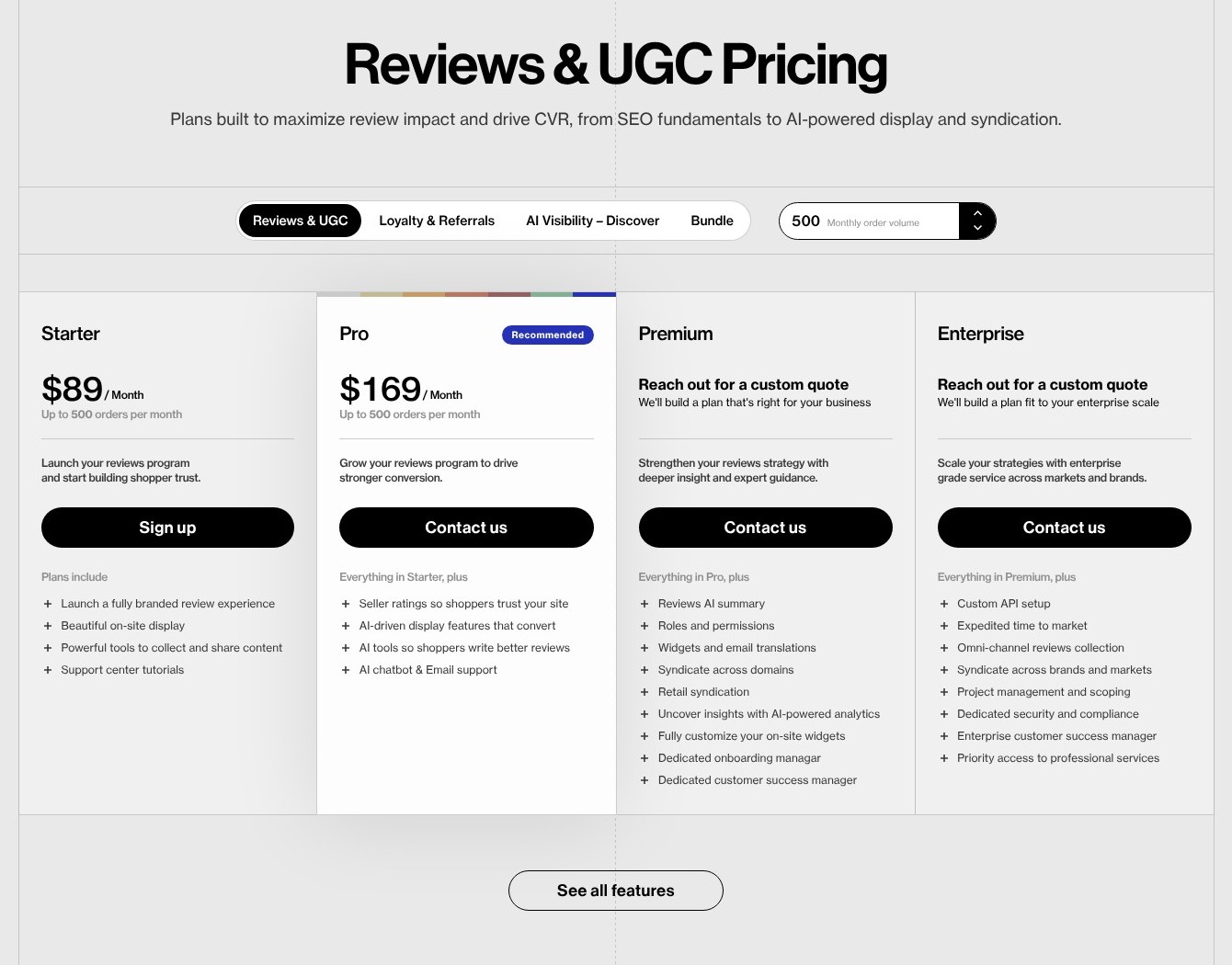
Starter is the paid plan I’d consider first. Pro becomes more compelling when you need richer customer answers or better ways to organize an established review collection.
Here’s the practical comparison before getting into each plan.
| Feature or price | Free | Starter | Pro |
|---|---|---|---|
| Monthly starting price on Shopify | $0 | From $15 | From $119 |
| Annual starting price on Shopify | Not applicable | $144/year | $1,068/year |
| Displayed price at 500 orders/month | Not a 500-order plan | $89/month | $169/month |
| Main collection allowance | Requests for 50 orders/month | Depends on purchased volume | Depends on purchased volume |
| Photo and video reviews | Not included | Included | Included |
| Yotpo branding removal | Not included | Included | Included |
| Rich snippets | Not included | Included | Included |
| Custom questions | Not included | Not included | Included |
| AI summaries and smart sorting | Not included | Not included | Included; see qualification below |
| Optional Reviews Booster | Not available | Available | Available |
AI summaries appear under Pro in the Reviews comparison and Shopify listing, but also feature on the Premium card. Confirm inclusion if they are your main reason to upgrade.
Free: $0 for Starting Your Review Collection
Reviews Free is a reasonable choice when your store is still small enough for its 50-order monthly allowance. You don’t need a paid plan simply because reviews matter to your business.
The Free and Starter limits distinguish between orders and outgoing messages:
- Review requests covering 50 orders per month on Free.
- Up to 500 outgoing emails, including reminders and messages covering multiple products.
- 200 first-month Kickstart Credits for new accounts.
These are different counters. A 50-order allowance does not mean you can publish only 50 reviews, and 500 outgoing emails does not mean you can request reviews from 500 separate orders.
That distinction matters when planning collection. An order can lead to more than one message, while a request does not guarantee that a customer will submit a review.
I would also budget around the recurring allowance, not the first-month credits. A temporary head start is useful, but it doesn’t tell you whether Free will accommodate normal trading.
Who I Would Recommend This Plan For
Choose Free if you’re launching a store, receive no more than 50 monthly orders, and want to establish a basic review-request routine.
Stay there while the allowance and presentation options meet your needs. If you’re consistently exceeding the limit, the problem is collection coverage, not whether your business is “big enough” for a paid badge.
Starter: From $15 per Month, With Volume-Based Pricing
Starter is the more practical option when you want customer photos and videos or a cleaner branded presentation without paying for Pro’s extra collection tools.
Its main additions include:
- Photo and video reviews for visual customer feedback.
- Yotpo branding removal for a less vendor-branded display.
- Rich snippets to support review information in search results.
- Up to 2,000 outgoing emails, subject to the package’s separate order allowance.
- Access to optional Reviews Booster for paid extra orders.
Rich snippets are a capability, not a promise that search engines will display stars for every product. Likewise, enabling photo reviews doesn’t guarantee customers will supply them.
For a store with a 500-order monthly requirement, the displayed Starter price is $89/month. That is the figure to compare with the $169 Pro package at the same allowance, rather than comparing a starting-tier Starter price with a larger Pro package.
Annual billing can reduce the starting-tier cost. Illustrative starting-tier comparison: 12 payments of $15 total $180, versus $144 paid annually, a $36 difference. That calculation does not establish the annual price for your store’s volume.
Who I Would Recommend This Plan For
I’d choose Starter for a small or growing store that wants visual customer content and branding control but has no immediate need for custom questions.
It is also worth considering when you outgrow Free. Compare the appropriate Starter allowance with your expected orders first, then decide whether any Pro-only feature deserves the additional spend.
Pro: From $119 per Month, With Volume-Based Pricing
Pro makes more sense when the challenge has moved beyond collecting basic reviews. You might need more structured answers, or customers may need help finding useful information within a larger review collection.
The main additions are:
- Custom questions to collect more specific product feedback.
- AI summaries to condense review feedback.
- Smart sorting to organize the reviews shoppers see.
- Google Seller Ratings, listed in the Shopify Pro package.
Custom questions are particularly useful when generic star ratings leave important buying questions unanswered. As an illustrative use case, a clothing store might want more structured feedback about fit rather than relying entirely on open-ended comments.
At 500 monthly orders, Pro costs $80/month more than Starter. I wouldn’t pay that difference merely because Pro sounds more suitable for a growing brand.
Who I Would Recommend This Plan For
Choose Pro when you can name the questions you want to ask or the review-display problem you need to solve.
Starter can remain the better purchase for an established store with straightforward needs. More orders may justify a larger allowance without justifying a higher feature tier.
What About Yotpo Premium and Enterprise?
Premium and Enterprise are worth discussing when a specific operational requirement takes you beyond Pro. They are not automatic destinations for every successful store.
Both higher Reviews tiers require custom quotes. There is no published universal starting fee to use as a reliable budget.
The reasons to open a sales conversation include:
- Premium: Cross-domain review syndication and dedicated support.
- Enterprise: Custom API requirements and cross-market services.
- Either custom package: A combination of volume, service, and implementation requirements that needs a written scope.
Syndication distributes review content beyond the original storefront. Identify the destinations you need and ask whether the quote covers them. Retail syndication can be an add-on, so don’t assume every connection is included.
For an API requirement, bring a description of the data you need to move and the systems involved. “Custom integration” is too broad to establish what you’re buying.
I’d ask for an itemized proposal separating the subscription from any implementation or service work. Also get the included order allowance, usage charges, renewal terms, and support commitments in writing.
The useful test is whether a lower plan prevents you from doing something necessary. If you cannot identify that limitation, you probably do not need a custom package yet.
Dedicated support may still have value for a team running a complicated program. But it should solve a support or operational need, not substitute for features you will never use.
Other Yotpo Costs to Consider
Your subscription is only part of the budget. The most predictable extras come from order growth, while loyalty rewards and implementation belong in separate spending categories.
- Reviews order growth: Starter and Pro can use Reviews Booster to handle extra orders. Rates depend on the plan. An illustrative Starter 50 calculation uses $0.20 per extra order: 60 orders would cost $15 + $2 = $17. That is not a universal overage rate.
- Loyalty usage: Pro includes 500 orders, then adds usage charges. A busier month can therefore increase the software bill even if you make no feature changes.
- Rewards funded by your store: Discounts and other rewards reduce what you retain from sales. They are not Yotpo subscription fees, but they still belong in your loyalty budget.
- Implementation spending: Budget separately for any outside help with setup or migration. Non-Shopify platforms may incur implementation and maintenance fees; ask what applies to your storefront.
- Billing and contract terms: Stopping use does not necessarily stop charges. The billing FAQ ties charges to the subscription end date on the latest paid invoice. It also describes annual downgrade requests up to 30 days before the billing-cycle end, so verify your renewal deadline.
For a temporary Reviews spike, Booster can be more practical than changing the base package. You can cap additional orders and pay for those used.
Enable it under Account Settings > Billing > Edit > Enable Reviews Booster, set the maximum additional orders, and approve the subscription in Shopify if applicable. Do this before exceeding the allowance: activating Booster later does not backfill missed requests.
Some packages bill around automatic review-request emails rather than the public order-based structure. If your invoice count looks wrong, ask for a reconciliation before assuming it equals storefront orders.
Finally, Yotpo retired its standalone Email and SMS products on December 31, 2025. Historical marketing email and SMS price lists are not current buying options. Review-request emails within Reviews were not discontinued by that change.
Yotpo Loyalty and Referrals Pricing Plans
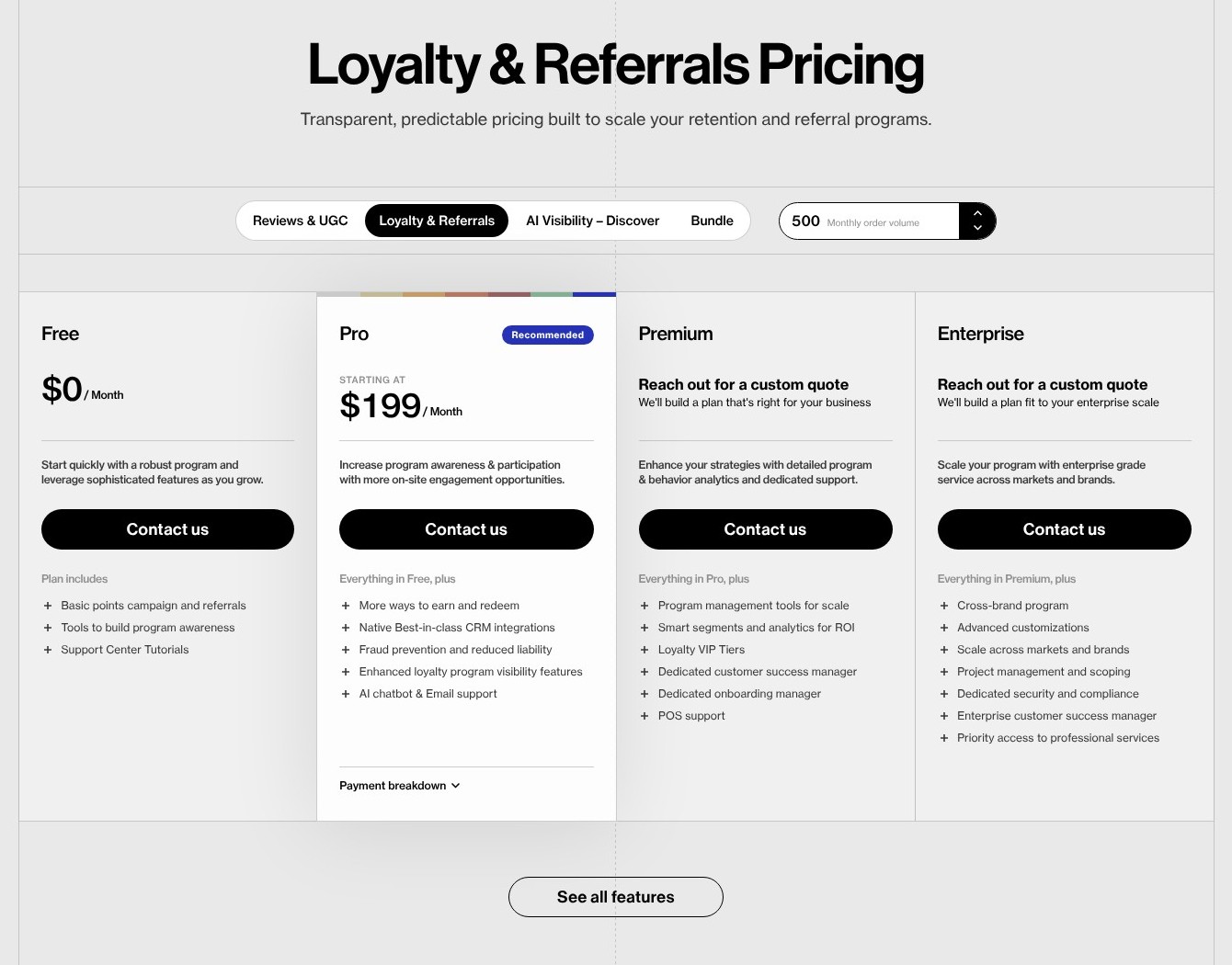
Loyalty is a separate purchase, and its economics deserve a separate decision. I’d add it when you have a clear reason for customers to buy again, not simply because it pairs with Reviews.
| Loyalty plan | Published price | Volume condition | Main fit |
|---|---|---|---|
| Free | $0 | Shopify stores with fewer than 100 monthly orders | Basic points and referrals |
| Pro | $199/month | Includes 500 orders; additional usage charges apply | More earning and redemption options |
| Premium | Custom quote | Confirm allowance and usage | VIP tiers and dedicated guidance |
| Enterprise | Custom quote | Account-specific scope | Larger or more complex programs |
The Free threshold is explicit in the Shopify Loyalty listing. A store at exactly 100 monthly orders should not budget on qualifying for “fewer than 100.”
Free: Basic Points and Referrals
Free gives a very small store a way to start with:
- Basic points.
- Referral rewards.
I’d use it to establish a simple offer customers can understand. Before adding more reward rules, work out what a redemption costs your store and whether the resulting order remains profitable.
Free software does not make the rewards themselves free. Its Shopify order threshold also means it is not a permanent no-cost option for a growing store.
Pro: $199 per Month, Plus Usage
Pro adds more ways to build the program, including:
- Birthday and anniversary rewards alongside purchase points.
- Flexible point redemption rather than only preset discounts.
- A customizable rewards page to explain and promote the program.
The subscription includes 500 orders. For budgeting, the website’s published usage schedule applies marginal rates to additional orders:
| Monthly order bracket | Website usage rate |
|---|---|
| First 500 orders | Included in $199/month |
| Orders 501 to 1,000 | $0.20 per additional order |
| Orders 1,001 to 3,000 | $0.10 per additional order |
| Orders 3,001 to 10,000 | $0.05 per additional order |
Illustrative totals using that website schedule: 1,000 monthly orders cost $299; 2,000 cost $399; and 5,000 cost $599. Each bracket applies only to orders within it.
The Shopify listing instead summarizes usage at $0.08 to $0.20 per order and directs stores above 5,000 orders to full pricing. Confirm your account-specific rate before committing. The website model is useful for planning, not a guarantee of your invoice.
Budget around monthly order volume rather than assuming only loyalty members or reward redemptions count. Ask which orders your account includes or excludes.
I’d recommend Pro when those extra reward and display options justify the fee, with room in your retention budget to fund the rewards too.
Premium: For VIP Programs and More Guidance
Premium adds:
- VIP tiers.
- Dedicated onboarding.
- Customer success support.
It suits a store that needs a more developed program and has someone responsible for running it. I would not buy VIP tiers before defining what customers must do to qualify and what each tier costs to serve.
Enterprise: For Requirements That Need a Custom Scope
Enterprise is quote-only. Discuss it when your program’s requirements cannot be covered clearly by the lower packages.
Ask sales to identify the specific Enterprise-only deliverables in your proposal. A larger order count alone is not enough information to decide whether those deliverables are worth buying.
Can You Save Money With a Yotpo Bundle?
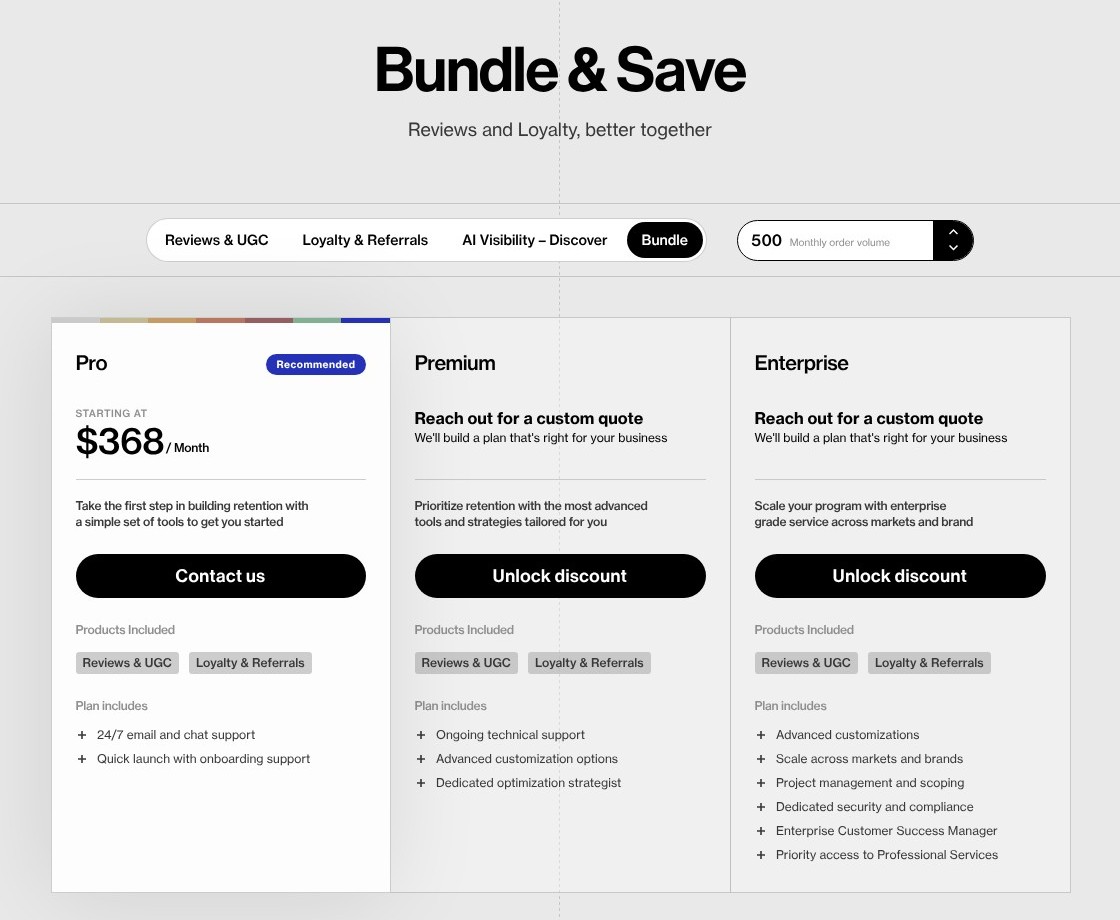
Possibly, but the displayed Pro bundle does not establish a saving on its own.
The Reviews + Loyalty bundle card shows $368/month. At the displayed 500-order component prices, Reviews Pro is $169 and Loyalty Pro is $199.
Illustrative comparison: $169 + $199 = $368. That matches the bundle card rather than demonstrating a discount.
The bundle FAQ also mentions a $199 starting price and $368 for 100 to 599 orders. Get a quote for your exact volume instead of treating either figure as universal.
Compare the proposal against standalone subscriptions with the same:
- Product tiers and included features.
- Order allowances and extra-order rates.
- Billing frequency, contract term, and included services.
I’d only bundle products you would otherwise buy. If Reviews Starter meets your needs, compare Starter plus Loyalty with the proposed bundle too, rather than assuming you need Reviews Pro.
An itemized quote can reveal a genuine saving or useful extra service. Without that, “bundle” describes how the products are packaged, not how much money you keep.
Yotpo Discover: What Does AI Visibility Cost?
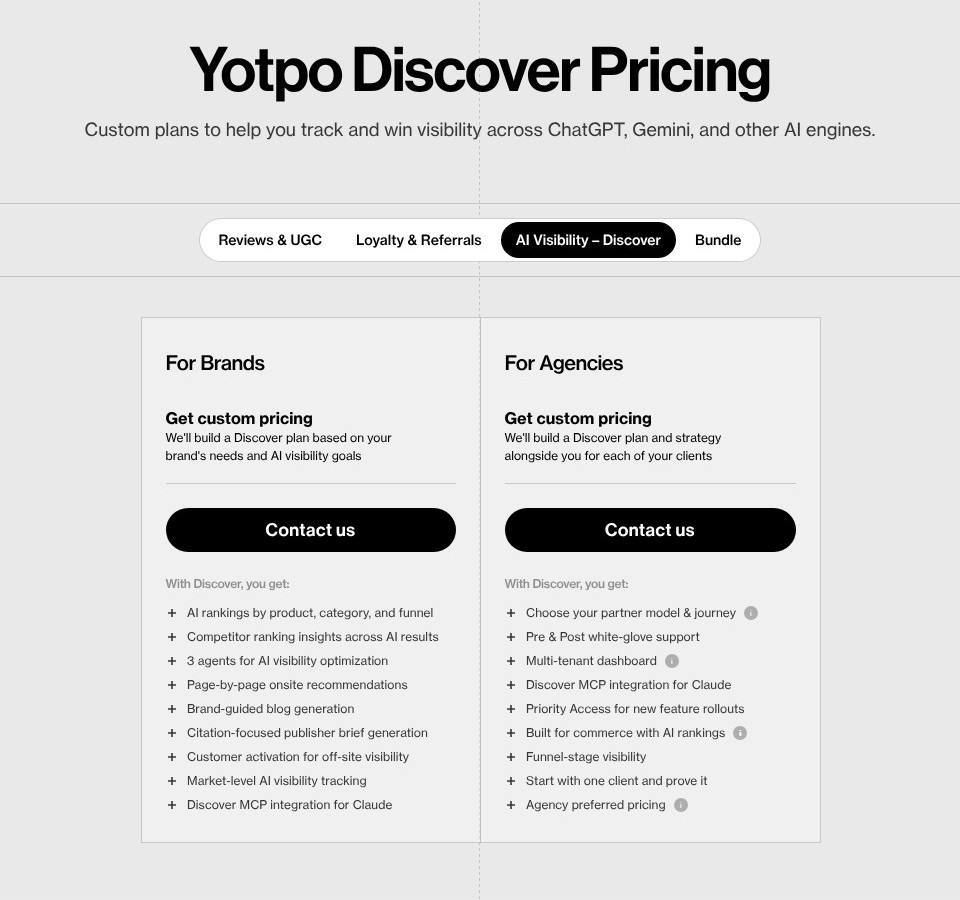
Discover needs its own budget. It is a separately quoted AI-search visibility product, not a feature automatically included in Reviews or the Reviews + Loyalty bundle.
Its custom pricing depends on catalog breadth, markets and languages, and the scope of optimization work rather than fixed monthly order tiers.
Its capabilities include:
- Tracking product and category rankings in AI search.
- Monitoring competitors.
- Using optimization agents to support visibility work.
I’d consider it for a brand that already has someone responsible for search visibility and enough capacity to act on the findings. A dashboard is less useful if nobody can make the resulting catalog or content changes.
For a smaller store, getting review collection and product information into shape would usually take priority over adding another custom-priced tool.
Ask for a proposal that names the products, markets, and optimization activities covered. Also agree on how progress will be assessed.
Discover can support visibility work; buying it does not guarantee AI recommendations, traffic, or conversions. Its commercial case should stand on its own rather than borrowing the value of your Reviews subscription.
When to Upgrade: A Breakeven Example
Upgrade when you need the additional allowance or can justify the extra features. Those are different reasons, and it helps to separate them.
At the same displayed 500-order allowance, Reviews Starter costs $89/month and Pro costs $169/month. The feature upgrade therefore adds $80/month, or $960 across 12 months before any usage changes.
The following is an illustrative calculation, not a claim about results Yotpo will produce.
Assume an additional order leaves $20 in contribution profit after product cost, fulfillment, payment fees, discounts, and other variable costs.
| Calculation | Illustrative amount |
|---|---|
| Starter to Pro monthly increase | $169 − $89 = $80 |
| Assumed contribution profit per genuinely additional order | $20 |
| Additional orders needed to cover the upgrade | $80 ÷ $20 = 4 |
| If contribution profit is only $10 per order | $80 ÷ $10 = 8 |
The key word is additional. An order from someone who would have bought anyway cannot reasonably be credited to the upgrade.
Revenue is not the right measure here, either. An extra $80 in sales does not cover an $80 software increase when fulfilling those sales has a cost.
For Pro, the practical question is whether custom questions or improved review presentation can create enough incremental profit, or save enough necessary work, to justify the difference.
If your only problem is exceeding the order allowance, compare a larger package or capped Booster usage first. And if you apply this calculation to Loyalty, deduct reward costs before estimating the profit available to cover its subscription.
Yotpo Pricing: Which Plan Should You Choose?
For a small store, I’d start with Reviews Free while the 50-order allowance fits. Move to Starter when you need more collection capacity, visual reviews, or branding removal.
Choose Reviews Pro when custom questions and better review organization solve a clear problem. At 500 orders, that decision costs an additional $80/month, so give the upgrade a specific job.
Add Loyalty when repeat purchasing supports a workable rewards program. Keep usage charges and reward costs in the budget, not just the $199 Pro subscription.
Premium, Enterprise, and Discover should follow defined requirements and itemized quotes. Bundles should follow a like-for-like cost comparison.
Before paying, confirm your expected order volume, required features, and billing terms in the actual package. That is a better way to control Yotpo cost than choosing by plan name alone.


