Shopware is a flexible, mid-market to enterprise ecommerce platform built around a free open-source core and three paid plans (Rise, Evolve, and Beyond) whose final pricing is sales-led and tied to your sales volume rather than a public flat list.
Our research team has spent years tracking ecommerce platforms across the spectrum, from beginner-friendly SaaS builders to developer-heavy open-source systems, and Shopware sits firmly at the powerful, technical end.
In this review I will walk through Shopware’s pricing, features, and the trade-offs that matter, so you can decide whether the flexibility is worth the higher total cost of ownership.
Why you can trust our review
We base our ecommerce platform reviews on hands-on testing, documented feature analysis, and pricing pulled directly from official plan pages and verified third-party trackers.
Where a platform uses sales-led pricing (as Shopware does), we label figures as indicative ranges rather than firm quotes. Our recommendations stay independent and are updated as platforms change their plans.
Shopware Pros and Cons
| Platform | Shopware |
| Best for | Mid-market and B2B brands that need flexibility |
| Ideal for | Scaling B2B/B2C stores, composable commerce, dev-backed teams |
| Rating | 4.2 out of 5 (Very good) |
| Free plan | Free Community Edition available (capped at €1M annual sales) |
Pros
- Free, open-source core you can fully own
- Strong native B2B and multi-channel features
- API-first, headless-ready architecture
Cons
- High total cost of ownership
- Technical setup, not turnkey
- Opaque, sales-led pricing on higher tiers
Need a quick summary of Shopware? Here are the best and worst things I found.
What I Like
- A genuinely free, open-source core (Community Edition) that you can download, self-host, and extend with no license fee, which is rare among platforms this capable
- Native B2B features that most SMB platforms force you to bolt on, including net and gross pricing by customer group, employee roles, order approvals, and quick ordering
- An API-first, modular architecture built on Symfony, so developers can build fully custom or headless storefronts without fighting the platform
- A clean, well-organized admin once the store is running, which reviewers consistently rate as one of the most usable backends among open-source platforms
What I Dislike
- Total cost of ownership is high once you add hosting, development, plugins, and maintenance, far above what a small SaaS store would pay
- The Community Edition setup (server, database, Composer) is too technical for non-developers, so most merchants need an agency or in-house developer
- Higher-tier pricing (Evolve and Beyond) is sales-led and tied to your sales volume, so you cannot see a clear number without contacting Shopware
- Many of the most useful features (advanced B2B, subscriptions, multi-inventory) sit behind the more expensive tiers
My Experience With Shopware
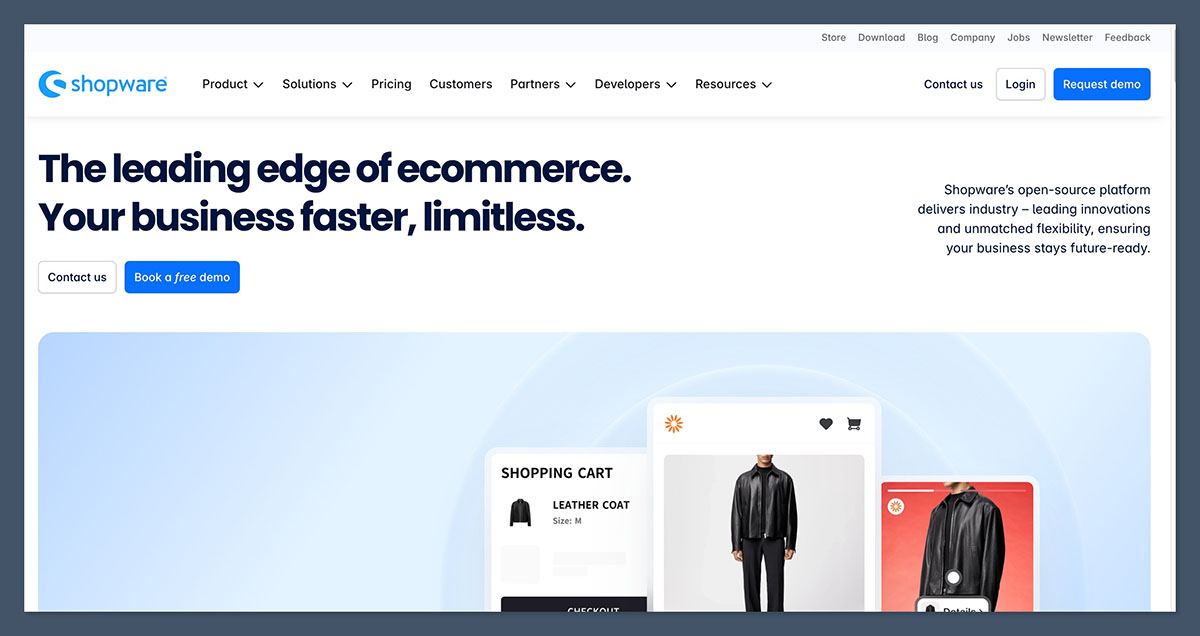
Getting started with Shopware is not the three-question onboarding you get from a hosted builder. With the Community Edition, the first step is a technical one: you need a server, a database, and Composer to install the platform, which immediately rules it out for merchants who want to be selling by the end of the afternoon.
The cloud and managed (PaaS) options remove that hurdle, but they are the paid route.
Once the platform is installed, the experience changes completely. The admin dashboard is clean and logically organized, and day-to-day operations like adding products, managing orders, and building content pages feel smooth. Among open-source platforms (think Magento or PrestaShop), Shopware stands out for how approachable the backend is once it is up and running.
Author’s Testing Notes
The gap between “installing Shopware” and “using Shopware” is the single most important thing to understand before you commit. The daily admin experience is genuinely pleasant, but getting to that point assumes either technical confidence or a budget for an agency.
If you are coming from Shopify or WooCommerce and expecting a similar turnkey start, the Community Edition will be a shock. The managed cloud plans are what make Shopware feel comparable to a hosted platform, and that is where the cost comes in.
How Adding Products and Content Works
Product management in Shopware is linear and clear. Variant handling, condition-based pricing rules, and custom attributes are all flexible, and reviewers score this area highly. You can create products manually, set up complex variant matrices, and apply pricing rules driven by conditions, which is useful once your catalog grows beyond the basics.
For content, Shopware’s standout tool is Shopping Experiences, the successor to “Shopping Worlds” from Shopware 5. It is a visual, drag-and-drop page builder for landing pages, category pages, and homepages, assembled from sections, blocks, and elements (text, images, video) with no code required.
This gives marketers a real CMS to work with, while developers can still go fully custom using Twig templates and SCSS.
Author’s Testing Notes
This split personality is Shopware’s core appeal. Your marketing team gets a visual page builder they can use without touching code, and your developers get full template-level control when they need it. Few platforms in this price range serve both audiences as well. The trade-off is that doing anything truly bespoke still leans on developer time, so the “no code required” promise only goes so far before you are back in a Twig file.
How Much Does Shopware Cost?
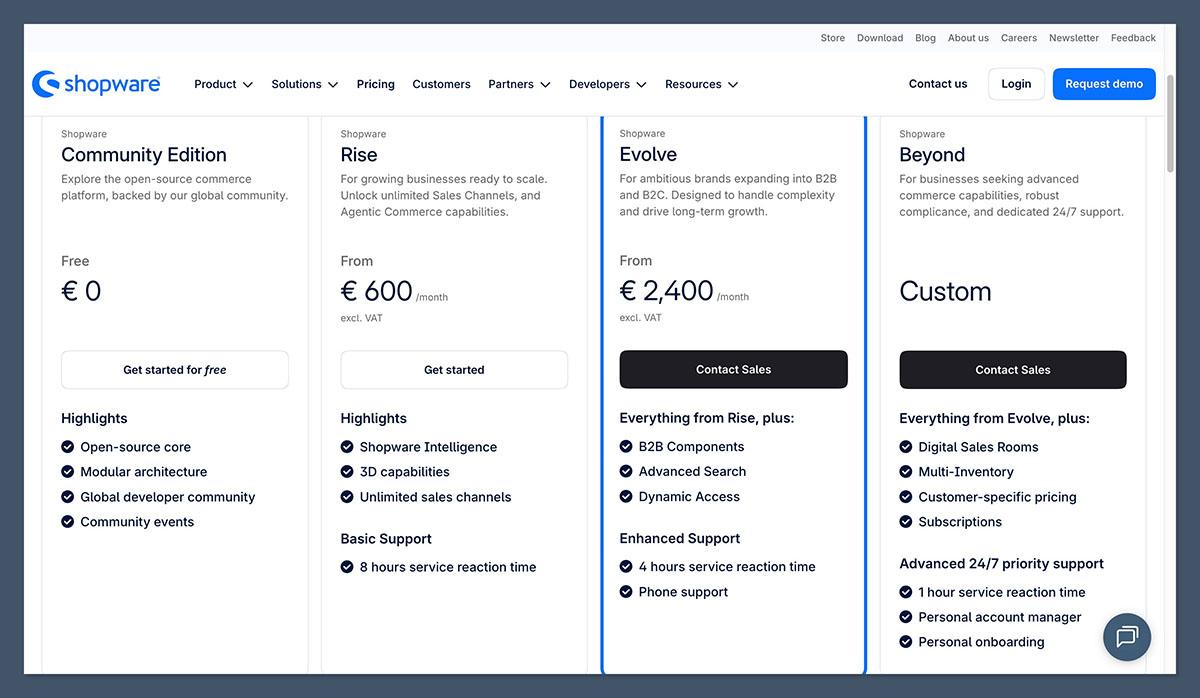
Shopware’s pricing model has shifted entirely to subscriptions, and it now works very differently from a typical SaaS builder. There are four editions: a free Community Edition and three commercial plans (Rise, Evolve, and Beyond).
The headline catch is that the higher tiers use sales-led pricing tied to your gross merchandise value (GMV), so the public pricing page lists features but negotiates the final numbers in a sales call.
Here are the indicative starting points that agencies, review platforms, and pricing trackers consistently report:
- Community Edition (€0 per month): free, open-source, and self-hosted, but with no official one-to-one support. Since a Fair Usage Policy introduced in March 2025, the free edition is capped at €1 million in annual sales, above which you must move to a paid plan.
- Rise (from around €600 per month, roughly $690): the entry commercial tier for growing B2C and D2C brands.
- Evolve (from around €2,400 per month): the mid-tier for more complex B2B and B2C operations, and Shopware’s self-described bestseller.
- Beyond (from around €6,500 per month, custom): the enterprise tier with advanced B2B, compliance, and 24/7 support.
It is important to treat the Rise, Evolve, and Beyond figures as indicative starting ranges rather than fixed list prices. Shopware sets final fees based on your sales volume and individual requirements, and lists all plan pricing in euros.
| Edition | Indicative price | Hosting | Best for |
|---|---|---|---|
| Community Edition | Free (self-hosted) | Self-hosted only | Dev-backed small and mid stores, cost-sensitive teams |
| Rise | From ~€600/mo | Cloud or self-hosted | Growing B2C/D2C brands wanting managed hosting |
| Evolve | From ~€2,400/mo | Cloud or self-hosted | Complex mid-market B2B and B2C |
| Beyond | From ~€6,500/mo (custom) | Cloud or self-hosted | Large enterprises with global complexity |
Is Shopware Good Value for Money?
This is where Shopware demands a clear-eyed look. The license fee is only one piece of the budget, and by most estimates it accounts for just 15 to 25 percent of the total cost of ownership. Once you add hosting, plugin subscriptions, agency development, and ongoing maintenance, a professionally built Shopware store can reach roughly $20,000 to $90,000 or more in its first year, with mid-market B2B implementations landing even higher.
Typical project costs reported by experienced agencies look like this: a starter shop on a standard theme with under 200 products runs around €3,000 to €8,000, a smaller custom shop around €8,000 to €15,000, and a mid-sized shop with custom design, ERP integration, and complex rules from €15,000 to €35,000 and up. Custom Twig themes often start around €8,000 to €15,000, and each ERP integration (SAP, JTL, Dynamics, and similar) frequently adds €5,000 to €15,000.
Author’s Testing Notes
If you only compare license prices, Shopware looks reasonable next to enterprise rivals. The honest number is the all-in figure. I would not recommend Shopware to anyone expecting their monthly platform fee to be the whole story.
A realistic ongoing run cost for a properly maintained small Shopware store (Community Edition plus managed hosting, basic plugins, and a small dev retainer) sits around €250 to €400 per month, and going below that usually means updates, backups, or monitoring get neglected.
Key Takeaways
- Free core, paid scale: Shopware’s Community Edition is genuinely free and open-source, but it is capped at €1M in annual sales and requires you to host and maintain it yourself.
- Sales-led pricing: Rise starts around €600/mo, Evolve around €2,400/mo, and Beyond around €6,500/mo, with final fees negotiated based on your sales volume.
- The license is the small part: Expect the license to be only 15 to 25 percent of total cost once hosting, development, and maintenance are included.
- Built for B2B and flexibility: Native B2B features, multi-channel selling, and a headless-ready architecture are the real differentiators.
- Not for beginners: Setup is technical, and most merchants will need a developer or agency to launch and maintain the store.
Designing With Shopware
Shopware gives you two distinct routes to a storefront, and which one you use depends on how much control you want.
The Theme Store offers roughly 180 themes, ranging from free to around $40, filtered by version, locale, cloud compatibility, price, and reviews. From the admin you can make basic visual adjustments (colors, fonts, layout) without writing code. For anything deeper, developers extend or build themes with Twig templates and SCSS, which gives full control over layout and storefront behavior.
Compared with the polished, beginner-friendly template galleries of hosted builders, Shopware’s theme selection is smaller and more developer-oriented. That is consistent with the platform’s positioning: it expects you to invest in design rather than pick a finished look off the shelf.
Selling Online With Shopware
Shopware’s commerce engine is where it earns its mid-market reputation, particularly for businesses that sell to other businesses or across multiple channels and countries.
B2B and Omnichannel Selling
Even the free Community Edition handles net and gross price display by customer group, so B2B buyers see net pricing while B2C customers see gross. Step up to Evolve or Beyond and you unlock the full B2B Components suite: employee and role management, order approval workflows, shopping lists, quick order by SKU or file upload, and customer-specific catalogs and pricing.
On the omnichannel side, you can manage multiple sales channels (different languages, currencies, tax regimes, and frontends) from a single admin, even in the Community Edition. The API-first setup makes it straightforward to connect custom channels or external systems, and the Beyond tier adds Multichannel Connect, a connector to roughly 950 marketplaces such as Amazon and Zalando, plus Click and Collect, a store locator, and AI-driven recommendations.
Workflow Automation With Flow Builder
Flow Builder is Shopware’s no-code automation tool, used to trigger emails, status changes, and behavior-based flows from a visual interface. It is available even in the Community Edition, though the more advanced capabilities (delayed actions and webhooks for system integrations) are gated to the Evolve and Beyond tiers. For teams that want to automate operational busywork without custom code, it is a genuinely useful inclusion.
Analytics
Shopware Analytics is a free app with more than a dozen pre-built dashboards tracking orders, customer data, and key conversion metrics. A nice architectural touch: it updates independently from the core, so your analytics can improve without waiting for a platform upgrade. That said, several reviewers note that deeper reporting still leans on extensions or a separate business-intelligence tool.
SEO and Marketing
SEO and marketing are areas where Shopware is solid but not exceptional out of the box. Native SEO tools cover URL templates, canonical URL settings, URL forwarding, and index rebuilds for a clean site structure. Built-in marketing includes newsletter recipient management and a promotions engine for discounts, coupon codes, loyalty, affiliate settings, and condition-based offers.
For full-funnel automation or more advanced SEO, most merchants integrate external email, marketing automation, and SEO platforms.
Shopware’s AI Features
Shopware has leaned hard into AI and workflow orchestration in 2025 and 2026, which gives it a credible “agentic commerce” angle rather than a generic chatbot bolt-on.
Shopware Intelligence is the AI layer, with tools available across both the Community Edition and paid plans, including a Copilot for data insights, an image editor, a 3D preview generator, and CAD-to-3D conversion. There is also an Intelligence+ add-on that offered unlimited usage if booked before a cutoff in May 2026, after which it transitions to a standard metered model.
Separately, Shopware Nexus is an event-driven integration and workflow service, in beta pricing at roughly €10 per 1,000 executions, with allowances and discounts tied to your main plan. It installs directly from the Shopware admin under Services, and right now it is squarely aimed at technical teams rather than everyday merchants.
Shopware’s Apps and Extensions
Shopware’s ecosystem is smaller than Shopify’s but mature enough for mid-market needs, with more than 3,000 apps and extensions in the official store covering payments, shipping, analytics, CRM, and more. Curated “Best of” collections each year help new merchants find trusted extensions, and plugin installation through the admin is straightforward.
The usual warnings apply: over-installing plugins can hurt performance and stability, and the quality of third-party extensions varies.
For complex setups (ERP, PIM, advanced logistics), the standard pattern is Shopware core plus selected plugins plus custom integrations through the API or Nexus workflows.
How Does Shopware Keep Your Store Secure?
Security responsibility depends heavily on which edition you run. On the managed cloud plans, Shopware handles much of the infrastructure security and updates for you. On the self-hosted Community Edition, security, patching, backups, and monitoring are your responsibility (or your host’s and agency’s), which is exactly why that realistic ongoing run cost matters. The platform itself ships monthly updates, and Shopware 6.7 (released in May 2026) brought performance improvements built on Vue.js 3 and Vite, along with European Accessibility Act compliance work.
Using Shopware’s Customer Support
Support is one of the clearest dividing lines between the free and paid editions.
Community Edition users get no official one-to-one support and instead rely on the Shopware Academy, documentation and forums, webinars, podcasts, YouTube, a Discord community, and community workshops. Paid plans add direct support with response-time SLAs that improve as you move up:
- Rise: 8-hour reaction time.
- Evolve: 4-hour reaction time plus phone support.
- Beyond: 1-hour reaction time, 24/7 availability, a personal account manager, and personal onboarding.
This tiered model is reasonable for the price, but it also means that if you choose the free edition and run into trouble, the community is your only safety net.
How Does Shopware Compare to Competitors?
Shopware positions itself between easy but black-box SMB SaaS (like Shopify) and powerful but heavy enterprise platforms (like Magento or Adobe Commerce and commercetools). It leans toward brands that value ownership, flexibility, and long-term scalability over the lowest upfront cost.
| Platform | Starting price | Hosting model | Best for |
|---|---|---|---|
| Shopware | Free core, paid from ~€600/mo | Open-source, cloud, or self-hosted | Mid-market and B2B brands needing flexibility |
| Shopify | $29 to $299/mo | Fully hosted SaaS | Turnkey selling, fast launch, beginners to large stores |
| WooCommerce | Free plugin (you host) | Self-hosted on WordPress | WordPress-based stores wanting low entry cost |
| Adobe Commerce (Magento) | Custom (high) | Self-hosted or cloud | Large enterprises with heavy customization |
| commercetools | Custom (contact sales) | Headless SaaS | Enterprises building fully composable commerce |
If Shopware feels like more than you need, the obvious alternatives split along familiar lines. Shopify is the turnkey choice for getting online quickly with minimal technical effort. WooCommerce keeps costs low for WordPress users willing to manage their own stack.
At the top end, Adobe Commerce and commercetools target enterprises with the budget and engineering teams to match.
How We Reviewed Shopware
To keep this review fair and accurate, we combined hands-on evaluation of the platform’s admin and features with documented analysis of its plans and pricing. Our assessment covers the areas that matter most for an open-source, mid-market ecommerce platform, each weighted by importance.
| Area | Weight | What we look at |
|---|---|---|
| Sales and B2B features | 30% | Core commerce, variants, B2B components, multi-channel selling |
| Flexibility and architecture | 20% | Open-source core, API-first design, headless and custom development |
| Ease of use | 15% | Setup complexity, admin clarity, day-to-day operations |
| Pricing and value | 15% | Plan structure, transparency, and total cost of ownership |
| Ecosystem and integrations | 10% | App store depth, ERP and third-party integrations |
| Support and reputation | 10% | Support tiers, community resources, and user review sentiment |
One detail worth flagging from the reputation data: Shopware’s reviews diverge sharply by audience. On business software sites like G2 it scores around 4.2 out of 5, with praise for flexibility and customization, while consumer-facing Trustpilot has shown ratings closer to 1.5 out of 5, driven largely by support frustrations rather than the software itself.
The pattern is consistent: agencies and technical teams rate Shopware highly, while less technical users find it complex or fragile, especially when they lean heavily on third-party plugins.
Shopware Review: Should You Build Your Store With Shopware?
Shopware is an excellent platform for the right business, and a poor fit for the wrong one.
If you are a mid-sized or enterprise brand that has outgrown a hosted SaaS builder and needs serious B2B capabilities, multi-channel selling, and the freedom of an open-source, API-first architecture, Shopware is one of the strongest options available, particularly across Europe and the DACH region. The combination of a free, ownable core and a clear upgrade path to managed enterprise tiers is genuinely compelling.
What holds it back from a higher score is accessibility and cost transparency. The technical setup, the reliance on developers or agencies, and a total cost of ownership where the license is only a fraction of the real spend all mean this is not a platform for very small merchants or solo founders on a tight budget.
The sales-led pricing on the higher tiers also makes it hard to compare cleanly against rivals without a sales call.
If you have the technical resources (or the budget to buy them) and your roadmap points toward complex B2B or composable commerce, Shopware rewards the investment. If you mainly want to start selling a handful of products quickly and cheaply, a turnkey platform like Shopify will serve you far better.
Shopware Review FAQs
Is Shopware free to use?
Shopware’s Community Edition is free and open-source, but you have to host and maintain it yourself, and since March 2025 a Fair Usage Policy caps the free edition at €1 million in annual sales. Above that, or for managed hosting and official support, you need a paid plan starting around €600 per month.
How much does Shopware actually cost to run?
The license is only part of the picture. Estimates put it at 15 to 25 percent of total cost of ownership, with a professionally built store often reaching $20,000 to $90,000 or more in its first year once hosting, development, plugins, and maintenance are included. A small, properly maintained store typically costs around €250 to €400 per month to run on an ongoing basis.
Is Shopware better than Shopify?
It depends on your business. Shopify is easier, faster to launch, and better for small to mid-sized merchants who want a turnkey hosted platform. Shopware offers more flexibility, stronger native B2B features, and full ownership of an open-source codebase, which makes it better suited to mid-market and enterprise brands with technical resources.
Does Shopware support B2B selling?
Yes, and it is one of Shopware’s biggest strengths. The free edition handles net and gross pricing by customer group, while the Evolve and Beyond plans add a full B2B Components suite covering employee roles, order approvals, shopping lists, quick ordering, and customer-specific catalogs and pricing.
Do I need a developer to use Shopware?
For the self-hosted Community Edition, almost certainly yes, since installation and maintenance are technical. The managed cloud plans lower that barrier, but most merchants building anything beyond a basic store will still rely on a developer or agency for design, integrations, and ongoing upkeep.
Which Shopware plan should I choose?
If you have development resources and a tight budget, the Community Edition is a strong starting point. Growing B2C brands that want managed hosting usually land on Rise, businesses with real B2B requirements need at least Evolve for the B2B Components, and large enterprises with global complexity move to Beyond. Match the plan to the features you genuinely need rather than the headline price.


