Shopify is a complete ecommerce platform with built-in shipping tools, while Pirate Ship is a standalone shipping app laser-focused on getting you the lowest possible USPS and UPS rates.
Both can work together, but understanding what each one actually does will save you real money on every label you print.
We’ve dug into the research, merchant discussions, and platform data to give you a clear answer on which is right for your business.
Shopify vs Pirate Ship: Quick Verdict
- Shopify Shipping – Best for merchants who want an all-in-one ecommerce stack with shipping baked in
- Pirate Ship – Best for US-based sellers who ship high volumes via USPS and UPS and want the lowest per-label cost
In this comparison, I’ll break down how Shopify and Pirate Ship stack up on shipping rates, features, workflow, and pricing so you can decide whether to stick with Shopify’s native tools, switch to Pirate Ship, or run both at the same time.
Quick Comparison: Shopify vs Pirate Ship
| Feature | Shopify Shipping | Pirate Ship |
|---|---|---|
| Product type | Full ecommerce platform with native shipping | Standalone shipping software for labels |
| Pricing model | Monthly plan ($29–$299/mo); shipping included | Free software; pay postage only |
| Carriers | USPS, UPS, FedEx, and others | USPS and UPS only |
| Rate level | Discounted; deeper savings on higher plans | Often lower USPS/UPS rates, especially cubic |
| Checkout integration | Native rate display in Shopify checkout | No checkout control; post-purchase only |
| Workflow | All-in-one orders, payments, and shipping | Backend label buying and batch shipping |
| Multichannel | Primarily Shopify; others via apps | Shopify, Etsy, eBay, WooCommerce, and more |
| Ideal user | Merchant prioritizing simplicity and integration | Cost-sensitive, higher-volume USPS/UPS shipper |
Best for Pricing: Pirate Ship
This is the clearest difference between the two.
Shopify charges a monthly subscription starting at $29 per month on the Basic plan, going up to $299 per month on Advanced, billed annually.
Shipping is included in those plans, and the discounts you get on carrier rates improve as you move up tiers.
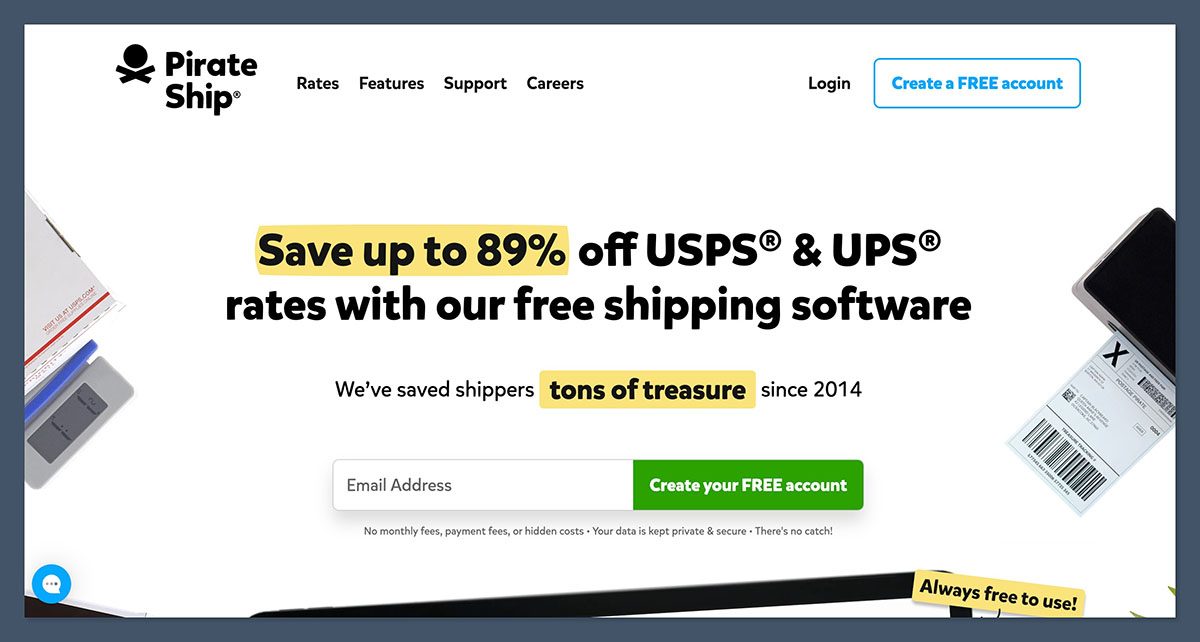
Pirate Ship charges nothing for the software itself. There are no monthly fees, no setup costs, and no per-label surcharges.
You pay only for the postage you buy, which means your software cost is literally zero regardless of your volume.
That said, pricing here is not just about software fees. The real question is the total cost per shipment once you factor in postage rates from each platform.
Pirate Ship markets savings of up to around 87% off retail carrier rates, with particularly aggressive pricing on USPS Priority Mail Cubic and UPS Ground Saver.
Merchant data and community discussions consistently show Pirate Ship beating Shopify’s discounted USPS and UPS rates, sometimes by several dollars per package depending on weight and size profile.
For low-volume shippers, the convenience of Shopify’s native labels may well offset a small per-label premium. For growing stores where shipping is a meaningful cost line, Pirate Ship’s rate advantage compounds quickly.
The Winner
Pirate Ship wins on total shipping cost
Free software plus consistently lower USPS/UPS postage rates makes Pirate Ship the more cost-efficient choice for most US-based shippers, particularly at higher volumes.
Best for Shipping Features: It’s a Tie
Both platforms cover the core shipping workflow well, but they do it from completely different angles.
Shopify’s shipping stack handles everything you need inside a single admin: shipping profiles, zones, flat and weight-based rates, carrier-calculated rates at checkout, local delivery and pickup options, and fulfillment integrations with third-party logistics providers.
For most straightforward ecommerce operations, this is more than enough without touching another tool.
Pirate Ship focuses entirely on the label-buying side of the workflow. Its feature set includes batch shipping, rate comparison across USPS and UPS services, address validation, customs forms, insurance, return labels, shipping rules, analytics, and multi-user management.
It integrates with Shopify, Etsy, WooCommerce, eBay, and other channels, pulling in orders and pushing tracking numbers back once labels are purchased.
Where Shopify has the edge is checkout: customers see live shipping rates during purchase, all managed natively. Pirate Ship has no presence at checkout at all.
Where Pirate Ship has the edge is in the depth of its label workflow: batch processing, granular rate comparison, and automation rules that Shopify’s native tools don’t match without extra apps.
The Winner
It’s a tie, depending on where you need the features
Shopify wins at checkout and storefront integration. Pirate Ship wins at backend label efficiency and rate shopping. Neither platform beats the other outright.
Best for Workflow and Ease of Use: Shopify
If simplicity is your priority, Shopify has a clear advantage. Orders, payments, customer data, and shipping labels all live in one dashboard.
You don’t switch between tools or manage separate logins, and tracking is automatically attached to orders without any extra steps.
For merchants just starting out, or those who ship modest volumes, this frictionless experience is genuinely valuable.
Pirate Ship introduces an extra step in the workflow. Orders need to be imported from Shopify (or another channel) into Pirate Ship before you can buy labels.
Once a label is purchased, Pirate Ship pushes tracking back to Shopify and marks the order as fulfilled. The loop works reliably, but it is a two-tool workflow: Shopify for the storefront and order management, Pirate Ship for the actual labels.
That said, for merchants shipping at volume, Pirate Ship’s batch processing tools make that extra step worthwhile. Printing dozens or hundreds of labels in a few clicks, with rate comparisons surfaced automatically, is faster in Pirate Ship than it is in Shopify’s native fulfillment flow.
The Winner
Shopify wins for ease of use
A single dashboard with checkout, orders, and shipping in one place is the simpler, faster experience for most merchants, especially those newer to ecommerce.
Best for Carrier Rates: Pirate Ship
Both platforms offer discounted USPS and UPS rates, but Pirate Ship’s rate advantage is well-documented. Shopify’s discounts improve with plan level, but even on higher plans, merchant comparisons show Pirate Ship consistently beating Shopify’s USPS and UPS pricing.
The gap is most noticeable on Priority Mail Cubic (where package density determines cost) and UPS Ground Saver, which Pirate Ship prices particularly aggressively for bulky or heavy shipments.
For FedEx or other carriers, Shopify has the broader reach, since Pirate Ship only covers USPS and UPS. If your shipping mix relies heavily on FedEx or regional carriers, Shopify’s integrations are the better fit.
The Winner
Pirate Ship wins on USPS/UPS rates
For merchants whose shipping is split between USPS and UPS, Pirate Ship’s pre-negotiated rates deliver lower per-label costs than Shopify on most services. If you also ship with FedEx, Shopify has the broader carrier coverage.
Best for Multichannel Sellers: Pirate Ship
Shopify’s native shipping tools are built around the Shopify ecosystem. If you sell exclusively through your Shopify store, that’s perfectly fine.
But if you also sell on Etsy, eBay, or WooCommerce, you’ll need additional apps to centralize fulfillment within Shopify.
Pirate Ship was built for exactly this scenario. It pulls orders from Shopify, Etsy, WooCommerce, eBay, and other channels into a single shipping dashboard, letting you buy all your labels in one place regardless of where the original sale happened.
For sellers operating across multiple storefronts and marketplaces, this consolidation is a meaningful operational advantage.
The Winner
Pirate Ship wins for multichannel operations
Centralizing orders from multiple sales channels into one shipping tool is a core Pirate Ship strength that Shopify’s native shipping does not replicate without third-party apps.
Best for Support: Shopify
Shopify offers 24/7 live chat support with escalation to human advisors for complex issues, phone support for Plus merchants, an extensive Help Center with guides and video tutorials, a community forum, and business courses.
Support channels span most major social platforms as well.
Pirate Ship is known for having a helpful support team, but as a free product it operates at a different support scale than a paid SaaS platform.
Its documentation and community resources cover most common questions, but it does not match Shopify’s breadth of structured support options.
The Winner
Shopify wins on support
24/7 live chat with human escalation, a thorough Help Center, and a large community forum make Shopify the stronger option when you need reliable, accessible support.
How We Evaluated Shopify vs Pirate Ship
This comparison is based on platform documentation, third-party software reviews, merchant community discussions, and published rate comparison data.
We evaluated both platforms across six key areas: pricing and postage rates, shipping features, workflow and ease of use, carrier coverage, multichannel support, and customer support.
Because Shopify and Pirate Ship solve different parts of the same problem, we also assessed how well they work together, since running both is a legitimate and common setup.
Shopify vs Pirate Ship: Final Verdict
Shopify and Pirate Ship are not really competing for the same job. Shopify is a full ecommerce platform that includes shipping as one feature among many.
Pirate Ship is a shipping-only tool that does one thing, and does it cheaply.
If you’re building an online store and want everything in one place, Shopify’s native shipping tools are good enough for most merchants, particularly those starting out or running modest volumes.
The integrated checkout, single dashboard, and broad carrier support are real advantages.
If you’re already on Shopify and shipping costs are eating into your margins, adding Pirate Ship to your stack is one of the lowest-friction ways to reduce per-order costs.
The workflow adds one extra step, but the rate savings on USPS and UPS labels often justify it quickly. Many established Shopify merchants run both: Shopify for the storefront and order management, Pirate Ship for the actual labels.
For multichannel sellers or anyone shipping at volume primarily via USPS and UPS, Pirate Ship is hard to argue against.
It’s free, the rates are competitive, and it connects back to Shopify without disrupting your existing setup.


