
Shopify
Compare costs Explore Shopify →Basic: 139 RON/month
99 RON/month billed annually
- Unlimited products
- International market tools
- Free and paid store themes
Gomag
Compare costs Explore Gomag →Basic: from €7/month, excluding VAT
Order-volume charges can apply
- Local invoicing integrations
- Romanian courier connections
- Included store themes
In the Shopify vs Gomag comparison, Shopify is my recommendation for international growth, while Gomag makes more sense for many Romania-first businesses. The deciding factor is how you need payments, delivery, invoicing, and marketing to work together, not simply which subscription looks cheaper.
Shopify brings international market tools, unlimited products, and a broad choice of themes and integrations. Gomag makes a compelling case when your priorities are Romanian couriers, local invoicing, and guidance focused on domestic ecommerce.
Neither choice removes the work of configuring your store. Shopify can need extra connectors for Romanian operations, while Gomag’s product limits and order-volume charges deserve attention before you commit.
Key takeaways
- International growth: Shopify, thanks to its market-specific currency, language, and shopping tools.
- Romanian operations: Gomag, particularly when its local integrations match your workflow.
- Design choice: Shopify, with free and paid themes across industries.
- Local guidance: Gomag, although Shopify also advertises Romanian-language assistance.
- Pricing: conditional, because catalog size, order volume, payment fees, and apps change the calculation.
Shopify and Gomag at a Glance
Shopify suits merchants building across markets; Gomag suits merchants organizing their business around Romanian operations. Both can serve a Romanian business, but their strengths suit different plans.
| What matters | Shopify: International growth pick | Gomag: Romania-first pick |
|---|---|---|
| Strongest fit | Merchants prioritizing international expansion and flexibility | Merchants prioritizing Romanian selling workflows |
| Entry subscription | Basic: 139 RON monthly, or 99 RON/month equivalent billed annually | Basic: displayed standard price of €7/month, excluding VAT |
| Product allowance | Unlimited products on the listed plans | Basic: 200; Advanced: 2,000; Elite: 10,000 |
| Trial | 3 days | Free trial advertised; confirm the current duration |
| Payments in Romania | Shopify Payments available, subject to verification | Check provider compatibility, pricing, and eligibility |
| Local operations | Available through integrations such as xConnector | SmartBill integration across tiers; Sameday from Advanced |
| International tools | Shopify Markets, with plan and payment prerequisites | International selling is possible; check destination-specific requirements |
| Main cost watchouts | Apps, payment fees, and possible third-party transaction fees | VAT, product limits, order-volume additions, and external services |
Who should choose Shopify?
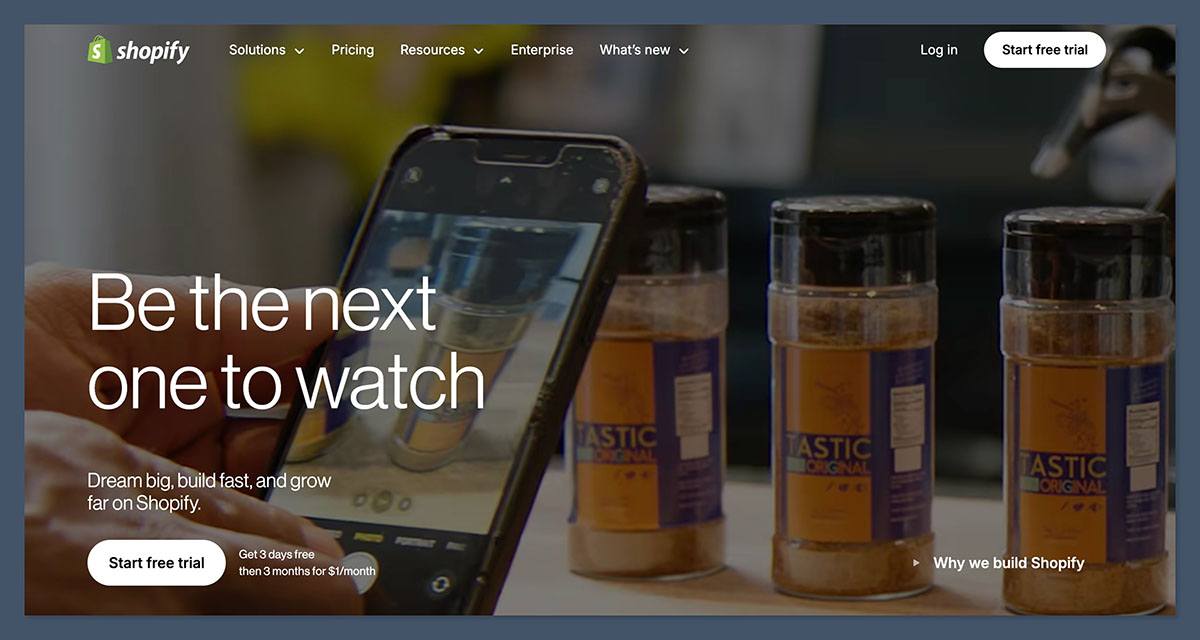
Choose Shopify if expansion is part of your actual business plan, rather than a distant possibility. Its international tools are more relevant when you already know which countries, languages, and currencies you want to support.
It also deserves attention if your catalog exceeds Gomag’s entry-level limits. Unlimited products remove that particular upgrade pressure, although they do not eliminate app or operational costs.
Who should choose Gomag?
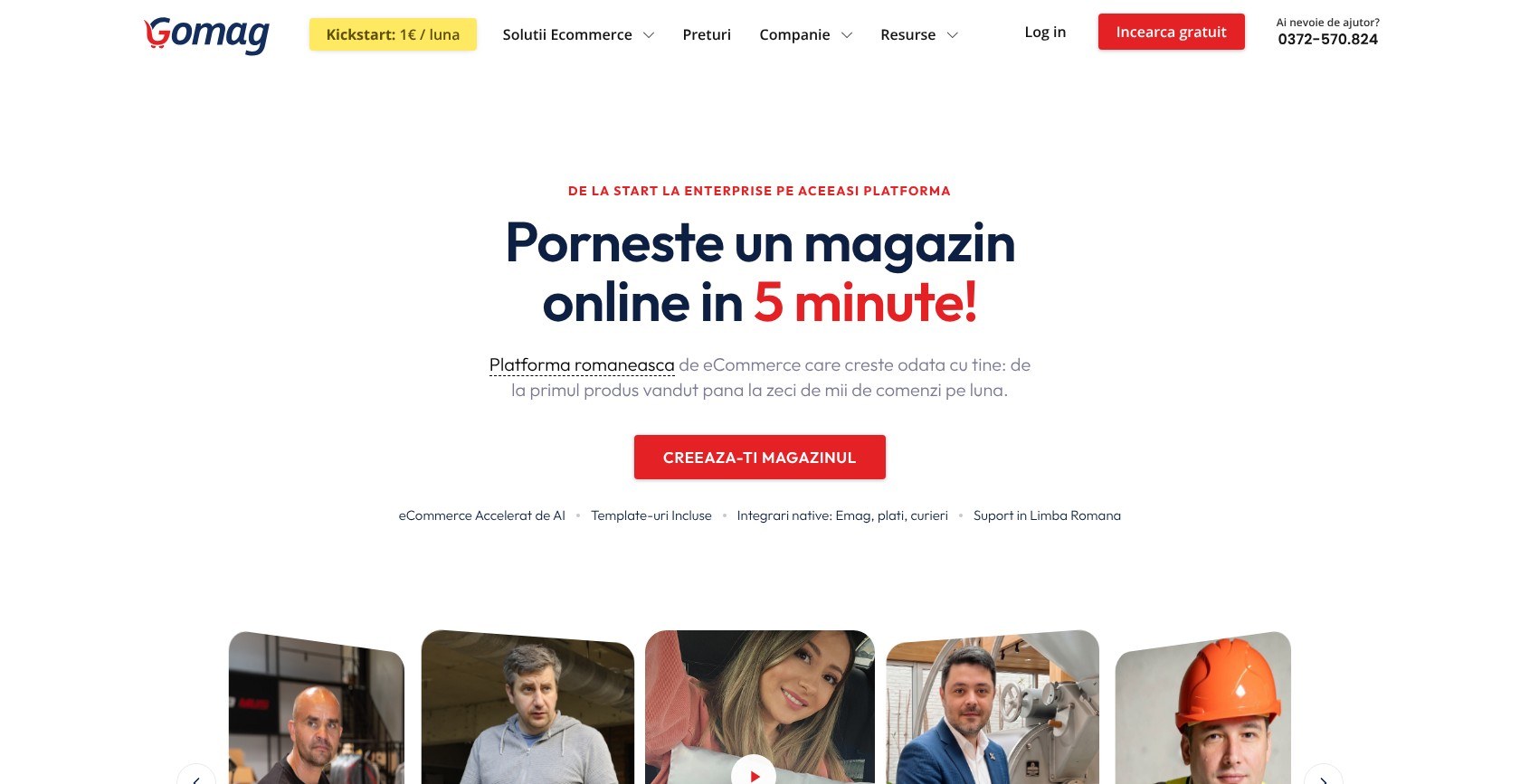
Choose Gomag if most of your customers will be in Romania and your daily work revolves around local delivery and invoicing. Matching those services to your subscription can matter more than having extra international options.
Its low displayed entry price is appealing for small catalogs. However, Basic is not a substitute for checking which integrations and automation features your store needs.
1. Pricing: Compare the Whole Cost of Your Store
Winner: Gomag for a small, low-volume store whose requirements fit its lower tiers; Shopify can become more attractive as catalog size and operational needs expand. There is no universal cost winner.
Start with subscriptions, then add the services required to run your business. Keep Shopify’s RON pricing and Gomag’s EUR pricing separate until you apply an exchange rate relevant to your budget.
Shopify pricing
| Plan | Monthly billing | Monthly equivalent, billed annually | Standard online card rate, from | Third-party transaction fee |
|---|---|---|---|---|
| Basic | 139 RON | 99 RON | 1.9% + 1.25 RON | 2% |
| Grow | 369 RON | 279 RON | 1.7% + 1.25 RON | 1% |
| Advanced | 1,940 RON | 1,460 RON | 1.5% + 1.25 RON | 0.6% |
Annual figures are monthly equivalents, not monthly payment commitments. Confirm the tax treatment and total billed amount before purchasing.
The standard card rates are starting rates, not a promise that every payment costs the same. International cards and American Express can have different rates.
Also distinguish payment processing fees from platform transaction fees. A processor charges for handling a payment; Shopify’s third-party transaction fee can apply separately when you use an external payment provider.
Shopify Payments is available in Romania, subject to business verification. You therefore do not automatically need an external gateway simply because your business is Romanian.
Gomag pricing
| Plan | Displayed standard monthly price, excluding VAT | Product limit | Selected inclusions |
|---|---|---|---|
| Basic | €7 | 200 | SmartBill integration |
| Advanced | €37 | 2,000 | 3 Gobots, eMAG integration, Sameday integration |
| Elite | €97 | 10,000 | 10 Gobots, API access, cart recovery |
Gomag pricing varies with the selected billing term and checkout conditions. Use these standard displayed prices as a baseline, not as a guaranteed promotional or renewal quote.
Its order-volume rule is particularly important. Standard subscriptions include a monthly average of 350 orders across the previous 3 subscription months, with an additional €67/month for each further 350-order threshold under the standard structure.
For example, an Advanced store averaging 650 monthly orders would reach €104/month before VAT: €37 for the base subscription plus €67 for the additional order tier. Apps and external services remain separate.
That is a more useful comparison than €37 alone. If you expect substantially higher volume, request the applicable terms rather than assuming every increment will follow the same pricing indefinitely.
Budget beyond the plan
Include these items in both quotes:
- Your required payment provider and applicable transaction charges.
- Courier contracts and delivery costs.
- Invoicing subscriptions, such as a separate SmartBill account.
- Connectors, marketing services, and any design work.
- Tax and currency-conversion costs relevant to your business.
Gomag’s free SmartBill integration does not make SmartBill itself free. Likewise, a Shopify connector may simplify local operations while adding another subscription.
Trial tip: Shopify offers a 3-day trial. Prepare your products and workflow checklist beforehand, and confirm Gomag’s current trial terms directly rather than assuming the evaluation periods match.
2. Selling Online: Shopify for International Growth
Winner: Shopify, because its international market tools and flexible integrations make it the stronger recommendation for cross-border growth. Gomag counters with a well-matched set of Romanian operational integrations.
Gomag supports international selling too. Shopify gets my recommendation when managing several markets is central to your business plan.
Sales Features
Shopify’s unlimited product allowance gives it an advantage for catalog-heavy businesses. Gomag caps the listed plans at 200, 2,000, and 10,000 products, so catalog size can determine your minimum subscription before other features enter the discussion.
Gomag’s higher tiers add useful capabilities. Advanced includes eMAG integration and 3 Gobots, while Elite includes 10 Gobots, API access, and cart recovery.
An API lets software systems exchange information through a programmed connection. Its presence matters if you need a custom integration, but it does not mean that integration is already built or included.
Prioritize the features that affect real orders:
- Catalog capacity for your planned product range.
- Marketplace connections for channels you will actually use.
- Automation for repeat order-handling tasks.
- Access to the systems your fulfillment and accounting teams need.
A Romania-focused merchant selling through eMAG may find Gomag’s Advanced package more relevant than Shopify’s international flexibility. A merchant managing a large catalog across several countries may reach the opposite conclusion.
Payment Options
Shopify Payments supports eligible Romanian businesses and offers card and accelerated payment methods. Business verification is still required, so availability in Romania does not guarantee approval for every applicant.
For Gomag, confirm that your preferred payment provider supports your business and intended selling destinations. Ask about settlement currency, refunds, provider charges, and any platform-related payment costs before signing.
For either platform, evaluate the entire payment journey. A familiar checkout is useful, but your accountant also needs to reconcile the customer’s payment with the invoice and the amount deposited into your bank account.
Apps and Integrations
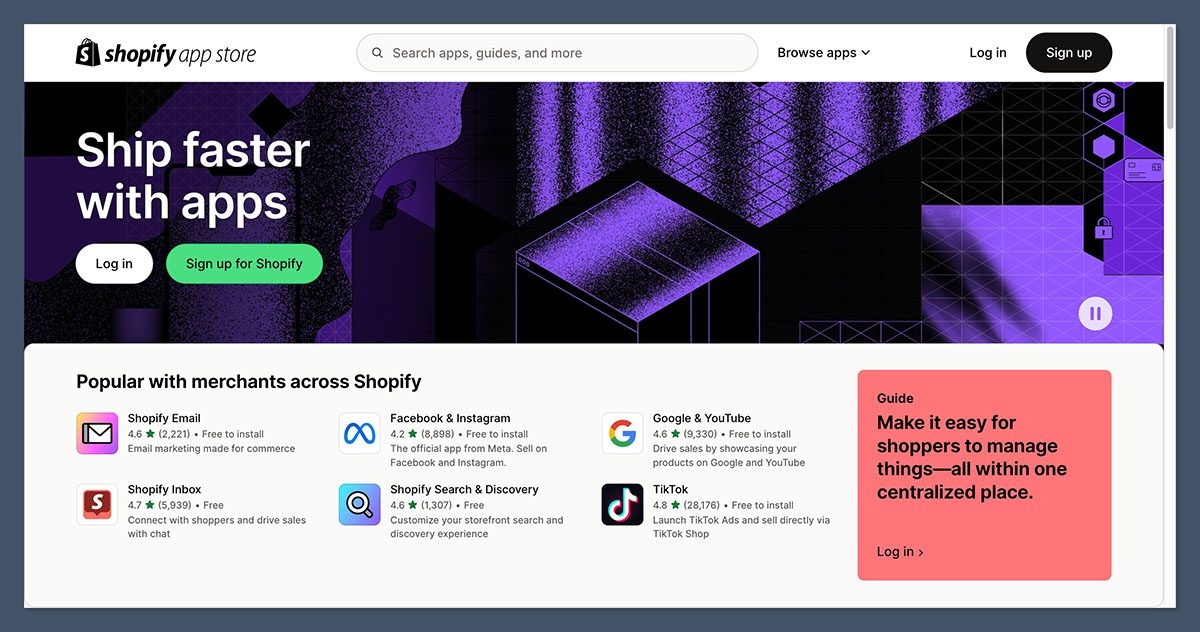
Gomag’s SmartBill integration connects invoicing and inventory, is free across subscription tiers, and requires a separate SmartBill account and configuration. Sameday integration is included on Advanced, Elite, and Enterprise, with courier contracts and delivery charges separate.
Shopify is not missing Romanian fulfillment options. Connectors such as xConnector support Romanian shipping-label and invoicing services, including SmartBill and local couriers; connector subscriptions and service charges need their own budget.
The key question is therefore not “Does an integration exist?” It is “Does it handle my required workflow on the plan I can afford?”
Practical check: map an order from payment through invoice, shipping label, inventory adjustment, and refund. Identify which steps are native, which use a connector, and which still need manual work.
Shopify wins for international flexibility, but Gomag may be the more direct choice when those steps center on its included Romanian integrations.
3. Marketing: Shopify for Broader Reach
Winner: Shopify for merchants targeting multiple markets, because its international tools support more localized customer experiences. Gomag remains competitive for Romania-focused campaigns and operational automation.
More marketing options do not automatically mean more sales. Your useful feature set depends on whether you need to reach new countries or communicate more effectively with the customers you already serve.
Marketing Tools
Gomag includes campaign tools and marketing integrations, while Gobots automate workflows involving orders, customers, products, email, and SMS. Plan quotas matter: Advanced includes 3 Gobots, compared with Elite’s 10.
That makes automation worth considering during plan selection, not after launch. Before upgrading, describe the tasks you want each automation to perform and check whether the available quota fits.
Shopify’s integration ecosystem gives you flexibility to assemble a marketing setup around your needs. The counterweight is cost and coordination: separate apps can introduce additional subscriptions and settings.
Compare the campaign you actually want to run:
- Which customer action should trigger the message?
- Which channel will deliver it?
- What customer data must move between systems?
- Which subscription and usage charges apply?
If your requirements are modest and Gomag covers them within your plan, adding more tools may offer little benefit.
SEO
Shopify supports editable SEO titles, meta descriptions, product content, and image alt text. Gomag also includes SEO tools and blogging features, so this is not a contest between having search controls and having none.
These controls help describe your pages to search engines and users. They do not establish ranking superiority for either platform.
For most merchants, useful product descriptions, clear categories, and relevant content deserve more attention than platform-level SEO promises. A technically available field achieves little if every product uses the same generic description.
Before choosing, check how you would edit a product title, category description, and image text. If you are migrating an existing shop, also ask how its current addresses and redirects will be handled.
International Selling
Shopify Markets organizes international markets with localized currencies, languages, pricing, and content. Availability depends on the feature and plan, while local-currency processing requires Shopify Payments or Adyen.
Those prerequisites belong in your budget. Turning on a market is not the same as completing translations, arranging delivery, setting return policies, or resolving tax obligations.
Gomag can sell internationally, so a Romanian store serving some overseas customers does not automatically need Shopify. Check the countries and customer experience you require rather than treating any cross-border sale as a reason to migrate.
Shopify’s advantage becomes more persuasive when localization is central to your growth strategy. For a predominantly Romanian audience, Gomag’s campaigns and automation may address the more immediate problem.
4. Ease of Use: Gomag for Romanian Store Operations
My pick for Romanian operations: Gomag, because its local integrations fit common domestic workflows. Shopify has the stronger case when your setup needs to span several countries.
Ease of use is more than an attractive dashboard. A store can be straightforward to design yet awkward to operate if staff must repeatedly move information between payment, courier, and accounting systems.
Getting Started With Shopify
Start by choosing your subscription and theme, adding products, and preparing the information required for payment verification. Then map the local services you need before selecting connectors.
For a Romanian business, the setup checklist should include:
- Shopify Payments eligibility and payout requirements.
- Courier and invoicing integration compatibility.
- Connector costs and responsibility for maintaining each connection.
- Languages and currencies needed at launch.
Shopify becomes especially appealing when this same setup must support an international roadmap. However, a domestic-only merchant may spend time configuring flexibility they do not currently need.
Getting Started With Gomag
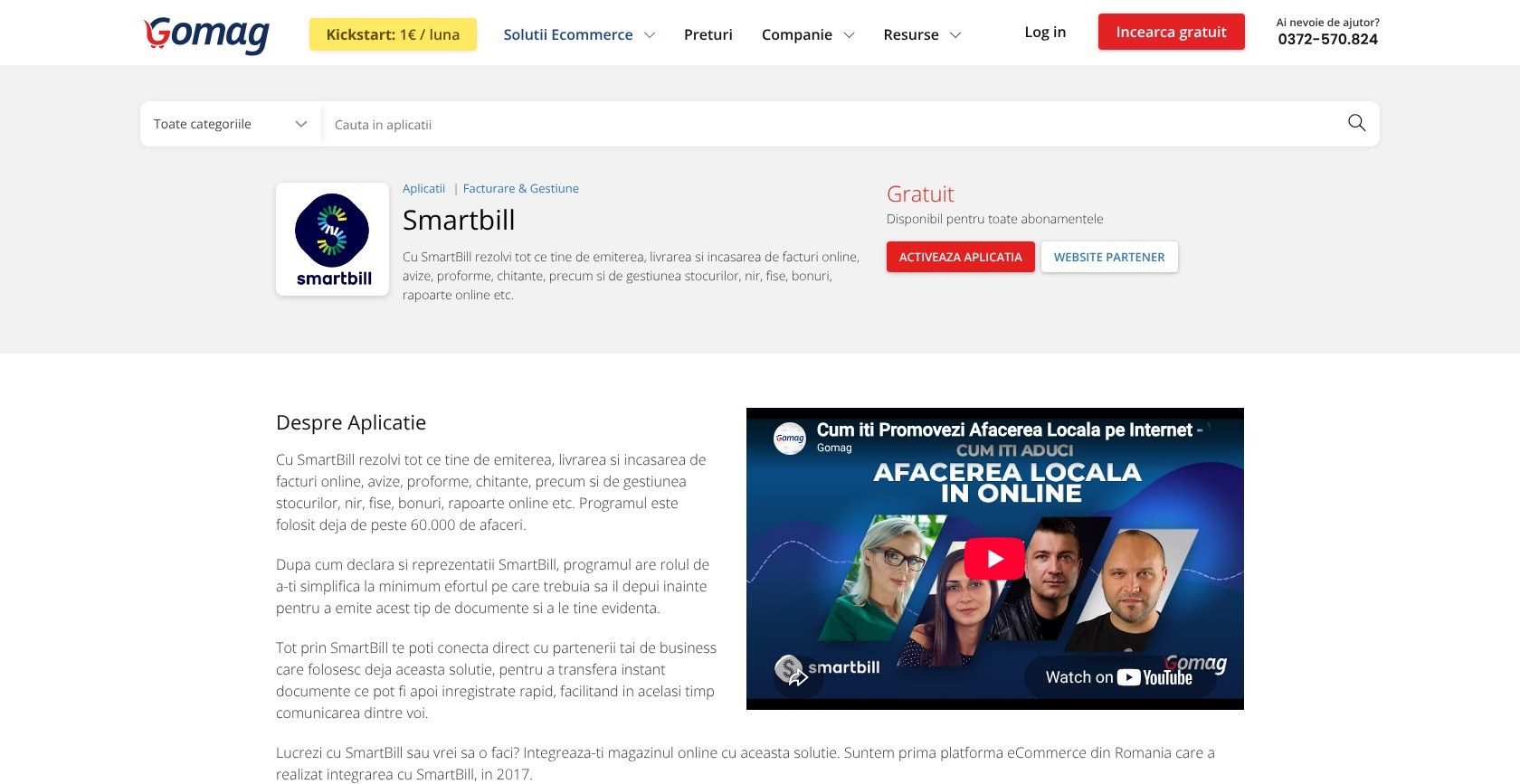
Start with catalog size, expected order volume, and required integrations. These factors help identify the correct tier before you spend time configuring the storefront.
Next, connect your payment provider, invoicing account, and courier service. Remember that SmartBill integration spans the subscription tiers, while Sameday starts with Advanced.
Gomag’s likely advantage is closer alignment with a Romanian operating model, not the absence of setup work. You still need external accounts, contracts, and correctly configured data exchanges.
Your Next Setup Steps
Give both platforms the same evaluation task. Use representative products and check whether your team can follow the whole order journey.
Include a normal purchase, a cancellation, and a refund scenario. Ask who handles failures between systems and what your staff would need to correct manually.
Language matters too, particularly for the people managing daily orders. Shopify also advertises Romanian-language assistance, so Gomag’s recommendation rests on local workflow alignment rather than exclusive language availability.
Choose the system that fits your recurring work, not simply the one with the shortest initial setup checklist.
5. Store Templates: Shopify for More Design Choice
Winner: Shopify, because its free and paid theme marketplace offers the stronger range of design choices for different retail needs. Gomag counters with included themes and visual customization.
Shopify is the more appealing starting point if your brand needs a particular presentation style. Its theme selection spans industries, giving you more directions to consider before commissioning custom design.
That choice can also create extra spending. A paid theme, specialist customization, or an app added to fill a design gap should be treated as a business expense, not an inevitable launch requirement.
Gomag includes themes and visual customization, which may be sufficient for a merchant who wants a presentable store without an extensive design-selection exercise. If you need dedicated design services, establish the scope and price separately.
Choose for Your Catalog, Not the Demo
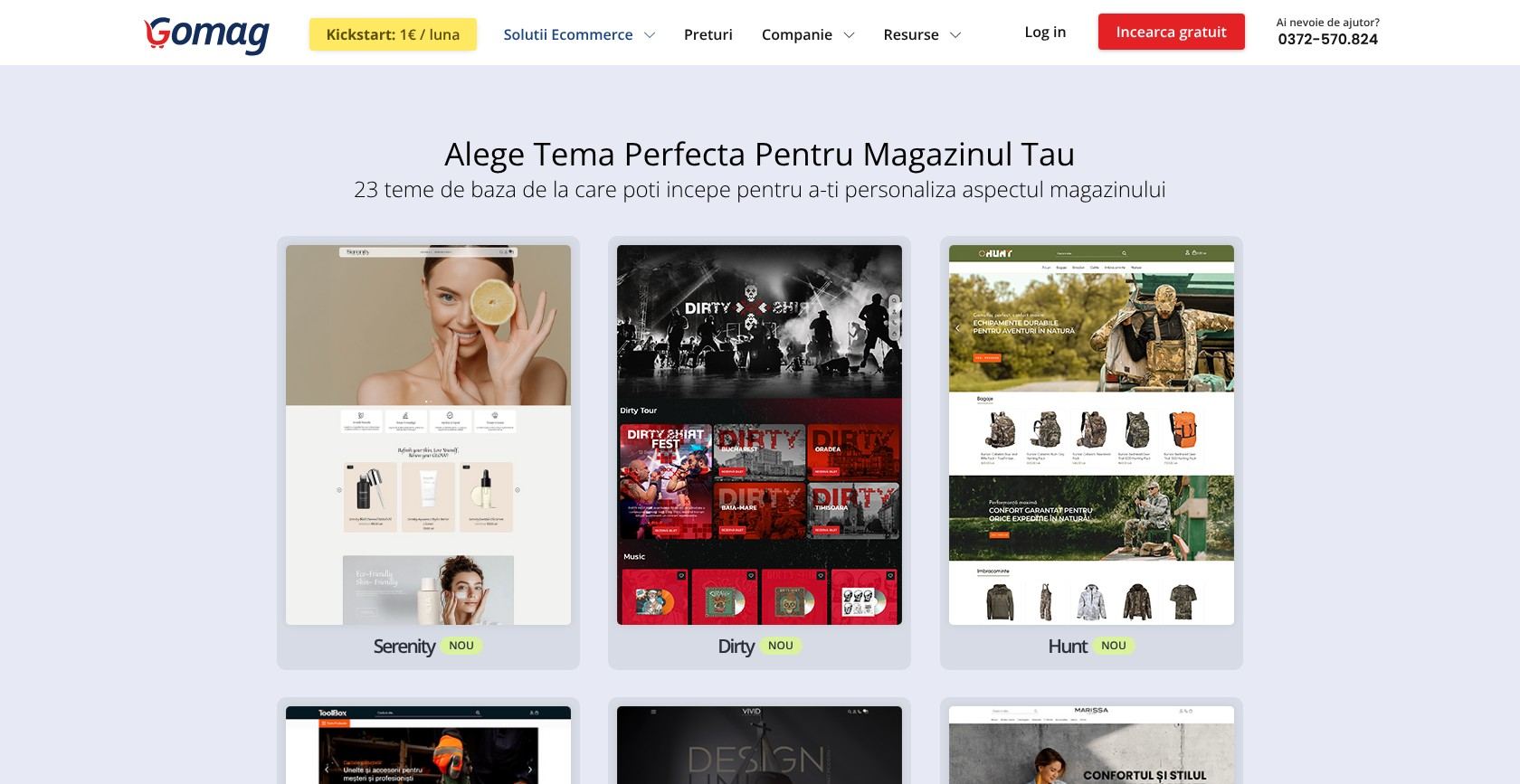
Evaluate both platforms’ themes against the content you actually have:
- Product pages: room for your specifications, variants, and useful images.
- Navigation: a category structure that suits your catalog.
- Mobile layout: readable product information and accessible purchase controls.
- Brand flexibility: practical control over colors, typography, and page presentation.
A fashion-style demonstration may look impressive while revealing little about whether the layout suits replacement parts or technical products. Substitute representative content before making a design decision.
Also separate visual preferences from functional requirements. A missing color option is different from a product page that cannot present essential buying information clearly.
Shopify wins on choice, but Gomag’s included designs may be better value if they already meet your requirements. More themes only help when they solve a genuine presentation problem.
6. Business Support: Gomag for Local Guidance
Winner: Gomag for Romanian operational guidance, based on its local focus. Shopify is stronger when around-the-clock chat availability is your priority.
I would start with Gomag for guidance around Romanian operations. Shopify also advertises Romanian-language assistance, so language alone does not decide this round.
Shopify Support: Pros and Cons
- Pro: 24/7 chat is useful when you work outside normal office hours.
- Pro: Romanian-language assistance is advertised.
- Con: A connector-related issue may require help from the app provider as well as Shopify.
- Con: Continuous chat availability does not establish how quickly a complex accounting or shipping issue will be resolved.
Gomag Support: Pros and Cons
- Pro: A Romanian ecommerce focus may make discussions about domestic operations more directly relevant.
- Pro: Ordinary online support is available through ticket/email channels.
- Con: The consultants’ telephone schedule, Monday through Friday, 09:00 to 17:00, is not proof of included phone support on every plan.
- Con: Enterprise advertises phone support; verify the channels included with your chosen subscription.
Before committing, present each platform with the same specific question about your payment, invoice, and courier workflow. Ask who owns the problem if information stops passing between services.
Give Shopify’s 24/7 chat extra weight if your team regularly works evenings or across time zones.
How We Compared Shopify and Gomag
This WebAppMeister comparison is a document-based assessment of pricing, selling features, marketing, ease of use, templates, and support. It uses documented capabilities and operating requirements rather than hands-on testing.
Round winners are editorial recommendations for the stated audience, not measured performance results. We have not measured conversion rates, loading speeds, search rankings, or support response times.
Costs are presented in their listed currencies, with billing and integration qualifications kept alongside them. Confirm checkout totals and required services before committing.
Prices current as of October 2026.
Shopify vs Gomag: Our Verdict
Choose Shopify if international expansion is a concrete priority. Its market tools, unlimited products, and design options give it the stronger case for a business building across countries.
Choose Gomag if Romanian operations drive your decision. Its local integrations and domestic focus can be a better fit, provided your subscription covers the catalog, order volume, and services you need.
Before paying, compare an all-in monthly budget and validate the same payment, courier, invoice, and refund workflow on both. Use the results to check that your preferred plan covers the work your team will do every day.


